How to Be Faster at Sim Racing: The Fundamentals
If you want to know how to be faster at sim racing, most advice stops at "use all the track" and "brake later." That's not enough. After coaching real-life racers and spending years analysing laps from top drivers, I've found they all follow the same underlying pattern — a five-step framework for driving right at the grip limit. In this guide I'll walk you through every step so you can stop guessing and start driving with purpose. (The non-shallow version of the second one exists, and it starts with not moving the marker: how to brake later.)
Before we go into the framework itself, there's one piece that changes everything: the car is constantly communicating with you. Once you learn to read those signals, the framework unlocks its full potential.
Train your senses first: feel, sound, and sight
At the limit, the car talks to you through three channels. Your steering wheel gets lighter when you're under- or over-driving and heavier when the tyres are loaded correctly. Tyre noise at a healthy slip angle produces a slight screech — almost like the tyres are singing — throughout every phase of the corner. And by watching the horizon line, you can spot rotation changes as the scenery shifts at different speeds.
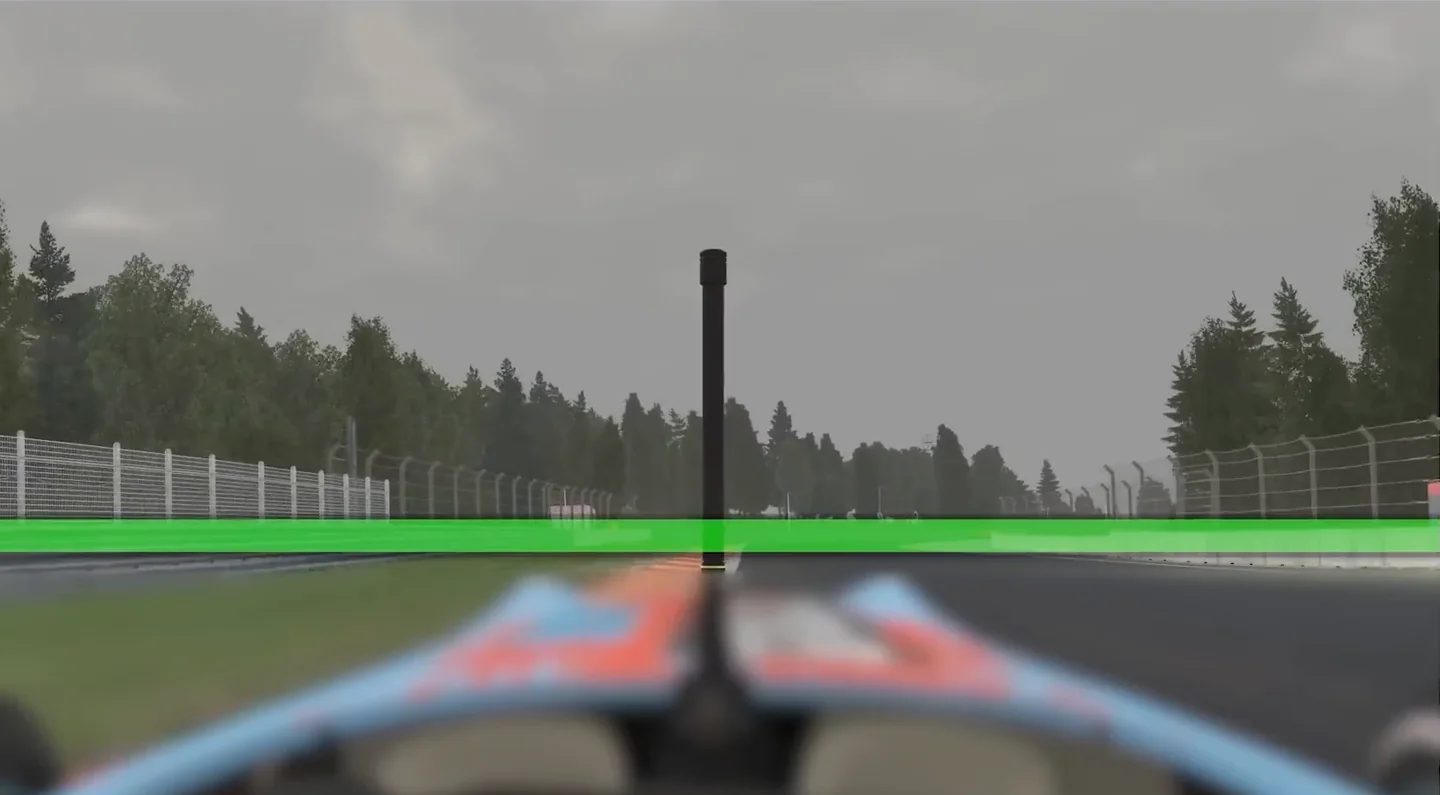
Most drivers focus on one of these and ignore the other two. Training all three in parallel is what allows you to make real-time adjustments instead of reacting too late. Every one of the twelve driving techniques leans on them — the braking section there tells you to hear the tyres, and this is where you learn to.
Sense-training drill: Centripetal Circuit
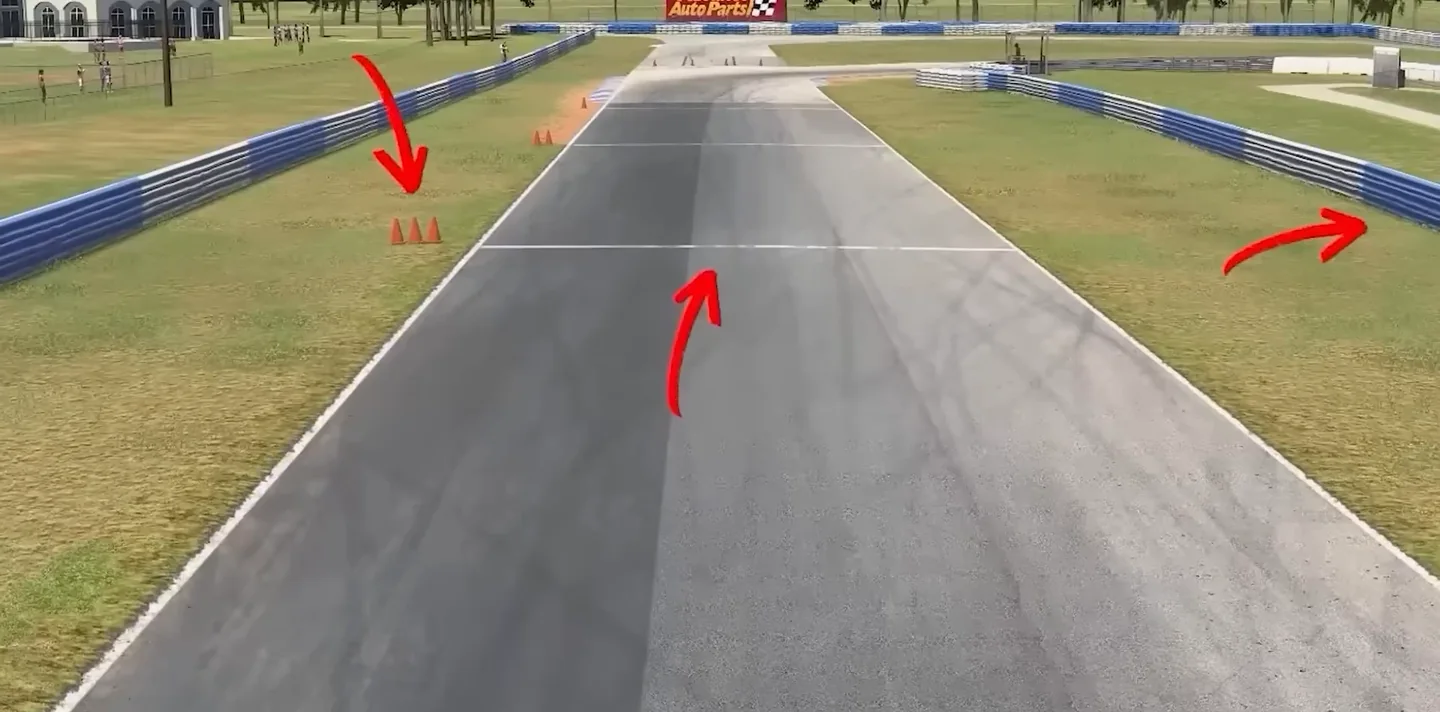
Load up the Centripetal Circuit, choose a lane, and try to hold the car in that lane as you progressively increase speed.
- As the car starts to understeer from the speed, notice how the steering wheel gets lighter.
- Gently feather the brake — feel the car wanting to rotate as the weight shifts forward.
- Listen to the tyre screech and watch the horizon line at the same time.
Do this before anything else. The framework steps below require these senses to be active; without them you're just following instructions blindly.
Step 1: Efficient racing lines (spatial awareness, not just "use all the track")
Every coach tells you to use all the track. Almost nobody explains how. The underlying skill is spatial awareness — knowing exactly where your left and right tyres are in space and placing them with precision. If you don't know where your car sits on the track, you'll always leave a small margin and bleed time every single lap. The exercises that build it — where to put the car, and how to know you did — are in five sim racing drills.
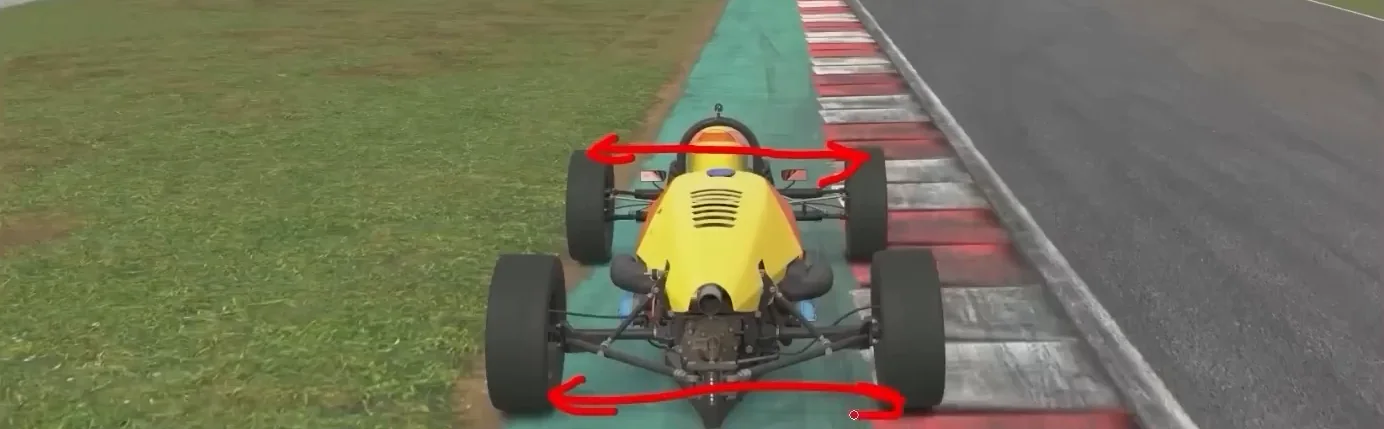
It's not just about the widest entry. Under braking, the car already experiences both horizontal and vertical weight transfer. If you're still pointing the wrong way at turn-in — steering left while the next corner is a right-hander — you're overloading the tyres before the corner even starts. Bring the car to the correct side of the track before you start braking, so the weight transfer works with you instead of against you.
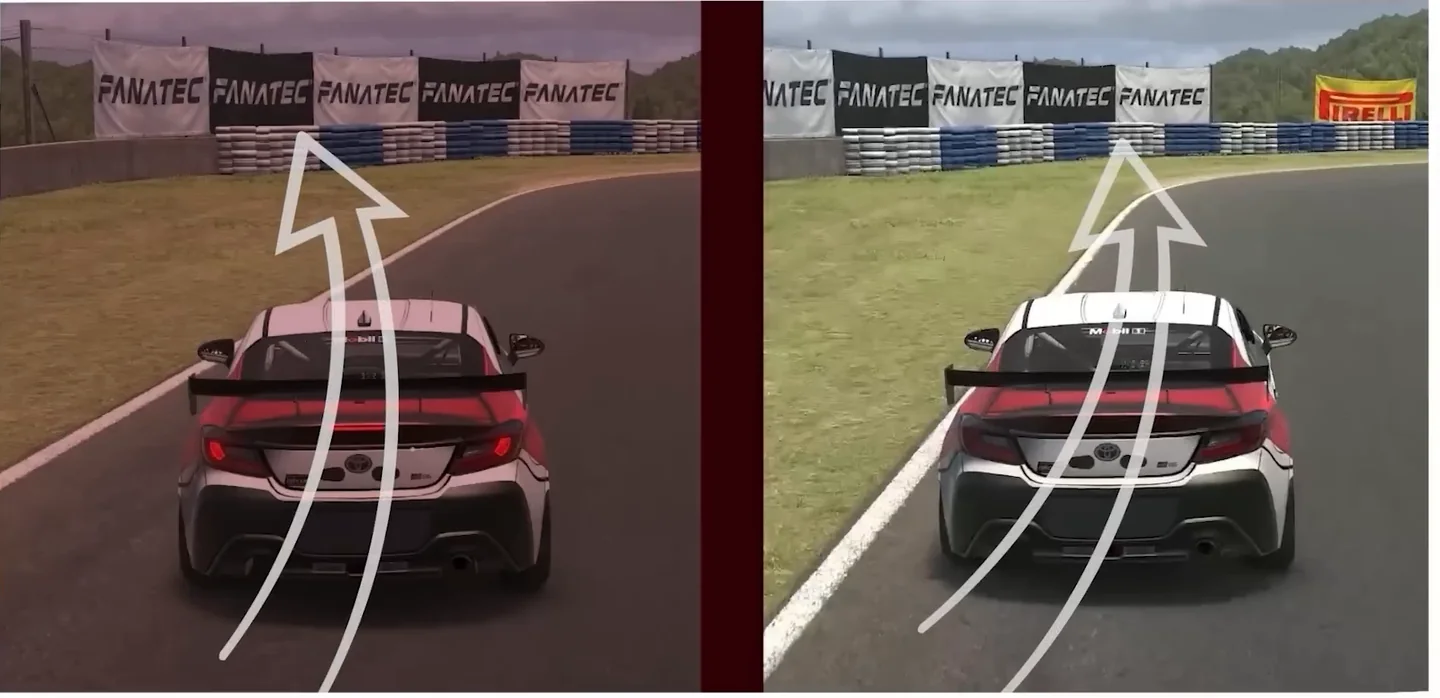
Shortening distance matters too. On certain corner sequences, braking diagonally cuts unnecessary distance without costing exit speed. And on sweepers like Maggots and Becketts, every small weave scrubs speed and adds distance. The car that flows through a sweeper in one clean arc is always faster than the car that makes three tiny corrections.
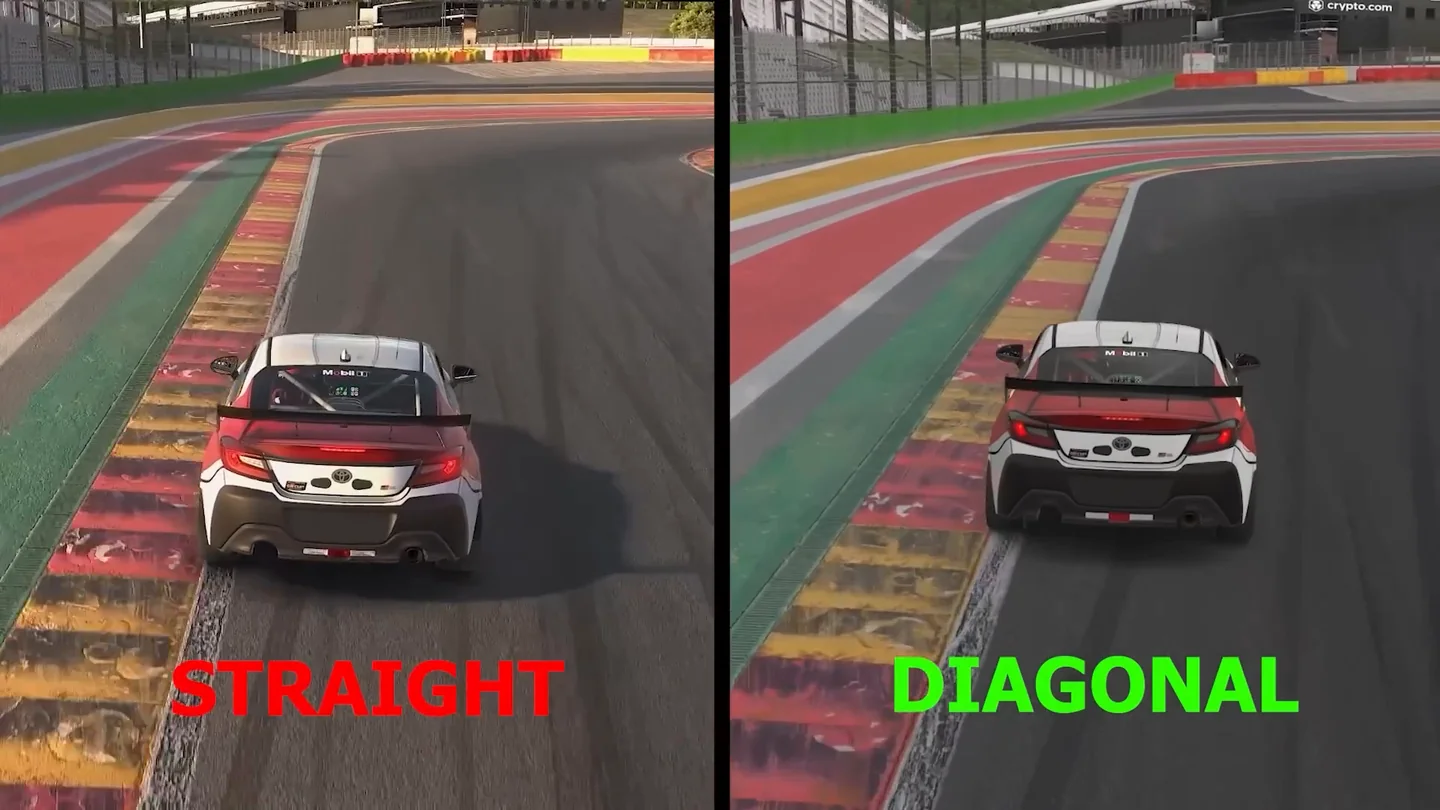
The difference between using all the track and using almost all the track can be as small as a tyre width — but on a single corner that gap is worth over a second and a half per lap.
Step 2: Fishing for grip — micro-adjustments on the brake
Good braking has two phases: threshold braking to shed speed, and trail braking to help rotate the car into the corner. Most drivers know this. What they don't know is what the quickest drivers are actually doing inside those phases.
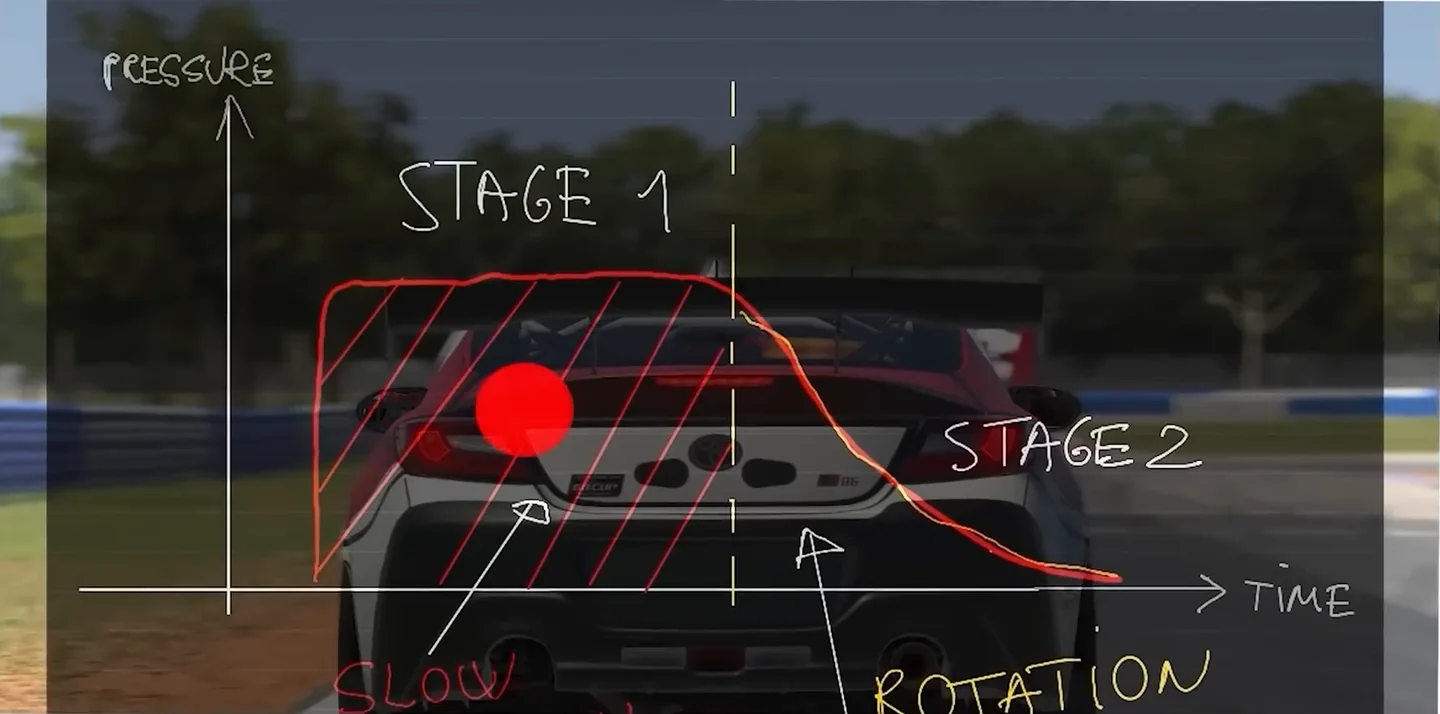
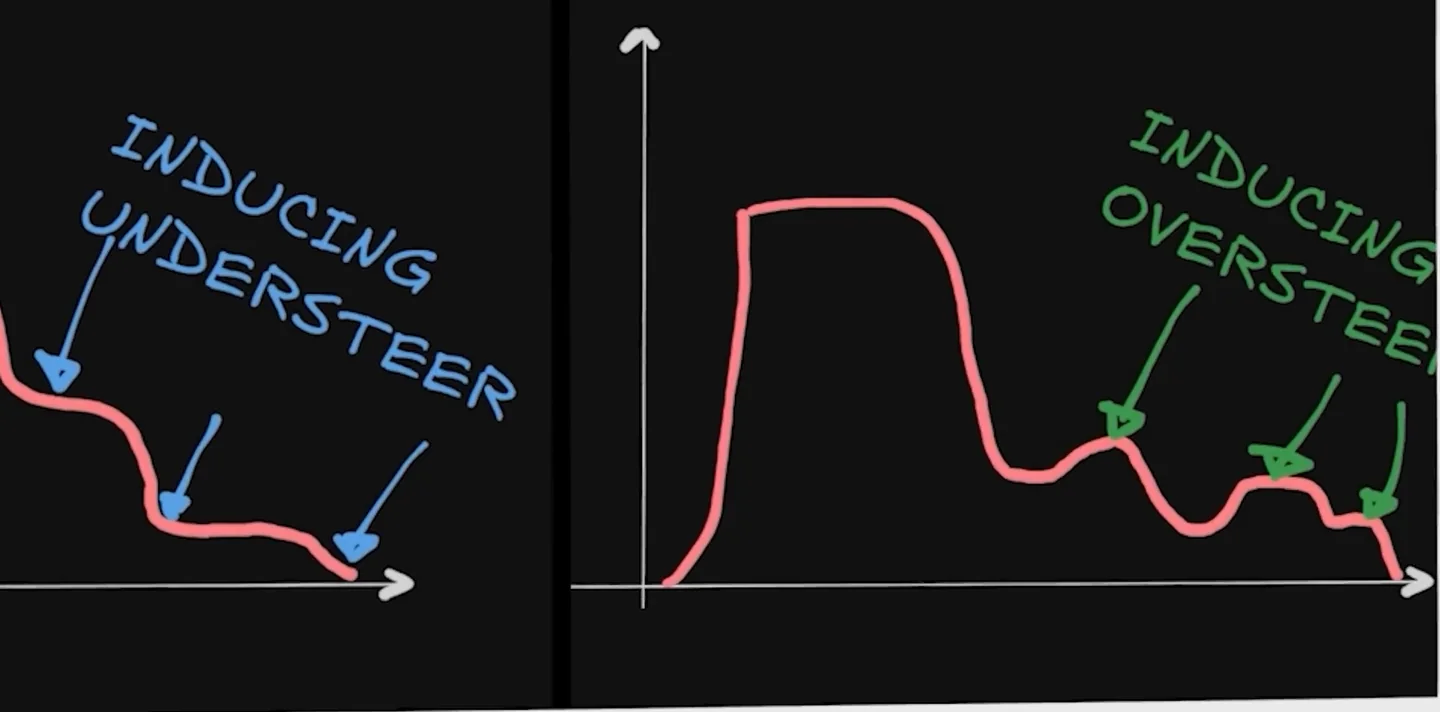
If you zoom into a top driver's brake-trace telemetry you'll see tiny fluctuations — small up-and-down movements in brake pressure during the trail. These are not mistakes. They're deliberate micro-adjustments.
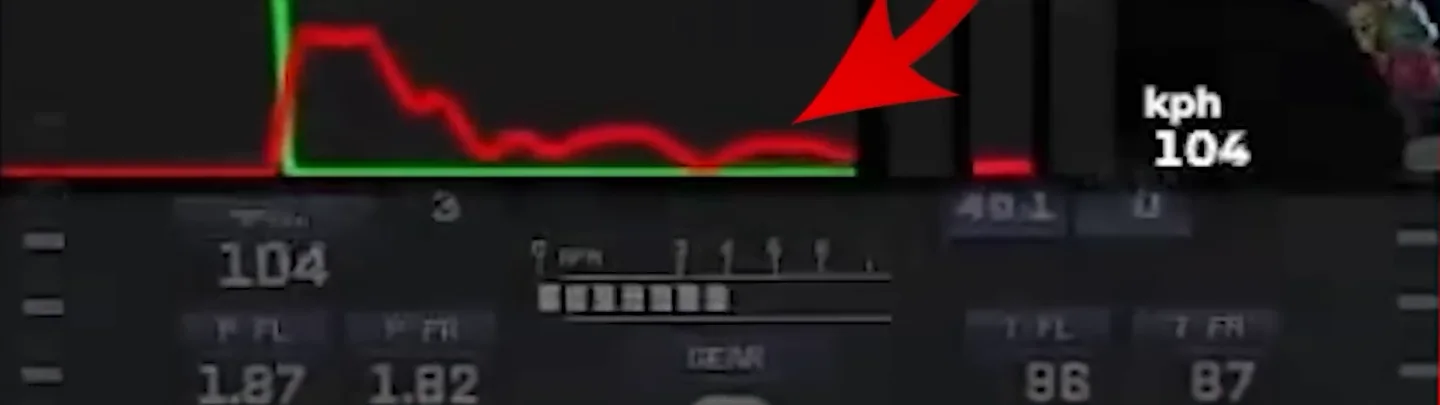
Here's the logic: as you release the brake, the front tyres regain some grip — but this starts to induce understeer. To counter it, you reapply a tiny bit of brake, shifting weight forward and helping the car rotate again. That rotation drops your speed slightly, so you release again to recover speed — which then reduces rotation. This cycle repeats like a dance: speed versus rotation, constantly fine-tuned in real time.
The same thing happens with the steering. Watch my steering input approaching a corner and you'll see back-and-forth movements on the wheel. I'm cranking in steering to use more grip, feeling the force feedback get lighter as the front starts to slide, backing off to avoid washing the tyre, then trying again in a smaller increment. That is fishing for grip. Not one commit and hope — continuous, active searching for the edge.
Grip-fishing practice drill
- Pick a corner you know well and push more speed into it than feels comfortable.
- Focus only on tyre sound, force feedback, and the horizon line.
- When you feel or hear the limit being exceeded, back off slightly — then immediately try to find the new threshold on the next attempt.
- You are not trying to set a lap time. You are mapping the edge, one micro-adjustment at a time.
Step 3: The traction circle is a budget, not a box
The traction circle is usually taught as a fixed shape you need to stay inside. That's not accurate — and that inaccuracy is why most people plateau.
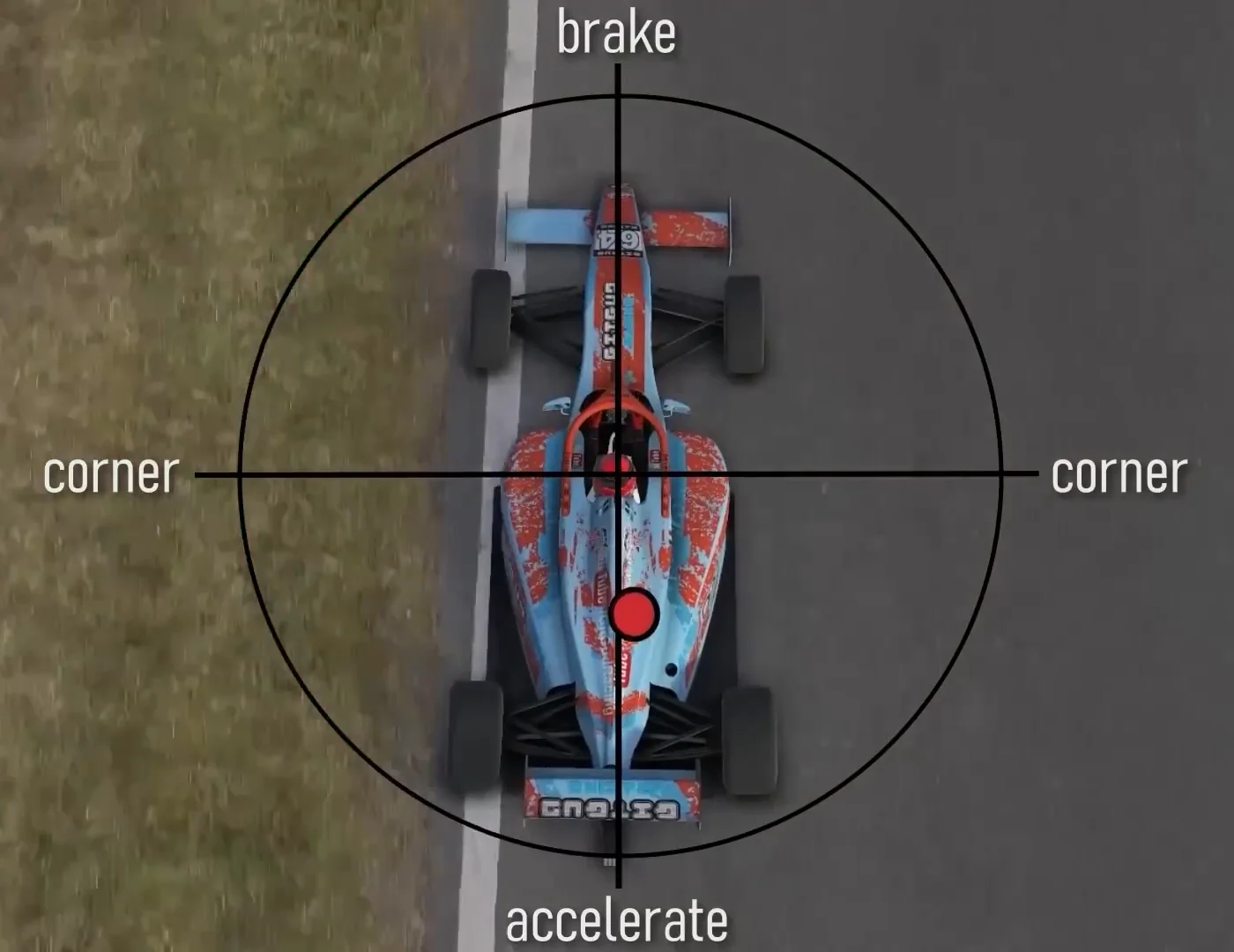
Think of it like a balloon. Press too hard in one area and another part bulges and loses stability. The moment you over-commit in one direction — too much throttle, too much steering, too much brake — you squeeze the circle and grip escapes somewhere else. Your tyres have a total grip budget available at any point in time, and you're splitting it between braking, steering, and accelerating. You can't take one percent more in any direction if the budget is already full.
In practice: brake late and hard into the corner, using close to 100% of available grip for braking. As you begin to steer in, you must trade braking traction for cornering traction — releasing the brake progressively so you stay on the edge rather than dropping below it. On exit, you make the reverse trade: cornering traction gives way to acceleration traction as you unwind the wheel and open the throttle.
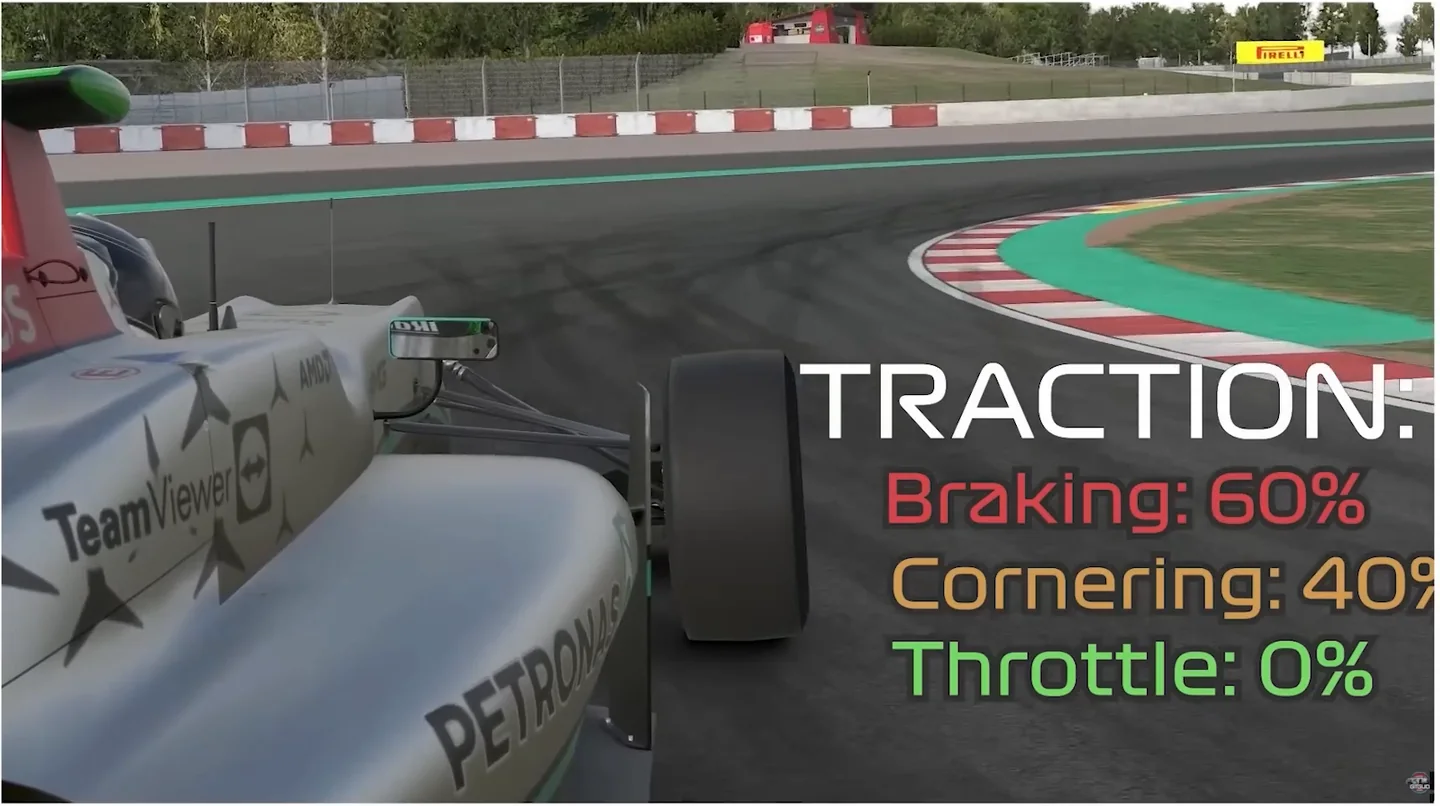
Do it progressively and you stay on the edge of the circle the entire way through. Do it abruptly and you crash the budget in one phase and have nothing left for the next.
Step 4: Predictive driving — seeing the grip one phase ahead
Think of a corner as having three phases, each with its own grip allocation: entry, mid, and exit. If you push beyond the limit in one phase, it costs you in the next. Use 110% on entry and you'll likely be down to 90% through mid-corner — and that's assuming you can hold it together at all.
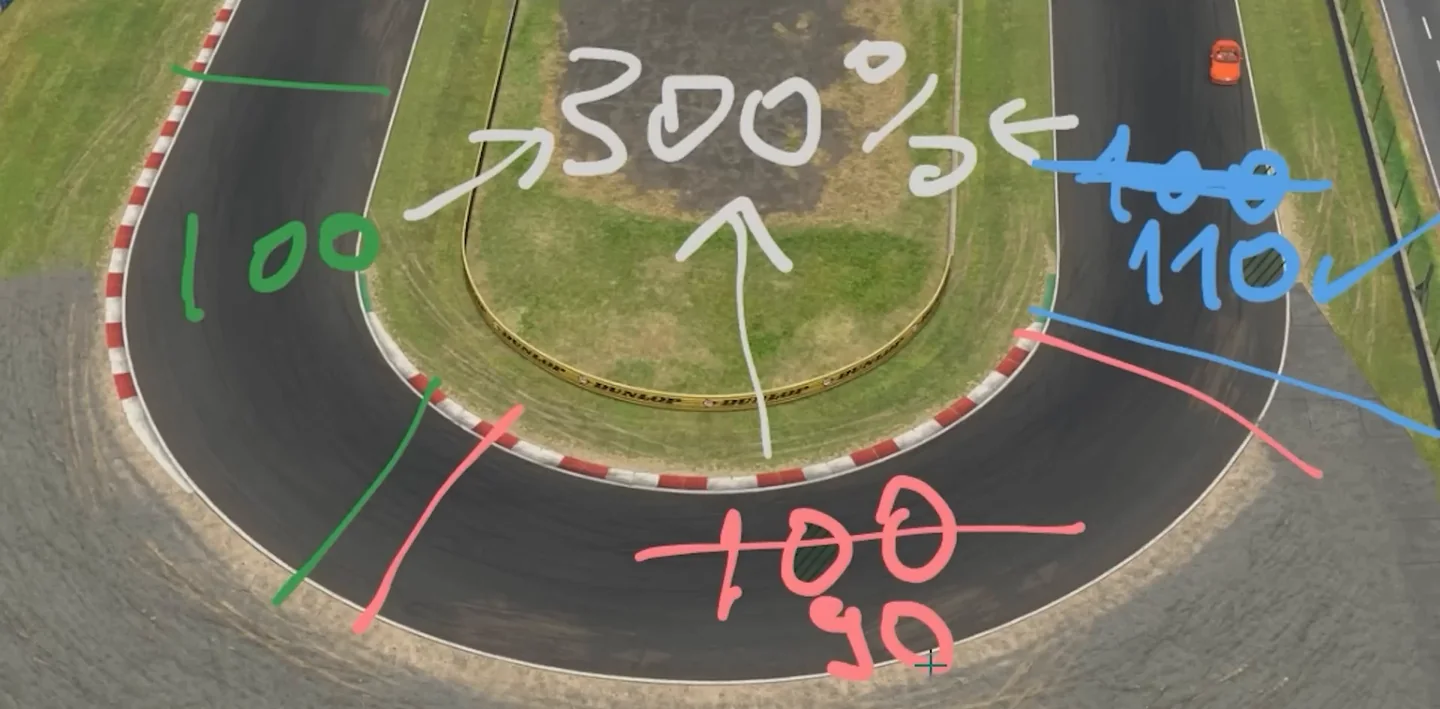
The top drivers aren't reacting to what the car is doing. They're projecting what it's about to do, based on their current speed, angle, and surface conditions. If they enter at 80% of the grip limit, they know there's spare capacity available and they can carry more speed through mid-corner or get on the throttle earlier. That's not instinct — it's a trained mental model built by repetition.
To make predictive driving learnable, you need atomic references: precise, repeatable markers for each corner. One marker for braking, one for turn-in, one for throttle. Vague references — "I brake around the middle of the kerb" — introduce too much variation over a stint and make prediction impossible. The more pixel-perfect your references, the more reliable your predictions, and the faster you'll close the gap between your plan and reality. On a circuit you have never driven there is an order to building that set from nothing — layout first, then one exact cue per action, then the braking point.
Step 5: The active-reset drill — the framework in practice
This is how you put all five steps together at speed.
Active-reset drill
Pick a single corner. Run attempt after attempt with active resets, pushing your best sector time gradually upward. When you hit a plateau — the point where gains seem impossible — begin the refinement sequence:
- Feel the limit. Use force feedback to sense when you're going under or over the grip limit.
- Listen to the tyres. Tyre noise reveals slip angle. Use it to fine-tune grip management alongside the horizon line for rotation changes.
- Analyse your line. Pull a replay. Are you using every inch of track? Are you covering unnecessary distance through the sweeper?
- Micro-adjust. Experiment with grip fishing — push harder on entry, refine your atomic braking, turn-in, and throttle references one at a time.
- Predict the grip. After a few attempts, a pattern emerges. Start testing your predictions: add a little more braking, add a little more entry speed, go to throttle slightly earlier — then check whether what happens matches what you expected. The closer your prediction to reality, the closer you are to the limit.
Execute each step systematically, staying on the edge of the traction circle throughout. Then go beat your best lap time.
Why most drivers stay slow: they skip the system
The drivers who stay slow are the ones treating each corner like a separate problem to react to. The drivers who get fast are the ones running a system: efficient lines built on spatial awareness, active grip-fishing through micro-adjustments, a traction budget managed across all three phases, predictive allocation based on repeatable atomic references, and a structured drill to push the threshold higher every session.
None of these steps are complicated in isolation. The difficulty — and the reward — is in doing all of them together, corner after corner, until they become automatic.
Pick one corner. Run the active-reset drill this session. Focus on one step at a time and layer the rest in as each one clicks. The lap time will follow.
Not sure this is what you should be working on yet? The framework above assumes you can already put the car where you want it, lap after lap. If that is not reliably true, the five stages of sim racing progression will tell you which problem is actually yours right now — and working on that one instead is almost always the faster route. If you would rather hear which one it is from someone watching you drive, that is what 1-on-1 sim racing coaching is for.
Everything above is one lesson each in the structured course library, which is worth knowing if you would rather work through the fundamentals in order than assemble them from separate articles.
How to be faster at sim racing FAQ
How many practice sessions does it take to improve one corner?
It depends on how you practice, not just how many hours you log. Mindless laps barely move the needle, while structured work like the active-reset drill compounds quickly. Most drivers see meaningful, repeatable gains within a few focused sessions per corner once they stop reacting and start running a system. Pick one corner, train your senses, refine your braking, turn-in, and throttle references, and the lap time follows far faster than grinding random laps.
Why am I slower than my friends in sim racing with the same car and setup?
Identical hardware and setup only level the equipment, not the technique. The gap is almost always in the details: leaving a tyre width of track unused, braking in one commit instead of fishing for grip, or over-committing in one phase and paying for it in the next. Faster drivers manage the grip budget across entry, mid, and exit and project what the car is about to do. Compare replays corner by corner and you will usually find time in your lines and brake release, not the menu.
Is trail braking or threshold braking more important for going faster?
They do different jobs and you need both. Threshold braking sheds speed in a straight line using close to all the available grip, while trail braking blends off that brake pressure as you turn in to help the car rotate. Threshold braking sets up the corner; trail braking shapes your entry and rotation. The quickest drivers add tiny brake-pressure micro-adjustments during the trail, reapplying a touch of brake to keep the front loaded and the car rotating rather than washing wide.
How do I get faster in iRacing or ACC specifically?
The fundamentals carry across both, but the feedback you lean on shifts. In iRacing the force feedback is detailed and direct, so the wheel going light at the limit is your clearest cue for fishing for grip. In ACC the tyre and slip-angle audio is excellent, so let the screech guide your slip while you watch the horizon for rotation. Either way, set repeatable references, manage the grip budget across all three phases, and refine one corner at a time.
Can you get faster at sim racing on a Logitech G29 instead of a Fanatec or Moza wheel?
Yes. A stronger direct-drive wheelbase like a Fanatec CSL DD or Moza R5 gives clearer, more detailed force feedback, which makes feeling the grip limit easier, but it does not drive the car for you. On a gear-driven Logitech G29 the signals are quieter, so lean harder on tyre sound and the horizon line to read rotation and slip. Technique, repeatable references, and managing the grip budget matter far more than the wheel, and plenty of fast laps are set on entry-level gear.
This guide is part of the free library at GitGud Racing Academy — an online sim racing academy built around weekly lap reviews, structured courses, drills and training tools.
Train this the right way
Reading is step one. Build it into muscle memory with structured, car-specific courses and personal lap reviews from a coach — inside the Academy.
Join the Academy · $39.99/mo incl. VATWatch the full video on YouTube