How to Drive Chicanes Faster in Sim Racing
A chicane punishes a mistake you made before you got to the part that felt difficult. The second half is where you lose the time, the first half is where you caused it, and the distance between the two is about one second — which is why so many drivers work on the wrong end of it for weeks.
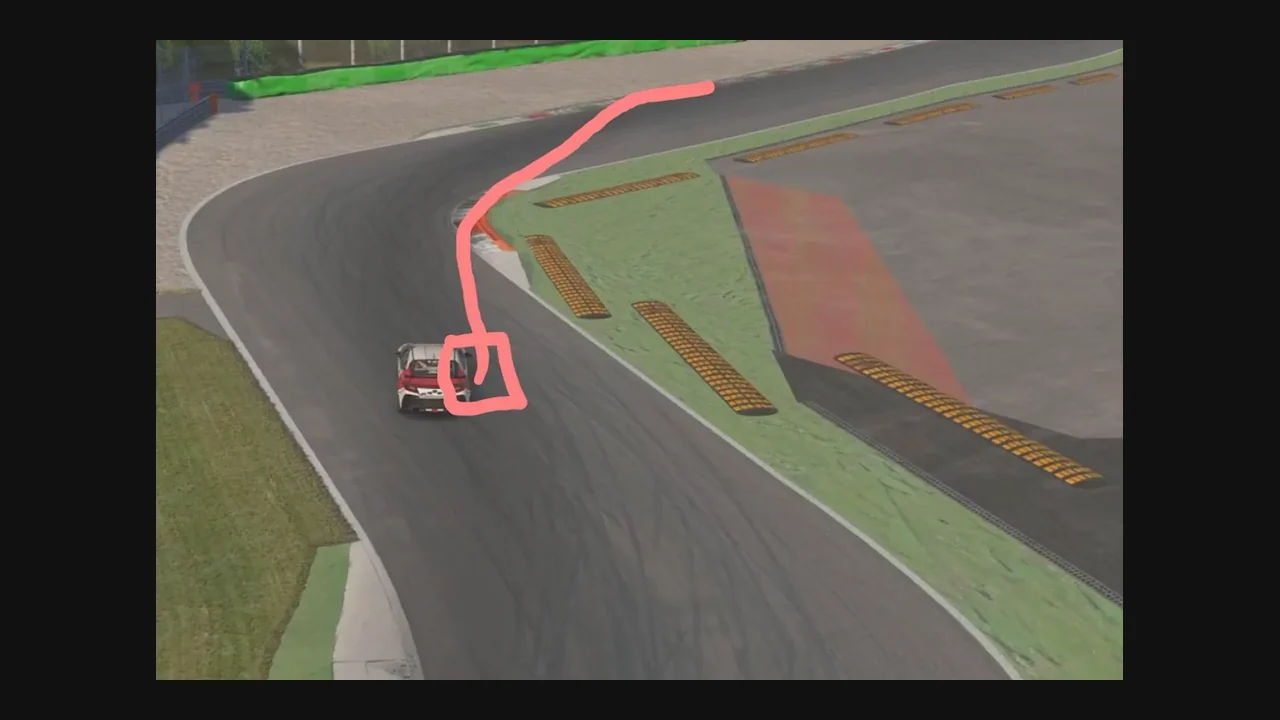
The specific thing that decides a chicane is where your car is sitting on the exit of the first turn. Not how fast you took it. Where it is. One or two metres of lateral position there changes the arc available to you through the second turn, and therefore changes your speed onto whatever follows. This guide is about getting that position right, and about the kerb use that makes it possible, taken from the chicane lesson and drill in our Foundations course with the coach's own drawings.
What is a chicane?
A chicane is a pair of corners in opposite directions, close enough together that they cannot be driven as two separate corners. Circuits use them to break up a straight, which tells you the most important structural fact about them: a chicane almost always leads onto something worth accelerating down, so the exit of the second turn is the thing being protected.

The trap is that the second turn's exit is not decided in the second turn. It is decided by where you emerge from the first. That makes the chicane one of the few corners where the right way to drive it is genuinely counter-intuitive: you drive the first half worse than you could, on purpose, to drive the second half much better.
One session, or a coach every week
- Personalized feedback
- One coaching session
- Advice based on your driving
 GITGUD ACADEMY
A full month for less than one 1-to-1 session.
The line: make it as straight as you can
The mental model that fixes most chicanes is to stop thinking of it as two corners and start thinking of it as a path you are trying to straighten. The lesson's phrasing is blunt: "you want to make straights out of the chicanes" — because "if you're going like a snake left to right, that's not going to be good."
Straightening the path means using every centimetre the rules allow, at both ends. The coach describes being "obsessed" about one question in particular: how much can you cut the first part of the chicane?

That is not recklessness, it is arithmetic. Every metre of track you use at the entry is a metre of radius you do not have to pay for with speed, and the two kerbs of a chicane sit exactly where the geometry needs them.
Why the exit of the first turn decides everything
Here is the part worth slowing down for, because it is the whole article.
Coming out of the first turn you want the car closer to the centre of the track, not hard against the outside. From the centre, the second turn is open: you can take a wide, shallow arc through it and be on the throttle early.

Now move the car one to two metres further towards the outside — a difference so small it barely registers from inside the cockpit. The lesson is precise about what happens: "it doesn't seem like it's a big difference in terms of the positioning, just being one, two metres more towards the right side, but now our racing line is compromised and we have to take a narrower part towards the exit."

A narrower arc through the second turn means a tighter radius, which means less speed, which means more braking — you are now slowing the car down again for a corner you had already slowed down for. That is the chicane tax, and almost nobody pays it knowingly. It is paid a second earlier, and collected a second later, which is why it feels like the second turn is the problem. From the cockpit the cause is easy to miss, so it is worth working through with a coach watching you drive.
When should you sacrifice the first turn?
Nearly always, a little — and the useful question is how much.
There are two extremes and the answer is neither of them. The first extreme is over-preparing: slowing down so much through the first turn to get perfect position for the second that you simply drive the whole complex slowly. The lesson's warning is direct — "we don't want to be on the other extreme in which we have our car here, because we're slowing down too much."
The second extreme is the opposite, and it is the more common of the two among quick drivers: carrying so much speed out of the first turn that the car ends up hard against the inside of the second, with no arc left at all.

The coach's description of that line is the most useful sentence in the lesson, because it names the shape: "it's almost like you're overtaking in this corner." That is exactly what it looks like — the line you would take if you were diving down the inside of somebody, which is a line chosen for position, not for speed. If your chicane exits feel like you are always fighting the car straight, look at whether you have driven yourself into the overtaking line.
Between the two sits the answer: "there's definitely a sweet spot to be found, and generally that's the centre of the track for chicanes." Not the outside, not the inside. The centre, arriving there with the car already pointed.
Changing direction without upsetting the car
The transition is where chicanes are won on feel rather than geometry, and the requirement is speed of hands, not smoothness of hands.
The drill's keyword is exactly that: "quick hands is a big keyword for chicanes — switching quickly from right to left." A chicane is the one place where a slow, progressive steering input is usually wrong, because the time you spend rolling from one lock to the other is time the car is neither turning one way nor the other, and that time is track you are travelling in a direction you do not want to go.
What makes the quick hands survivable is that the car is already pointed when you make them. If you arrive at the transition still needing to slow down, a fast input will unsettle the rear — and then you are correcting instead of accelerating. The load moving across the car as you swap direction is ordinary weight transfer; the chicane just asks for it twice in a second.
On the pedals, the default pattern from the lesson is: trail brake all the way to the first kerb, then commit. "We're adding more steering, we're dropping the brakes a lot and still braking, still braking, still on the brakes — trail braking up until we hit the kerb. The car is already pointed into the right direction, and now we smash the throttle confidently."

The exception is worth knowing: in some chicanes you carry a little brake into the middle section as well, all the way to the second turn. The lesson puts the split at roughly 85 per cent of cases following the first pattern — trail to the first kerb, then throttle — which makes the middle-brake version something to reach for when the first one leaves you arriving at the second turn too fast, not the default.
When taking more kerb helps, and when it costs you
Kerbs are how a chicane gets straightened, and they are also how a chicane throws you off.
The useful distinction is between a kerb that shortens your path and a kerb that unsettles the platform. The first is free time. The second is a loaded gun, because a car pitched sideways as you are trying to apply throttle costs you the exit you were protecting. Flat, wide kerbs can usually be used fully; tall sausage kerbs and the aggressive serrated type will pitch the car, and how much the car tolerates depends on the car.

The drill's car choice is deliberate for this reason — a GR86, "since it's a car where you can really make it a lot easier going over kerbs, so you can get a better feel of cutting". A softer, more compliant car is the right thing to learn kerb use in, because it tells you what the kerb is doing rather than punishing you for asking.
Two practical points from the drill. First, the throttle goes down before the kerb, not after it: "it's important to reach 100 on the gas before hitting the kerb on the right side with your right tyre." Arriving at the kerb already accelerating settles the car onto its rear tyres. Second, between the two turns there is often a small amount of throttle even though you are not finished turning — "add a little bit of throttle to keep the momentum up, to keep the minimum speed up" — and then a brief return to the brake as the second turn arrives.

Track limits: the legal line and the fast line are not the same
Everything above assumes you stay inside the limits, and in a sim that is a harder constraint than it sounds, because the penalty is automatic and it does not care that you were half a car width over for a tenth of a second.
The lesson's framing is the right one: "using every inch of the track, staying in the limits, without getting a slowdown or an off-track." That is the real optimisation — the fastest line that counts.
Three things are worth being precise about, because guides often are not:
- The rule is not universal. What counts as exceeding track limits differs between simulators, between series within a simulator, and between leagues running their own regulations. There is no single "two wheels" rule you can carry from one grid to the next. Check the rules for the thing you are actually racing.
- The detection point is not always the white line. Some circuits and some series police a kerb's outer edge, some the line, some a sensor strip. The only reliable way to know where your limit is on a given combo is to find it deliberately in practice and back off a hand's width.
- A legal cut is not automatically a fast cut. If mounting that much kerb unsettles the car, you have bought a shorter path and sold your exit. Test both and compare the section, not the corner.
The useful habit is to establish, in practice, exactly how much you can take without triggering anything — then drive to a reference slightly inside that, so a small mistake costs you nothing instead of a lap.
Four chicane mistakes
- Over-preparing for the second turn. Slowing so much in the first half that the whole complex is slow. The tell is that your minimum speed happens in the middle, not at either apex.
- The overtaking line. Too much speed out of the first turn, the car pinned against the inside of the second, no arc left. The tell is a second, unplanned brake application between the turns.
- Slow hands through the transition. Rolling from one lock to the other instead of swapping. The tell is a flat spot in the middle of the speed trace where the car is travelling in neither direction usefully.
- Not cutting because you are afraid of the limits. Leaving a metre at both ends because you got a warning once. That is a real cost, paid every lap, for a risk you can measure once in practice.
The chicane drill: measure both turns together
The course drill uses a GR86 at Monza's first chicane, with an active reset point before the braking zone. The braking reference given is the 100-metre board, second gear through the first part, first gear before the kerb.


Three exits from the first turn
- Set the reset point before the braking zone, and fix your comparison end point well down the following straight. As with every chicane, the number that matters spans both turns and the exit, never one turn alone.
- Five laps committing to the first turn. Carry as much speed as you can through the first half and see where it puts you. Note where your car sits laterally on the exit of the first turn, and the speed at your end reference.
- Five laps over-preparing. Slow the first half deliberately to arrive at the second turn perfectly placed. Same two numbers.
- Five laps hunting the middle — aiming to arrive at the centre of the track, already pointed, with the throttle coming in before the second kerb.
- Then a kerb comparison, holding the line constant: five laps taking a conservative amount of kerb, five taking as much as the limits allow. Watch stability on the exit as much as the clock.
Judge on the speed at your end reference and the section time, not on how it felt. The over-prepared set often feels the best and the committed set often feels the fastest, and neither is usually the quickest. Keep the braking point identical across sets so you are testing position rather than entry speed.
If your chicanes are inconsistent rather than slow — good one lap, ragged the next — that is usually a reference problem rather than a technique problem, and the method for building references precise enough to repeat is in the cornering guide. The full lesson and drill this page is built from, along with every other corner type, are in the Foundations course.
Chicane FAQ
What is the fastest way through a chicane?
Make the path as straight as you can. Use every legal centimetre at both ends, cut the kerbs as far as the limits allow, and arrive at the exit of the first turn near the centre of the track with the car already pointed — that position is what opens the second turn up. The default pedal pattern is to trail brake all the way to the first kerb, then commit to the throttle once the car is pointed. The chicane line.
Why does the exit of the first turn matter so much in a chicane?
Because it sets the entry to the second. One or two metres too far towards the outside — a difference you barely feel — forces a narrower arc through the second turn, which means a tighter radius, less speed, and a second brake application for a corner you had already slowed for. The time is lost a second before the part that feels difficult, which is why so many drivers work on the wrong half. Why the first exit decides everything.
Should I accelerate between the two turns of a chicane?
Usually a little — enough to keep the minimum speed up — then off it and back onto the brake as the second turn arrives. What does not work is treating the gap as a straight and committing fully, because the car still has to change direction afterwards; throttle you cannot keep is throttle that cost you the transition. Changing direction.
Why does the second kerb of a chicane make the car unstable?
Usually because you arrive at it still asking the car for something else — still braking, still adding lock, or not yet on the throttle. A kerb taken by a settled, accelerating car is absorbed; the same kerb taken mid-transition pitches it. The fix is earlier in the sequence: get the car pointed sooner so the throttle is already down when the kerb arrives. Kerb use.
Can sacrificing too much of the first turn make me slower?
Yes, and it is one of the two ways to get a chicane wrong. Slowing the first half excessively to arrive perfectly placed for the second means you drive the whole complex below its potential. The opposite error is carrying so much speed out of the first turn that the car ends up pinned against the inside of the second with no arc left. The sweet spot is the centre of the track with speed still on the car. How much to sacrifice.
Is taking more kerb always faster in a chicane?
No. More kerb is a shorter path, which is a real gain, but only while the car stays settled enough to use its exit. The test is whether the throttle goes down at the same point afterwards — if it goes down later, the kerb cost more than it saved. Flat, wide kerbs can usually be used fully; tall sausage kerbs and aggressive serrated ones will pitch the car. When kerb helps.
How do track limits work at a chicane?
They vary — by simulator, by series within a simulator, and by league, so there is no single rule you can carry from one grid to the next, and the detection point is not always the white line. The practical approach is to find the real limit deliberately in practice, then drive to a reference slightly inside it so a small mistake costs nothing. A legal cut is also not automatically a fast one if it unsettles the car. Track limits.
Why do quick hands matter more in a chicane than elsewhere?
Because the time spent rolling from one lock to the other is time the car is turning neither way usefully, and in a chicane that time is track travelled in the wrong direction. A fast swap works only if the car is already pointed when you make it — if you still need to slow down at the transition, quick hands will unsettle the rear instead. The transition.
This guide is part of the free library at GitGud Racing Academy — an online sim racing academy built around weekly lap reviews, structured courses, drills and training tools.
Train this the right way
Reading is step one. Build it into muscle memory with structured, car-specific courses and personal lap reviews from a coach — inside the Academy.
Join the Academy · $39.99/mo incl. VAT