GITGUD ACADEMY
Deals

Sim-Lab Discount Code (5% Off) + Rig Buying Guide

Sim-Lab Discount Code (5% Off) + Rig Buying Guide

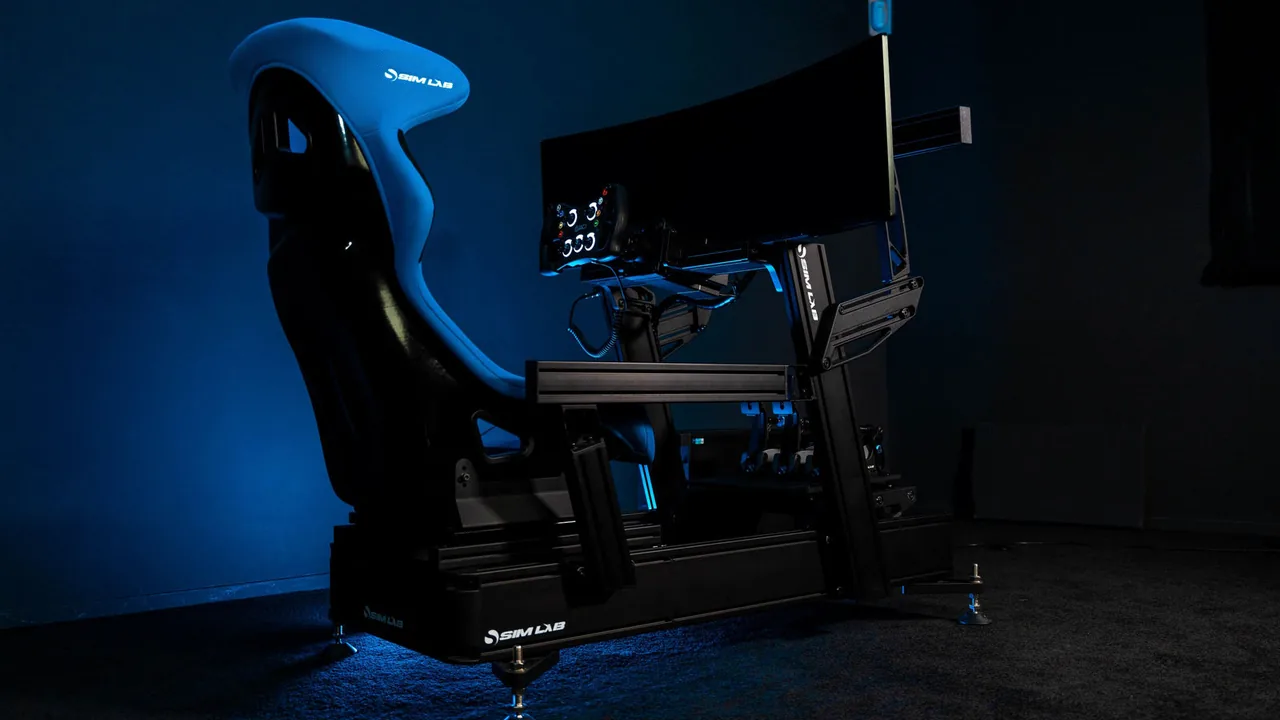
I race on a Sim-Lab P1X. I moved to it from a cheap generic rig, and the difference was not subtle — it is the upgrade I should have made first instead of last. I also have a Sim-Lab partner code, so here it is, along with everything I would want to know before spending four figures on aluminium.

Sim-Lab

5% off your Sim-Lab order

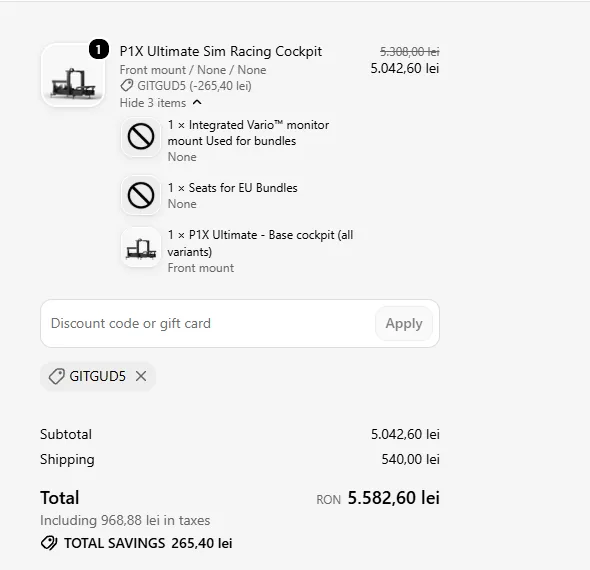
Heads up: this is an affiliate link. If you buy through it I earn a commission at no extra cost to you, and the code takes the price down for you. That is the whole arrangement. EU store prices include tax; UK buyers pay import VAT on delivery.

The thing nobody tells you about rig prices

Every headline price you see for a sim rig is a bare frame. Not "mostly complete" — a frame. No seat, no seat brackets, no seat slider, no monitor mount.

Here is what that means in practice, priced through Sim-Lab's own configurator on 7 August 2026, in euros including tax for the EU store:

  • GT1 Evo, bare chassis: €379.
  • The same rig, actually usable — single monitor mount, S1 Enduro GT seat with brackets, seat slider: €996.95.
  • With a triple monitor mount instead: €1,146.95.

That is 2.6 times the sticker price, before shipping. Nothing dishonest is going on — every rig brand prices this way — but if you budget from the headline number you will be short by roughly the cost of the rig again.

Shipping is quoted live at checkout and scales with the build. A bare GT1 Evo was €39.02 to Amsterdam, €53.48 to Berlin and €64.06 to London on 7 August 2026. A loaded P1X Ultimate was €52.94, €70.49 and €81.77 to the same three cities.

The current range

Five chassis, EU prices including tax, read 7 August 2026:

  • GT1 Evo — €379. The entry point. Built from 80x40 and 40x40 profile, joined with corner brackets.
  • GT1 Pro — €649. Same profile sizes as the Evo; the money goes on redesigned joints, not heavier extrusion. Ships with rubber feet rather than the adjustable set.
  • P1X Pro — €789. Steps up to 120x40 uprights and a 160x40 base, and replaces the universal corner brackets with bespoke sandwich plates and pre-drilled holes.
  • P1X Ultimate — €899. Sim-Lab's answer to criticism of the P1X Pro — back to fully slotted, quad-slot profiles and the classic straight uprights. Includes the adjustable feet.
  • Mercedes-AMG PETRONAS — €999 without a seat. A licensed F1-position rig.

One pricing trap on the P1X Pro: choosing the Fanatec direct-drive mount takes it from €789 to €879. The other two mount options do not carry that €90 upcharge, and the P1X Ultimate charges the same price whichever mount you pick.

The profile sizes are not printed on any product page — I pulled them out of Sim-Lab's own assembly manuals. They matter more than the marketing suggests, because heavier profile is most of what stops a rig flexing under a strong direct-drive wheelbase.

Everything is standard 40-series, and that is the real argument

Sim-Lab sell corner brackets described as "Slot 8", 40 mm — meaning the rigs use the industry-standard 8 mm T-slot, 40-series aluminium profile system.

That is the quiet reason to buy one. Any 40-series part from any supplier fits. Brackets, extra profile, a keyboard tray, a mount somebody else designed and printed — none of it has to come from Sim-Lab. You are buying into a standard, not a walled garden, and in five years when you want to bolt something on that does not exist yet, it will still fit.

Which one to buy

  • Running a belt or gear wheel, or a lower-torque direct drive? The GT1 Evo is genuinely enough. Put the money you saved into a decent seat.
  • Running a serious direct-drive base? Go P1X. The heavier 120x40 uprights and 160x40 base are the point — under real torque, upright flex is what you feel as vagueness at the wheel.
  • Formula position? Look at the Mercedes rig, but check the seat situation before you order.

What I would tell you before you order

Two honest things.

Assembly takes a while and it is fiddly. This is my own experience of building mine and it is the one thing I would warn a friend about. It is not difficult — everything lines up and the manual is decent — but set aside an afternoon, not an hour, and do it with the instructions actually open rather than from the photos. Aluminium profile rewards patience and punishes guessing which bolt goes where.

Do not order one if you need it by a date. This is the loudest theme in Sim-Lab's own recent reviews and it is not about the product. Sim-Lab hold 4.5 out of 5 on Trustpilot across more than 6,000 reviews, with 84% at five stars — the praise is consistently about rigidity and finish, and the complaints cluster almost entirely on stock and communication rather than quality. Reviewers through late 2025 and early 2026 reported seats delayed by six weeks to three months, orders split across multiple couriers on different days, and stated dispatch times that did not hold. If it is a birthday or a season opener, buy from a reseller with the thing physically on a shelf.

Two regional warnings

If you are in the US: sim-lab.us is a real US store shipping from Pennsylvania with no duties to pay, which is the good news. The bad news, checked on 7 August 2026, is that the P1X Pro, P1X Ultimate and GT1 Pro were all out of stock there — every variant. What you could actually buy was the bare GT1 Evo at $449 or the Mercedes rig at $1,099. Check stock before you fall in love with a model.

If you are in the UK: there is no UK warehouse and no UK entity. Every rig is far past the £135 threshold, so you pay import VAT plus a courier handling fee when it lands. Reviewers have reported £200 to £250 of unexpected charges on orders around the £1,200 mark. Add roughly a quarter to the sticker price and you will not get a nasty surprise at the door.

Two things Sim-Lab does not publish

I went looking for both and could not find them, so I am not going to invent them.

  • Warranty length. Both storefronts say only that it "varies by product type and region". No number anywhere. For a four-figure purchase that is worth an email to them before you buy.
  • Torque ratings. No Sim-Lab page states a maximum Nm figure for any chassis. If you see a guide confidently telling you a specific rig "handles up to 12 Nm", that number came from somebody's imagination, not from Sim-Lab.

Is it worth it coming from a cheap rig?

For me, yes, and it was not close. The thing a budget rig costs you is not comfort, it is feedback: when the frame moves, you cannot tell the difference between the car sliding and your rig flexing, so you learn to distrust the wheel. A stiff rig gives you back information you did not know you were missing.

You do not buy an aluminium rig to be comfortable. You buy it so that what you feel through the wheel is the car and nothing else.

That said — if your wheelbase is a belt-driven unit and your rig is bolted to a solid desk, this is not your next upgrade. Spend the money on a correct field of view and better pedals first. Both are cheaper and both will find you more lap time than a stiffer frame will.

Sim-Lab discount code FAQ

Is there a Sim-Lab discount code?

Yes, the code on this page takes 5 percent off and goes in at checkout. Be aware that several sim-racing creators run link-only Sim-Lab partnerships with no customer-facing code at all, so pages advertising enormous Sim-Lab discounts are usually recycling something long expired. Confirm the total actually drops before paying rather than trusting a badge on a coupon site.

How much does a Sim-Lab rig actually cost?

Far more than the headline, because every chassis price is for a bare frame with no seat, seat brackets, seat slider or monitor mount. Priced through Sim-Lab's own configurator on 7 August 2026, a GT1 Evo is 379 EUR as a frame but 996.95 EUR once you add a single monitor mount, an S1 Enduro GT seat with brackets, and a slider. Budget roughly two and a half times the sticker price.

Which Sim-Lab cockpit should I buy?

It depends on your wheelbase. If you run a belt, gear or lower-torque direct-drive wheel, the GT1 Evo is genuinely enough and the money saved is better spent on a good seat. If you run a serious direct drive, step up to the P1X line, whose heavier uprights and base exist precisely to stop the frame flexing under real torque, since flex is what you feel as vagueness at the wheel.

Do Sim-Lab rigs use standard aluminium profile?

Yes. Sim-Lab use the industry-standard 8 mm T-slot, 40-series profile system, confirmed by the Slot 8 40 mm corner brackets they sell as spares. That is one of the strongest arguments for buying one: any 40-series part from any supplier will fit, including brackets and mounts other people have designed. You are buying into an open standard rather than a closed ecosystem.

How long does Sim-Lab take to ship?

This is the most common complaint in their recent reviews, and it concerns logistics rather than product quality. Through late 2025 and early 2026, reviewers reported seats delayed by six weeks to three months, orders arriving split across several couriers on different days, and stated dispatch times that did not hold. If you need a rig by a specific date, buy from a reseller who physically has it in stock.

Do UK buyers pay import charges on Sim-Lab?

Yes. Sim-Lab has no UK warehouse and no UK entity, and every rig comfortably exceeds the 135 GBP threshold, so import VAT plus a courier handling fee is charged on delivery. Reviewers have reported 200 to 250 GBP in unexpected charges on orders around the 1,200 GBP mark. Add roughly a quarter to the sticker price when budgeting and the bill at the door will not surprise you.

Train this the right way

Reading is step one. Build it into muscle memory with structured, car-specific courses and personal lap reviews from a coach — inside the Academy.

Join the Academy