Sim Racing Seating Position: GT3, Formula & Ergonomic Rig Setup
Most seating-position advice contradicts itself, and it took reading a lot of it to work out why. The sources are not disagreeing — they are measuring from different places. "45 degrees of elbow bend" and a "90 degree elbow angle" describe wildly different postures, because 45 degrees of bend from straight is a 135 degree included angle. Two drivers follow two guides, end up at opposite ends of the rig, and both believe they did it right.
So this page locks one convention and works from four angles you can take off a single photo. The tool below tells you which of them sit outside the band for what you drive, in which direction, and what to move first. The rest of the page explains where those numbers come from, what to do when there is no number, and the order to change things in.
1 · What are you driving?
2 · Four angles from your photo
Seat recline from vertical
Phone inclinometer laid flat against the seat shell — not the padding, not a bolster. Zero it on the floor first.
Hip angle torso to thigh, included
On your side-on photo mark three points: shoulder, hip (the bony bump at your side) and knee. Measure the angle between them with a protractor app.
Knee angle thigh to shin, included
Take the photo with the brake fully pressed. At rest it reads 15° or more different, which is enough to send you the wrong way.
Elbow angle upper arm to forearm
Hands on the rim at 9 and 3, not draped over the top, with your shoulder blades touching the seat back. Measure shoulder to elbow to wrist.
Same target for GT, formula and rally — only seat recline, pan tilt, hip and knee change with discipline.
Optional — sharpens the diagnosis
Seat pan tilt nose-up from horizontal
Phone laid flat along the centreline of the cushion, with nobody sitting on it. Zero it on the floor first.
Ankle angle shin to sole, included
Foot on the brake at working pressure with your heel on the plate. Measure between your shin line and the sole of your shoe.
Same target for GT, formula and rally — only seat recline, pan tilt, hip and knee change with discipline.
Upper-arm elevation from vertical
Hands on the rim. Compare your upper-arm line against straight down — a plumb line, or the vertical edge of the photo.
Same target for GT, formula and rally — only seat recline, pan tilt, hip and knee change with discipline.
3 · Anything hurt, or feel off?
Seating position is a performance problem, not a comfort one
It gets filed under comfort because that is where it hurts first. But every input you make passes through your body's contact with the rig, and the geometry decides how much authority you have over each one.
- Pedal distance sets how much of the brake's range your leg can actually reach, and how finely you can modulate inside it. A leg near lockout has no resolution left.
- Wheel distance sets steering precision. In one study, moving drivers closer than their own self-chosen "comfortable" distance cut peak shoulder muscle force by 31% and joint force by 45% — and their own sense of comfort had not found that position.
- Seat support decides whether your body stays still under heavy braking. If your backside lifts, your reference for pedal pressure moves with it.
- Head and screen position decide what you can see, which decides where your braking references are.
The clearest evidence is on the elbow. A simulator study of 40 drivers measured both steering precision and maximum steering velocity across a range of elbow angles, and found both significantly better at 95° and 120° than at 70°, 145° or 160°. Arms too straight and arms too curled are not merely uncomfortable — they are measurably slower to correct a car.
How to measure, before any number means anything
Every figure on this page assumes one stance. Change the stance and the numbers stop applying.
- Hands at 9 and 3, on the rim — not draped over the top.
- Shoulder blades in contact with the seat back.
- Wearing the shoes you actually race in. Real seat fitting insists on kit-worn fitting for the same reason: thin soles move pedal geometry by centimetres.
- Brake fully pressed for the photo. A knee angle at rest reads 15° or more different from the same knee under braking, which is enough to send you the wrong way.
Then the conventions. Joint angles are the included angle — 180° means the limb is dead straight. Seat recline is measured from vertical, so 0° is bolt upright. Seat pan tilt is nose-up from horizontal. Where a guide gives you a number without telling you which frame it used, you cannot safely use it.
GT3 sim racing seating position
The GT template has one defining feature: your hips sit above your heels. You are sitting on top of the pedals, not in front of them.
| What | Target | Why it matters |
|---|---|---|
| Seat recline from vertical | 10–25° | This is a purchasable seat specification, not an opinion |
| Seat pan tilt, nose-up | 8–16° | Stops you sliding forward under braking |
| Hip angle | 100–115° | The master constraint everything else serves |
| Knee at 100% brake | 120–135° | Under 110° your quads burn out inside a lap |
| Elbow at 9 and 3 | 95–120° | Measured optimum for precision and steering speed |
| Ankle on the brake | 95–105° | The tightest-consensus number in the research |
| Upper-arm elevation | 15–40°, never past 60° | 60° is an ergonomics standard, not a preference |
Two of those are hard limits rather than preferences. A knee under 110° at full brake is the single named cause of quads that burn out inside a lap, and past 145° emergency braking performance measurably drops because a near-straight leg has nothing left to give. Upper-arm elevation past 60° breaches an ISO seated-work standard — that one is a published ceiling, not a survey of what drivers happen to do. Once the position is set, the GT3 sim racing guide covers the driving the class rewards — braking on ABS, trail braking and working with traction control.
Formula and F1 sim racing seating position
Formula is not "GT but more reclined". It is a different template, and the discriminator is the opposite of the GT one: your heels sit above your hip point. You are lying behind the pedals rather than sitting above them.
Once the rig position is right, the driving itself changes too — the Formula sim racing guide covers braking without ABS, aero grip and the steering technique open-wheelers reward.
- Seat recline: 30–40° from vertical, against GT's 10–25°.
- Hip angle: 90–100°, a more closed hip than GT.
- Knee at full brake: 130–145°, straighter than GT.
- Seat pan tilt: 10–20°.
Elbow, ankle and upper-arm targets do not change. That is worth knowing because it tells you what a discipline switch actually costs: four things move, three stay, and the three that stay are the ones governing your hands and feet.
One thing to be careful of if you are shopping rather than adjusting: many cockpits cap their recline well short of 30°. A rig that physically cannot reach the formula band cannot be set to a formula position, however you arrange everything else. If that is what has you replacing a frame rather than adjusting one, what to look for when buying a cockpit covers what is and is not in the box, and how to confirm delivery before you order.
Rally and touring position
Broadly the GT template — hips above heels, recline around 15–25°, the same hip and knee bands. One real Group A car measured about 26° of recline at the lumbar and a wheel tilted around 22°, which is more upright and closer than a GT3 driver would choose.
The practical difference is that rally and touring positions are built around visibility and rapid, large steering inputs rather than sustained cornering load. If you find yourself running a slightly closer wheel than the GT numbers suggest, that is not a mistake.
Sim racing wheel position
Distance has a test rather than a number. Sit back with your shoulder blades pressed into the seat, extend one arm straight over the top of the rim. The rim should land somewhere between your mid-forearm and your wrist joint.
But the real pass/fail is the other half, and it is the half people skip: your shoulder blade must not lift off the seat back to reach any part of the rim you actually use. Test it reaching for the far side, not just the top. This is the single best-quantified finding in the research — the shoulder-load reduction from sitting closer is large, and drivers do not find that position by feel.
Height: the wheel centre sits somewhere between your sternum and the base of your neck, and the top of the rim should not be above eye level. Check the shoulder-to-elbow-to-hub line and keep your upper arm under that 60° ceiling.
Diameter is a real variable and usually the right fix for two common complaints. Racing rims are typically 300–330 mm; formula rims are smaller. If your hands foul your knees at the bottom of the rim, or your elbows hit the rig sides, try a smaller wheel before you move the seat — moving the seat to solve a rim-size problem breaks everything you already set.
Sim racing pedal position
Distance is what sets your knee angle at full brake, so it is really the same adjustment under another name. Set it by the angle, not by feel.
Height sets the hip-versus-heel relationship for your discipline — and it moves the knee angle too, so distance gets re-checked after any height change.
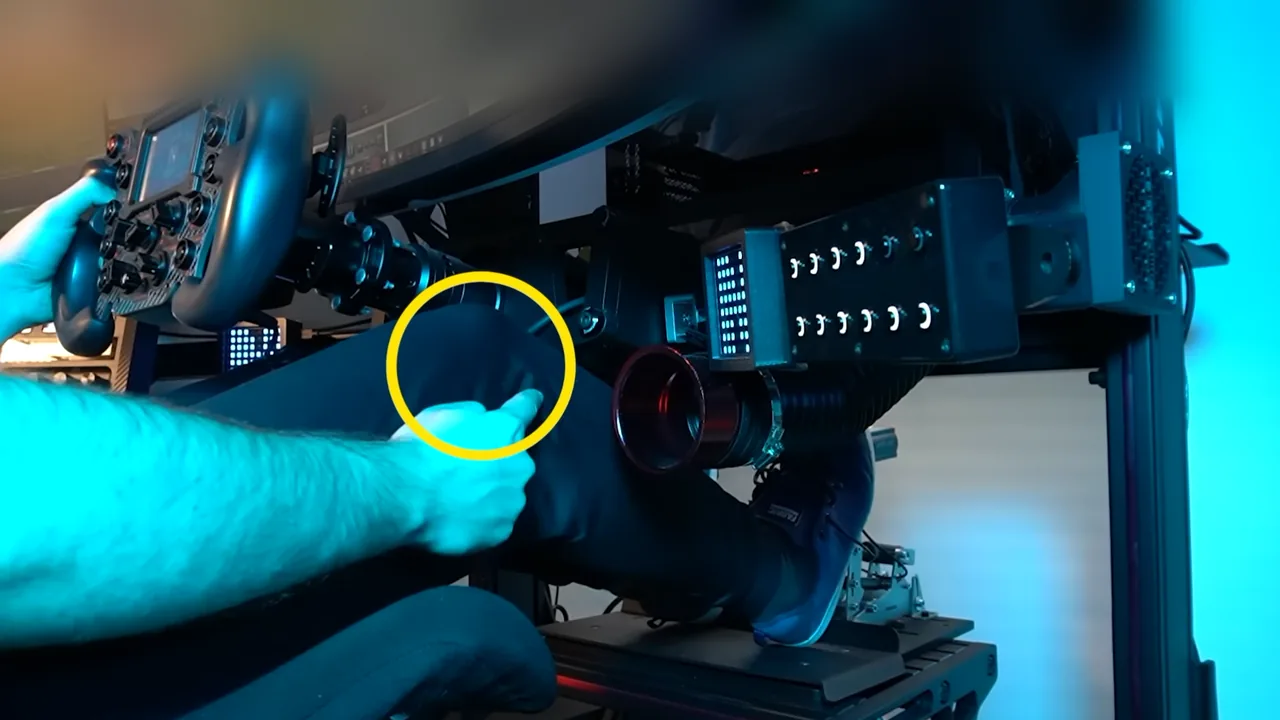
Lateral alignment costs nothing and matters more than its obscurity suggests. Your hip, knee and the brake pedal should sit in one straight line. Four independent sources name lateral offset as the first thing to check for pain on the sides of the knee, and nothing else comes close — braking force travelling up the leg off-axis has to go somewhere.
Face angle has no reliable number anywhere. Set it functionally: your ankle lands near 98°, your heel stays planted, and the whole sole contacts the face. Chasing a published figure here is chasing numbers that contradict each other.
If holding a steady, repeatable brake pressure is physically hard, that may be the pedal rather than the geometry — brake pedal tips and brake pedal settings cover that side, and five braking mistakes found in one lap shows what a bad brake trace looks like when the cause is the driver.
How to set up your sim racing seating position, in order
The order is not arbitrary. Each step is defined by the ones before it, so doing them out of sequence means doing several of them twice.
The sequence
- 1 · Seat recline and pan tilt. Together these set your hip angle, which everything downstream serves. You cannot set one without the other.
- 2 · Seat height. The lowest that still clears the rim from your view of the screen.
- 3 · Pedal distance — sets knee angle at 100% brake.
- 4 · Pedal height — sets hips-above-heels or heels-above-hips. Then re-measure the knee; you just moved it.
- 5 · Pedal lateral alignment. Brake square to the hip. Free, and it is the top cause of side-of-knee pain.
- 6 · Pedal face angle — until the ankle lands near 98°, not to a number.
- 7 · Brake force calibration. Last of the pedal group, because it depends on everything above it.
- 8 · Wheel distance — the wrist test, with shoulder-blade contact as the real pass/fail.
- 9 · Wheel height — shoulder-elbow-hub line, upper arm under 60°.
- 10 · Wheel tilt — after height, because a higher wheel needs less tilt.
- 11 · Screen height, then distance, then recalculate your FOV.
- 12 · Lumbar support — genuinely last, and this matters.
Why recline comes first: every later test is defined with your shoulder blades against the seat back. Change recline afterwards and you have invalidated the wrist test, the elbow angle and the upper-arm elevation simultaneously.
Why lumbar goes last: radiographic work found that lumbar support changes the lumbar spine but has no significant effect on seated pelvic posture. A pad cannot fix a pelvis rolled back by a closed hip angle. Fit it early and it masks a geometry fault; fit it last and it corrects the small residual it is actually capable of correcting.
And the rule that saves the most wasted evenings: change one or two things, then drive a full thirty minutes. Foam deformation and postural drift continue for about half an hour, so ten minutes will mislead you. Move the seat in 10–20 mm steps — for calibration, the entire regulated driver fore/aft window in Formula 1 is 75 mm. "Move it a bit" is not an instruction.
Expect a corrected position to feel wrong at first. One documented case had a driver insisting he was reaching for the pedals when he objectively was not.
What hurts, and what to check first
This is geometry, not diagnosis. Each row says what the published sources attribute a sensation to, in the order they attribute it.
| What you feel | Check first |
|---|---|
| Lower back ache | Hip angle too closed — pedals too high, or knees above hips |
| Shoulder or upper-back burn | Wheel too far, then wheel too high |
| Knee pain on the sides | Brake not square to the hip. Highest-confidence single answer here |
| Knee pain front or back | Pedal distance, then brake force too high for the knee angle |
| Quads burning out inside a lap | Knee under about 110° at full brake |
| Shin ache | Pedal face too vertical, or seat too close |
| Calf ache, toes pointing down | Pedal face too flat, or pedals too far |
| Numb feet or pedal cramp | Pedal face angle, heel pressure — and footwear, the cheapest fix of all |
| Numb legs or backside | Cushion too long, pressing behind the knee |
| Tingling fingers | Wrist bent sideways — the tightest safe budget of any wrist direction |
| Neck and trap tension | Screen or in-sim horizon too high — you are looking up to drive |
| Backside lifts under braking | Brake force too high for the current geometry |
| Sliding forward under braking | Pan tilt too flat or nose-down |
| Inconsistent brake pressure | Floating heel — the named enemy of repeatable braking |
| Slow to catch a slide | Arms too straight, elbow past 145° |
| Fine for ten minutes, then it hurts | You judged too early. This is a testing fault, not a geometry fault |
If your lap times swing rather than your body aching, that is a different problem — why your lap times are inconsistent is the better starting point.
The things with no reliable number
Pedal face angle. Wheel tilt. Brake force. Eye-to-screen distance. Screen height. Neck angle.
Published values for all six contradict each other with no definitional excuse — wheel tilt alone spans 5° to 22° across sources that are all describing the same thing. Any guide that hands you a single figure for these is inventing precision, and a tool that goes quiet where the evidence is thin is what makes the numbers it does give worth trusting.
Set them by test. And where the direction is known even if the number is not, use the direction: a higher wheel needs less tilt; a lower seat wants the pedal faces angled further forward; raising brake force means re-running every "does anything move under braking?" check above it.
Moving your seat just invalidated your FOV
This is the step almost everyone skips. Field of view is derived from your eye-to-screen distance, and you have just changed it. A correct FOV that you calculated before moving the seat is now simply wrong.
Re-measure and run it again through the FOV calculator. If you are still deciding on screens rather than positioning the ones you have, the monitor setup visualizer shows the same lap on a single screen, an ultrawide and triples.
And once the rig is right, the limiting factor moves back to your inputs — weight transfer covers what your pedals are doing to the car's balance, and five drills gives you something structured to practise once you can actually feel the car.
One honest limitation
No published ergonomics study has ever measured a sim rig. Every number here is extrapolated from automotive seating research, and two things do not transfer cleanly.
Whole-body vibration is a leading risk factor in professional-driver back-pain research and does not exist on a static rig, so those occupational findings overstate the transfer. And brake effort runs the other way entirely: sim load-cell pedals are routinely calibrated far above road-car brake effort, which means knee loading on your rig may be higher than in any vehicle that literature studied. Nobody has measured it.
This page describes geometry. It is not medical advice and cannot diagnose anything — if something hurts persistently, or you feel numbness that does not settle, that is a question for a doctor rather than a racing coach.
Get the position right, then find out what is left
A correct seating position does not make you fast. What it does is remove a category of excuse: when your knee angle is right, your brake trace is telling you about your braking rather than about your leg running out of travel. It makes the rest of your driving legible.
The same logic runs through the whole rig: a seat in the right place still cannot help you if the thing it is bolted to moves under braking. The sim racing upgrade order starts there, and it is the reason stability outranks almost every component people buy first.
Which is the point at which the interesting problem starts, and it is the one a diagram cannot solve for you. Two drivers with identical, textbook-correct positions can be losing time in completely different places, and from the seat both of them feel like a normal lap.
That is what lap reviews inside the GitGud Racing Academy are for — you send one lap, a coach goes through it corner by corner, and you get the biggest thing to fix named first. Set the rig up tonight, drive your thirty minutes, and then find out what is actually costing you.
Seating position FAQ
What is the correct sim racing seating position?
There is no single correct position, because GT and formula are two different templates rather than two points on one slider. In a GT or tin-top position your hips sit above your heels, with the seat reclined roughly 10 to 25 degrees from vertical and your knee at 120 to 135 degrees with the brake fully pressed. In a formula position your heels sit above your hip point, the seat is reclined 30 to 40 degrees, and the knee runs straighter at 130 to 145 degrees. Elbow, ankle and upper-arm targets are the same for both.
What is the correct GT3 seating position in sim racing?
Hips above heels, seat reclined 10 to 25 degrees from vertical, seat pan tilted 8 to 16 degrees nose-up, hip angle 100 to 115 degrees, and the knee at 120 to 135 degrees measured with the brake fully pressed. Two of those are hard limits rather than preferences: under about 110 degrees of knee angle your quads burn out inside a lap, and past 145 degrees your emergency braking performance measurably drops because a near-straight leg has nothing left to give.
How is a formula seating position different from a GT one?
The defining difference is the hip-to-heel relationship, and it is inverted. A GT driver sits above the pedals with hips higher than heels; a formula driver lies behind them with the heels above the hip point. That drives the rest: more recline (30 to 40 degrees from vertical against 10 to 25), a more closed hip angle of 90 to 100 degrees, and a straighter knee at 130 to 145 degrees. Worth checking your cockpit's adjustment range before chasing it, because many rigs cap recline well short of 30 degrees.
How far away should my sim racing wheel be?
Use the test rather than a measurement. Sit with your shoulder blades pressed into the seat back and extend one arm straight over the top of the rim: it should land somewhere between your mid-forearm and your wrist. The real pass or fail is the second half, which most people skip — your shoulder blade must not lift off the seat back to reach any part of the rim you actually use, so test it reaching for the far side too, not just the top. Sitting closer than feels natural measurably reduces shoulder load.
Why does my knee hurt when sim racing?
Where it hurts points at different causes. Pain on the sides of the knee is most commonly the brake pedal not sitting square to your hip, so braking force travels up the leg off-axis — four independent sources name lateral alignment first and nothing else comes close. Pain at the front or back is usually pedal distance, either too close so the joint is compressed or too far so the leg is near-locked, or a brake calibrated harder than your knee angle can support. Persistent pain is a question for a doctor, not a rig adjustment.
In what order should I set up my sim racing rig?
Seat recline and pan tilt first, because together they set your hip angle and because every later test is defined with your shoulder blades against the seat back. Then seat height, pedal distance, pedal height, pedal lateral alignment, pedal face angle, and brake force. Then wheel distance, wheel height, wheel tilt. Screen and FOV after that, and lumbar support genuinely last — a lumbar pad cannot correct a pelvis rolled back by a closed hip angle, so fitting it early just masks a geometry fault.
Why does my seating position feel wrong after I fix it?
Because a corrected position usually does at first, and because ten minutes is not long enough to judge. Foam deformation and postural drift continue for around half an hour, so a change that feels wrong early can settle, and one that feels fine early can start aching. Change one or two things, drive a full 30 minutes, and move the seat in 10 to 20 millimetre steps — for calibration, the entire regulated driver fore-and-aft window in Formula 1 is 75 millimetres.
This guide is part of the free library at GitGud Racing Academy — an online sim racing academy built around weekly lap reviews, structured courses, drills and training tools.
Train this the right way
Reading is step one. Build it into muscle memory with structured, car-specific courses and personal lap reviews from a coach — inside the Academy.
Join the Academy · $39.99/mo incl. VAT