Why Your Lap Times Are Inconsistent
Your best lap says you're capable of it. Every other lap says something else. That gap is the most frustrating thing in sim racing, and the usual response — grind more laps and hope it settles — is exactly the thing that keeps it going. Inconsistent lap times are not a personality trait and they're not bad luck. They have a cause, that cause is almost always on a short list, and the list is diagnosable in one honest stint. One exception before you start: if the gap only shows up in races — quick in practice, slow for the first three laps of every race — that is not inconsistency, it is race pace, and it has a different fix.
This guide is the diagnosis, in the order I'd run it with a driver. Find where the variation lives first, then work out what's producing it. Skip the first step and you'll spend a week fixing a corner that was never the problem.
Step one: find WHERE the time is moving
Before you touch technique, you need to know which part of the lap is actually scattering. And crucially, you compare your laps against each other — not against an alien's lap, not against the world record. You're looking for your own spread.
The variance hunt
- Run a clean stint — eight to ten consecutive laps, no resets, no bailing out of a lap because it "felt bad". Bailed laps hide the problem.
- Compare the laps sector by sector against each other. Ignore the very best and the very worst; you're looking for the sector with the widest spread, not the one with the fastest time.
- Take that sector and narrow it to one corner. Usually one corner is doing most of the damage.
- Overlay two of your own laps through that corner — your best and an ordinary one — and read the traces in this order: brake application point → brake release shape → minimum speed → throttle application point → steering angle.
The first thing on that list that differs is your cause. Everything after it is a consequence. This is the step drivers skip most often: they see a different minimum speed and start working on entry speed, when the actual difference was a brake point ten metres apart and the minimum speed was just the arithmetic playing out.
Drift or scatter? The single most useful distinction
Look at the shape of your times across the stint before you look at anything else.
- Drift — the times move steadily in one direction, getting slower (or quicker) as the run goes on. That's the car or the track changing, not you. Fuel burn, tyre wear, temperature and pressure climb, track rubbering in.
- Scatter — the times jump around with no pattern, a good one then a poor one then a good one. That's your inputs.
Drift and scatter want completely different fixes, and drivers routinely try to fix drift with technique work. If you're two-thirds through a stint on worn fronts, your entry should be earlier and softer — that's adaptation, not inconsistency.
Cause 1: Your references are approximate
The most common cause by a distance. "I brake around the 100 board", "somewhere after the kerb ends", "when the corner starts to open" — each of those has metres of built-in slop, and metres of braking-point slop becomes tenths of entry-speed slop, which becomes a different corner every lap. It's also why, in the twelve driving techniques, vision and references come first and consistency tenth — most scatter traces back to the first skill.
The tell: your brake application point is the first thing that differs on the overlay.
The fix: one specific, immovable object per input — brake, turn-in, throttle. Not "around the 100 board": the board itself, or the crack in the kerb beside it. Walk the lap corner by corner in a session with no timer running and write each one down; the point is that a reference either exists or it doesn't, and vague ones fail under pressure first. When the track supplies nothing exact to use — a blind entry, a long featureless kerb — manufacturing a reference of your own is the harder half of this.
Cause 2: You're driving with no margin
If your average corner entry sits exactly on the limit, roughly half your entries are over it. Every one of those needs a correction, and a correction costs more than the entry gained. The result looks exactly like inconsistency, because it is — but it's an inconsistency you built in by choosing a target with zero tolerance.
The tell: your fast laps and your poor laps have similar entry speeds, but the poor ones have a steering correction or a lift right after the apex.
The fix: aim so your worst entry still fits inside the grip budget. Your peak drops a hair, your average climbs.
Cause 3: You're steering the car instead of braking it
A corner rotated with steering angle depends on what the car happens to give you on that entry, and the car gives you something slightly different every lap. A corner rotated with the brake release is something you control — the same release shape produces the same rotation.
The tell: lots of steering angle at turn-in, a light front end, and mid-corner corrections. Your steering trace looks busy where your brake trace looks like a cliff edge.
The fix: trail braking, treated as a consistency tool rather than a lap-time trick. If yours already exists but isn't reliable, the three-step fix is the shortest path — particularly the stationary pedal-shape drill, which builds a release you can repeat before you ever have to do it at speed.
Cause 4: You're racing the delta bar
A live delta is a feedback loop that punishes the plan. Two tenths in the red and you push somewhere you never intended to push. Green and you get cautious and hand it straight back. Either way you're now driving a lap you didn't plan, which is the definition of an inconsistent one.
The tell: your worst laps follow your best laps. You set a good one, then immediately overdrive trying to beat it.
The fix: turn the delta off while driving and score references instead — pass or fail per corner. Put the delta back on in review, where it belongs.
Cause 5: The car changed and you didn't
You drove the same and got a different result, so it must be you — except the car you drove on lap two isn't the car you're driving on lap fourteen. Less fuel, hotter tyres, higher pressures, more rubber on the racing line.
The tell: drift, not scatter. Also: the change is one-directional and repeats identically in the next stint.
The fix: stop treating it as an error. Learn the direction each change pushes the car — lighter fuel brakes shorter and rotates more freely; worn fronts want an earlier, softer entry and more patience to the throttle — and move your references with it deliberately.
Cause 6: The setup is peaky
A setup that produces the fastest possible lap is often one that punishes small errors hardest. If the car snaps the instant you release the brake slightly quicker than planned, you don't have a technique problem so much as a car that grants no forgiveness for being human.
The tell: the car feels fantastic on a perfect lap and horrible on every other one. Your mistakes are big and sudden rather than small and recoverable.
The fix: move toward stability while you're still learning the track or the car. A stable setup you can repeat produces a better average than a quick one you can't, and the average is what a race is scored on. Chase the last tenth of setup once the laps repeat.
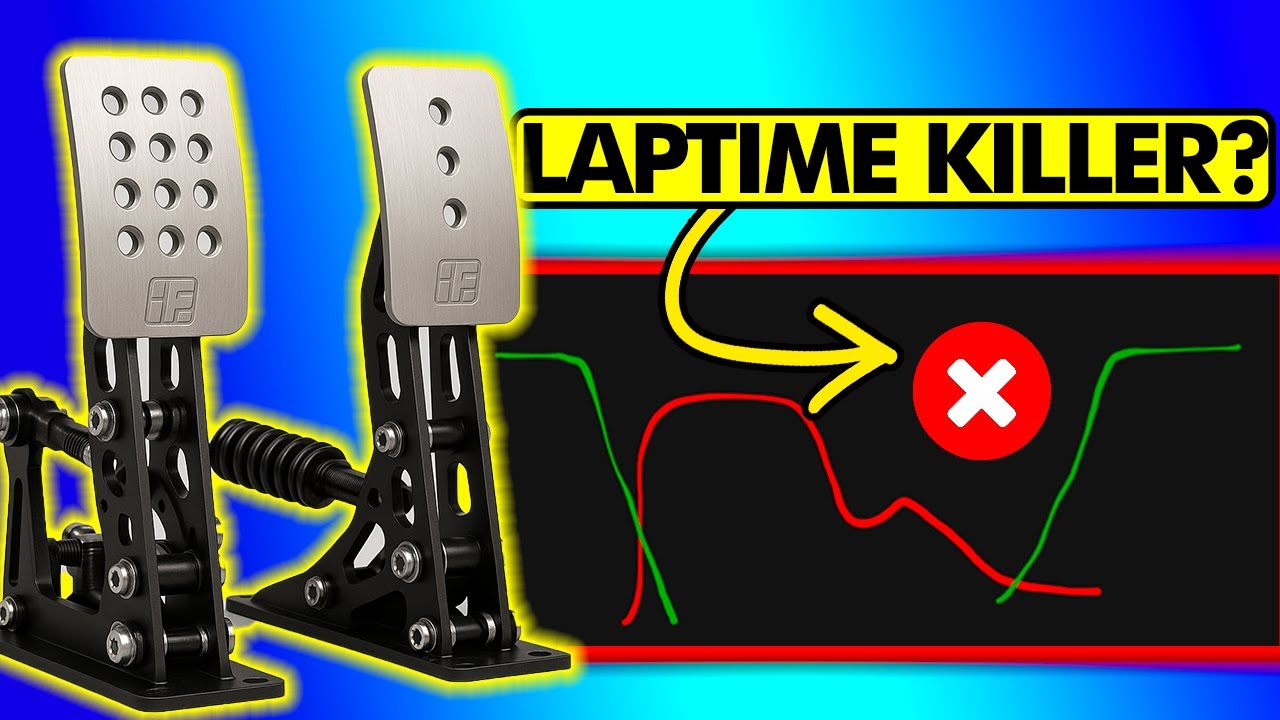
Cause 7: Your pedals aren't repeatable
You cannot deliver a consistent input through inconsistent hardware, and this one is invisible until you check it.
- Brake force set too high. If reaching 100% takes everything your leg has, you have almost no control down in the low percentages where the trail lives — so the release is effectively random. Set the force to something you can hold steady and modulate. The brake pedal settings guide covers the calibration and the curve.
- A pedal set that flexes or slides. If the rig moves when you brace, the same leg effort produces a different pressure depending on how hard you were braced — and you brace harder when you're pushing. Mounting matters more than most people think; there are more of these gotchas in 5 brake pedal tips.
- Foot position wandering. Heel planted, ball of the foot on the pedal, same place every time. A foot that creeps up the pedal face changes the leverage and therefore the pressure you get for the same effort.
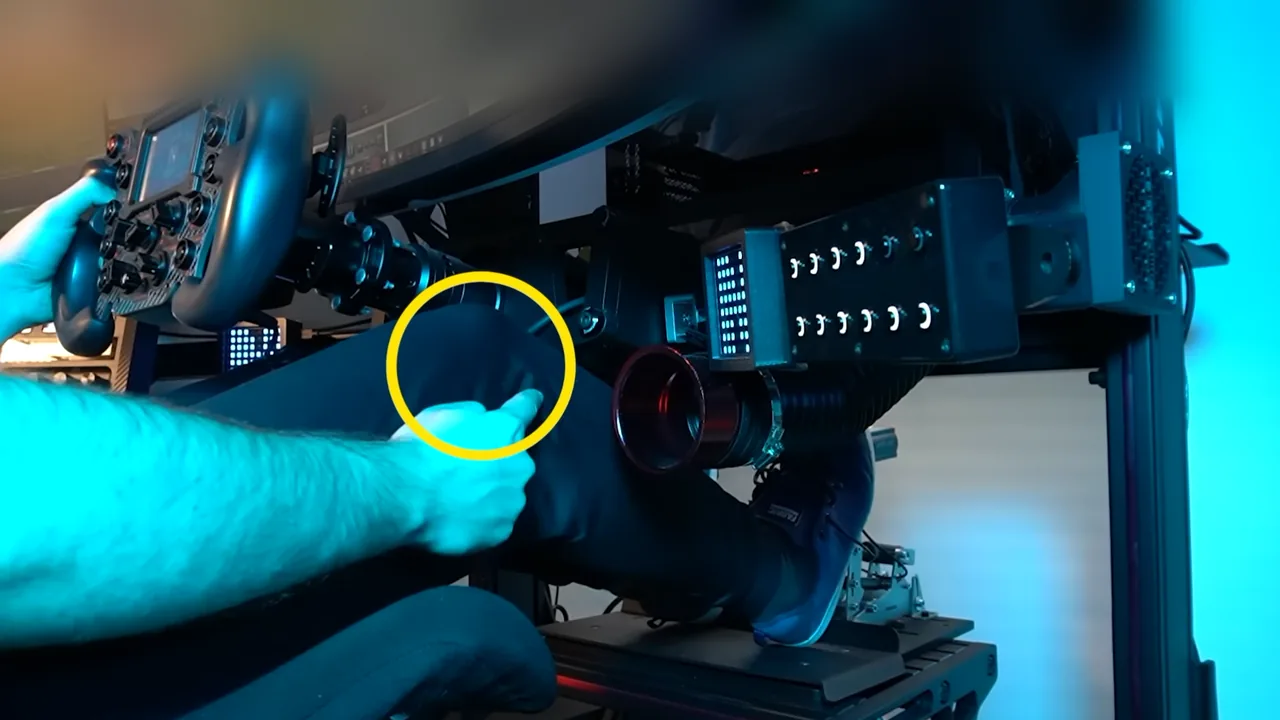
All three of those sit downstream of where you sit. A leg close to straight at full brake has no fine control left in it to be repeatable with, whatever the pedal is set to — check the knee angle before you conclude the hardware is the problem.
Cause 8: You can't feel the limit reliably
Consistency depends on the car telling you where the edge is. If the signal is broken, you're guessing — and guesses vary.
The usual culprit is force feedback that clips: the signal saturates right at the limit, so the wheel goes numb exactly where you needed the information most. Set the gain so the peaks stop just short of clipping and the difference is immediate — check yours with the FFB settings tool, and there's more on why lower is usually better in the best force feedback settings guide.
The other is field of view. If your FOV is far wider than geometry says it should be, speed and distance are compressed and your braking-point judgement gets noisier — you're guessing at distances the picture is actively misreporting. The FOV calculator fixes that in two minutes.
The check to run before you blame your technique
Two minutes, before any diagnosis session, so you know the stint you're about to judge is worth judging:
- Pedals calibrated, and the brake force where you left it.
- Force feedback not clipping.
- Wheel rotation and in-game steering lock matching what you learned on.
- Same seating position and same FOV as your last session.
- Tyres in their working window on the laps you're judging — a rushed out-lap produces a lap that tells you nothing.
- No traffic, and a consistent fuel load if you're comparing runs.
The uncomfortable one: you might not know the track yet
Here's the honest test. Sitting away from the rig, can you drive the lap in your head, corner by corner, naming the gear, the reference and the shape of each one? If you can't, you're not inconsistent — you're still learning the circuit, and the "inconsistency" is just the visible part of that.
There's nothing wrong with being at that stage — and it is a genuine stage, not a personal failing. The five stages of sim racing progression covers what it is and what ends it. It's only a problem if you misdiagnose it and start hunting for a technique fault that doesn't exist. The answer there is track learning done properly: slow laps building references, then blocked repetition on the corners you're least sure about. How to practice sim racing effectively lays out that session structure.
Almost nobody is inconsistent at everything. They're inconsistent at one corner, for one specific reason, and it colours their whole opinion of their driving. Find the corner and the reason, and the problem shrinks to something you can actually work on.
What to do with the answer
Run the variance hunt tonight. Name the corner, name the input that differs first on the overlay, and match it to a cause above. Then pick the one fix and drill it on its own — one cause per session, or you won't know which change did the work.
When you've got the cause, how to practice sim racing effectively turns it into a session plan that actually drills it, and how to be faster at sim racing covers the framework the whole thing hangs off. And if the laps actually repeat fine and are simply slower than the reference — same apex speed, worse corner — that is a different fault entirely: see the braking technique guide.
Consistency is a technique problem before it is a concentration problem. If you want the underlying skills rebuilt in order rather than patched one corner at a time, the sim racing courses are the structured version of exactly that. And if you have worked through the checklist and still cannot name the cause, get feedback on what is actually causing your inconsistency.
This guide is part of the free library at GitGud Racing Academy — an online sim racing academy built around weekly lap reviews, structured courses, drills and training tools.
Train this the right way
Reading is step one. Build it into muscle memory with structured, car-specific courses and personal lap reviews from a coach — inside the Academy.
Join the Academy · $39.99/mo incl. VAT