GITGUD ACADEMY
EN
Volume 1 · Start here

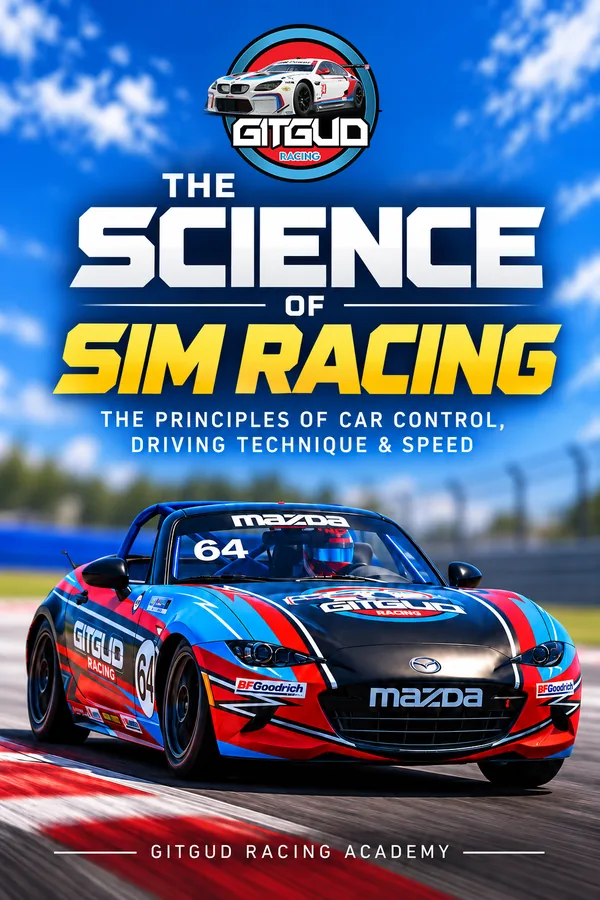
The Science of Sim Racing

The Principles of Car Control, Driving Technique & Speed

An illustrated driving technique ebook for sim racers and track drivers.

When your lap times stop improving, it helps to understand what the car is telling you. The Science of Sim Racing connects grip, weight transfer, braking, steering and throttle, so you can recognise mistakes, understand their causes and practise with a clear purpose.

  • 308 pages*
  • 29 chapters
  • 152 drawings
  • 8 languages

$4.99One-time purchase

Get Volume 1 · $4.99
Or get all 3 books for $9.99, save 33% →
  • English
  • Deutsch
  • Español
  • Italiano
  • Português (Brasil)
  • Русский
  • 繁體中文
  • 简体中文

* Page count of the English edition's print layout.

Who this book is for

Written for sim racers, with driving principles that also help you understand real-world circuit driving.

  • You are new to sim racing and want good habits from the first lap.
  • You have raced for a while and your lap times have stopped improving.
  • You drive several cars and want the principles that hold in all of them.
  • You want drills to run in practice, not just theory.
Inside the book

What you will learn

  1. Understand why braking in a straight line, then trailing the brake, decides how fast you can enter a corner.

  2. See with the traction circle why braking and turning hard at once pushes the car wide.

  3. Find the racing line and reference points that make every type of corner repeatable.

  1. Recognise understeer and oversteer early, and cause them on purpose to rotate the car.

  2. Use telemetry to connect what you feel in the car with what your inputs actually show.

  3. Recognise the habits that cost you tyres, race pace and positions.

How the book works

A structured way to learn

Work through the book in order to build your understanding, or go back to a chapter when a problem shows up in your driving. The explanations, illustrations and exercises stay together, instead of a practice plan pieced together from separate articles and videos.

  • Progression

    A connected progression through the subject, chapter by chapter.

  • Illustrations152

    illustrations beside the explanations.

  • Exercises

    A practice exercise at the end of every chapter, to come back to.

  • Languages

    Every language edition in one purchase, to read in the one you prefer.

Inside the book

Pages from this edition of the book. Every purchase includes every language edition.

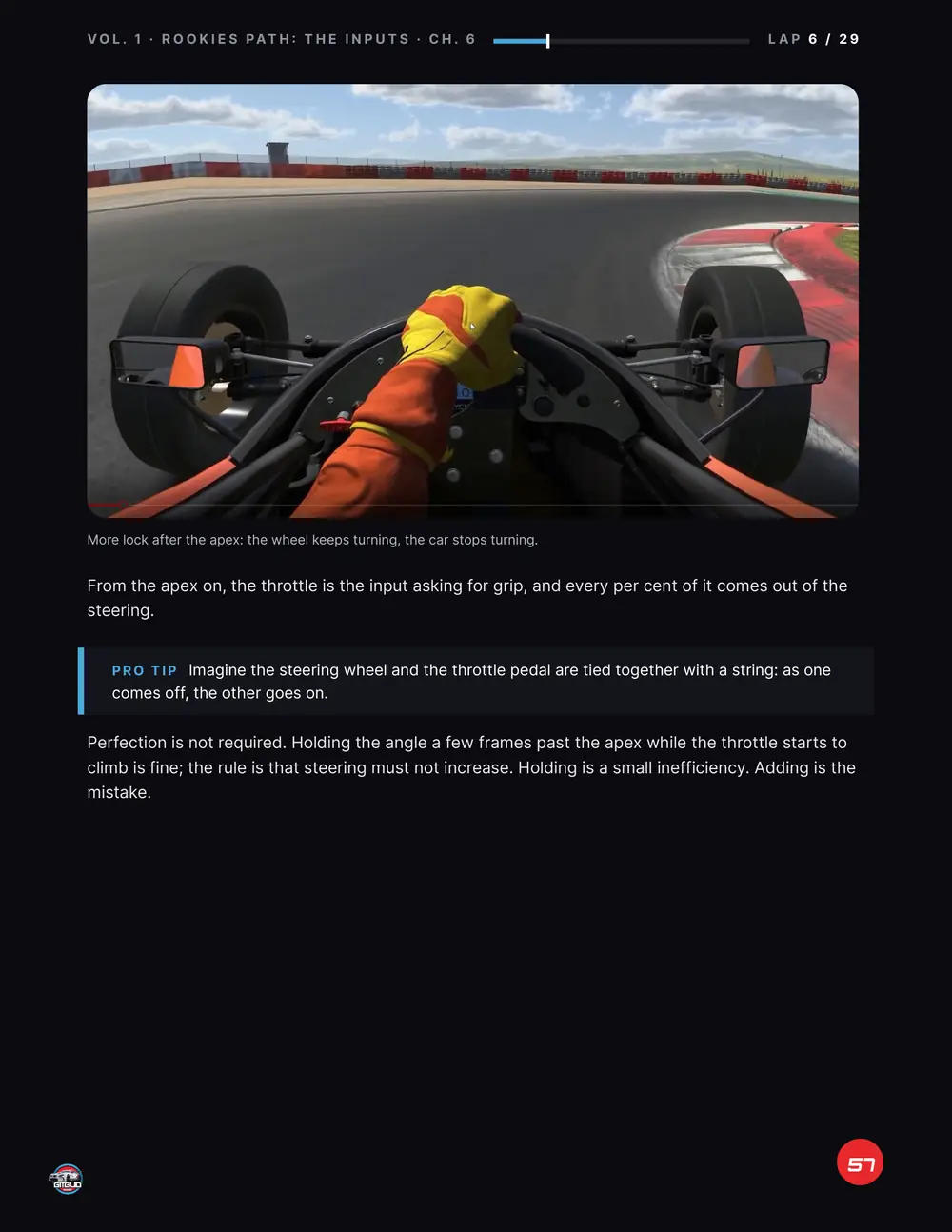
  1. Never after the apex: The Science of Sim Racing, page 57

    Chapter 6 · Page 57 · Never after the apex

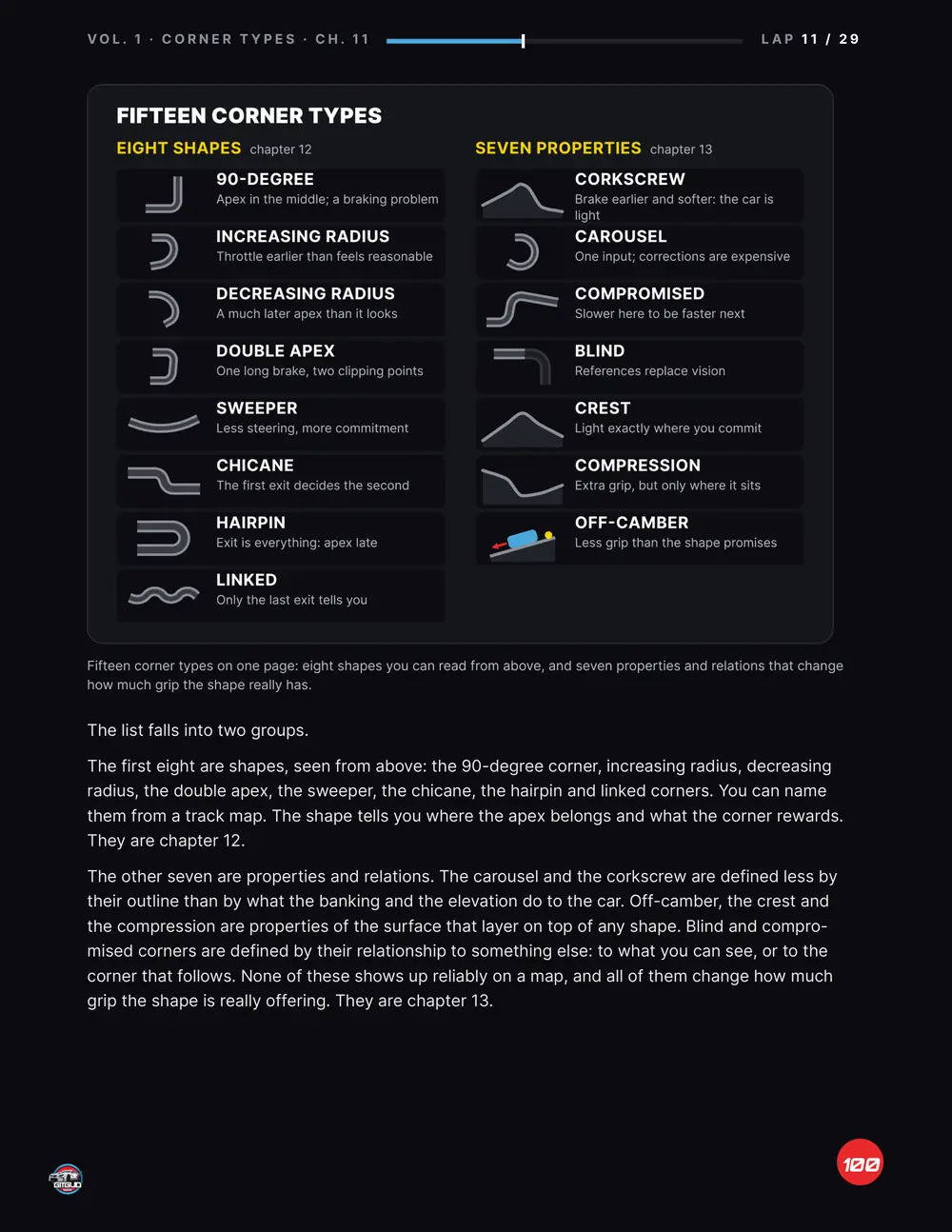
  2. At a glance: The Science of Sim Racing, page 100

    Chapter 11 · Page 100 · At a glance

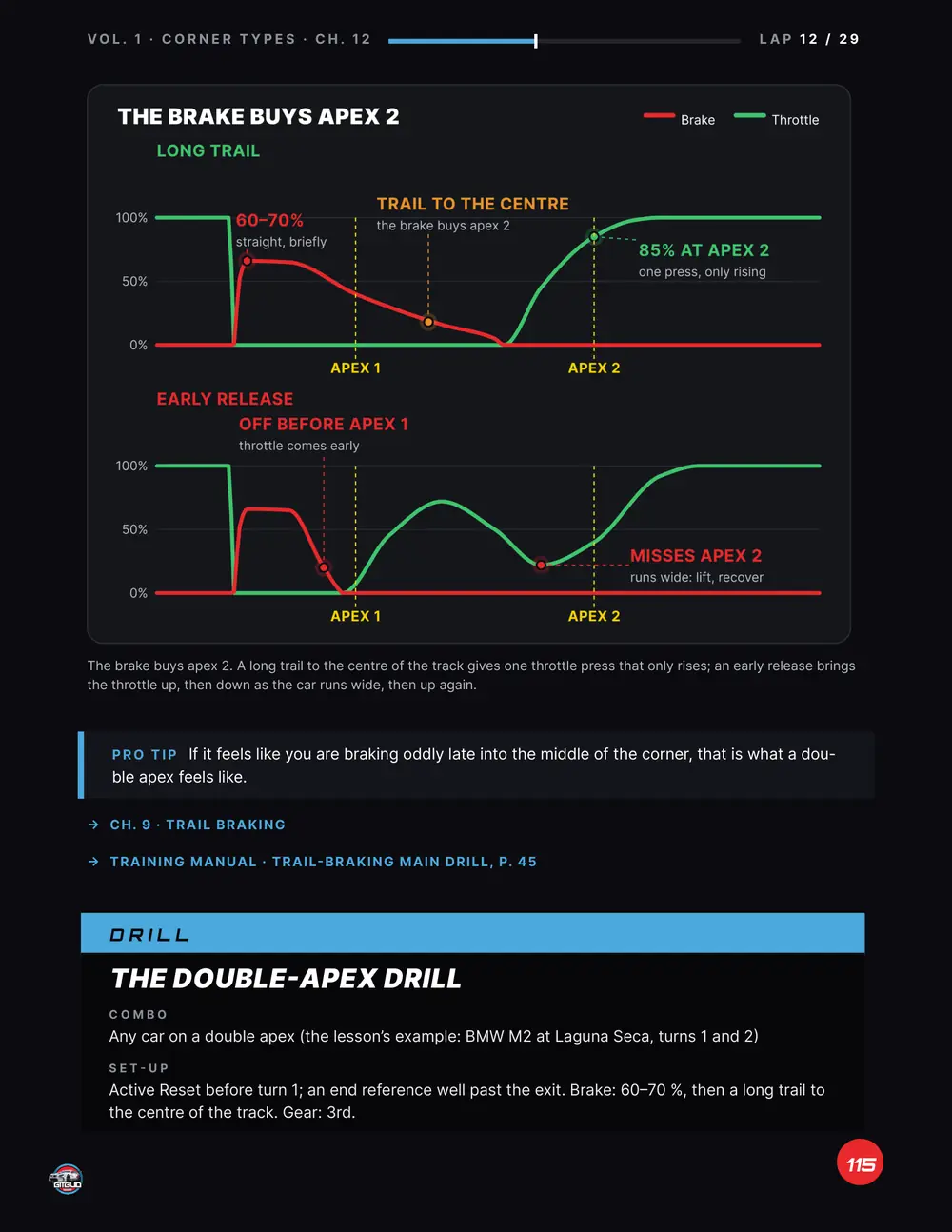
  3. The double apex: The Science of Sim Racing, page 115

    Chapter 12 · Page 115 · The double apex

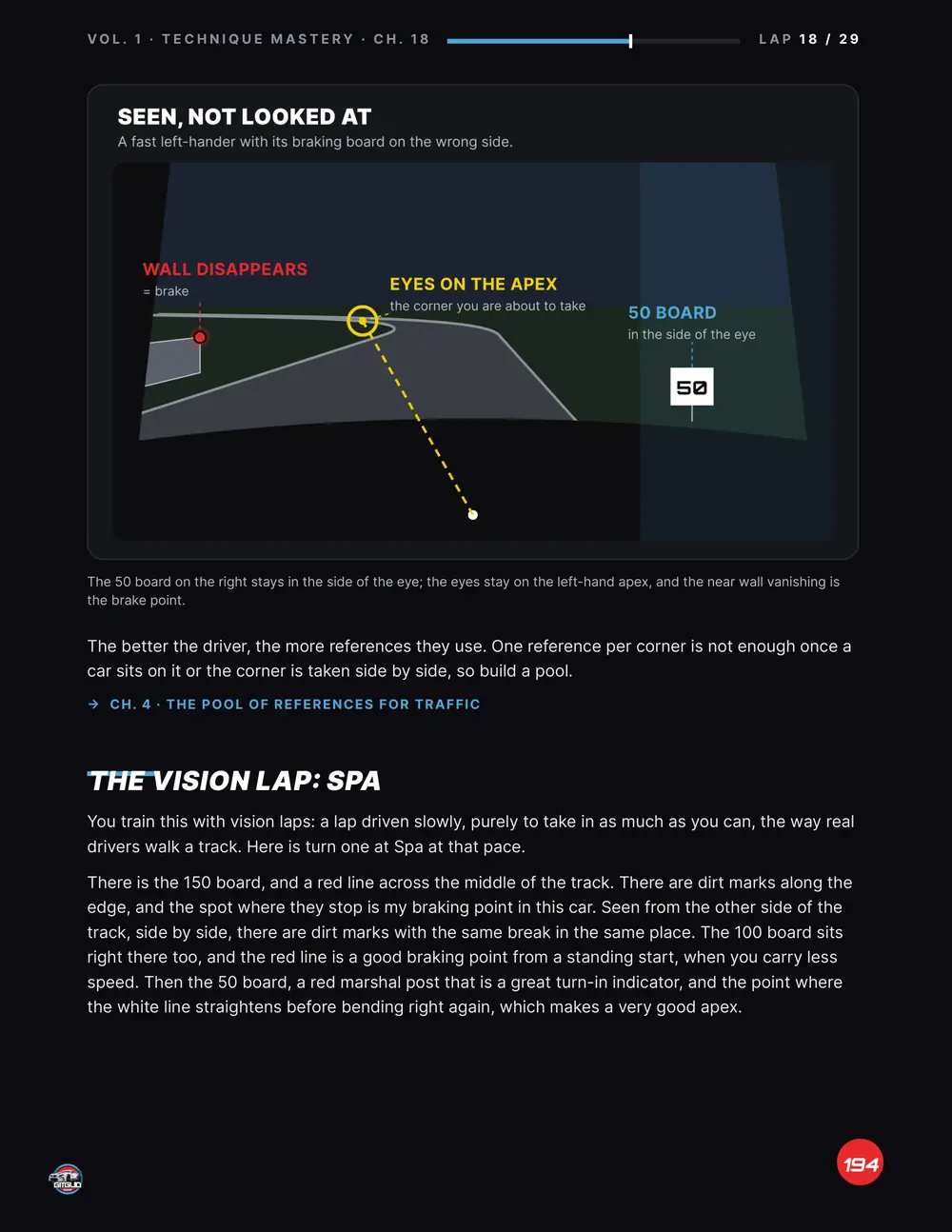
  4. References you do not look at: The Science of Sim Racing, page 194

    Chapter 18 · Page 194 · References you do not look at

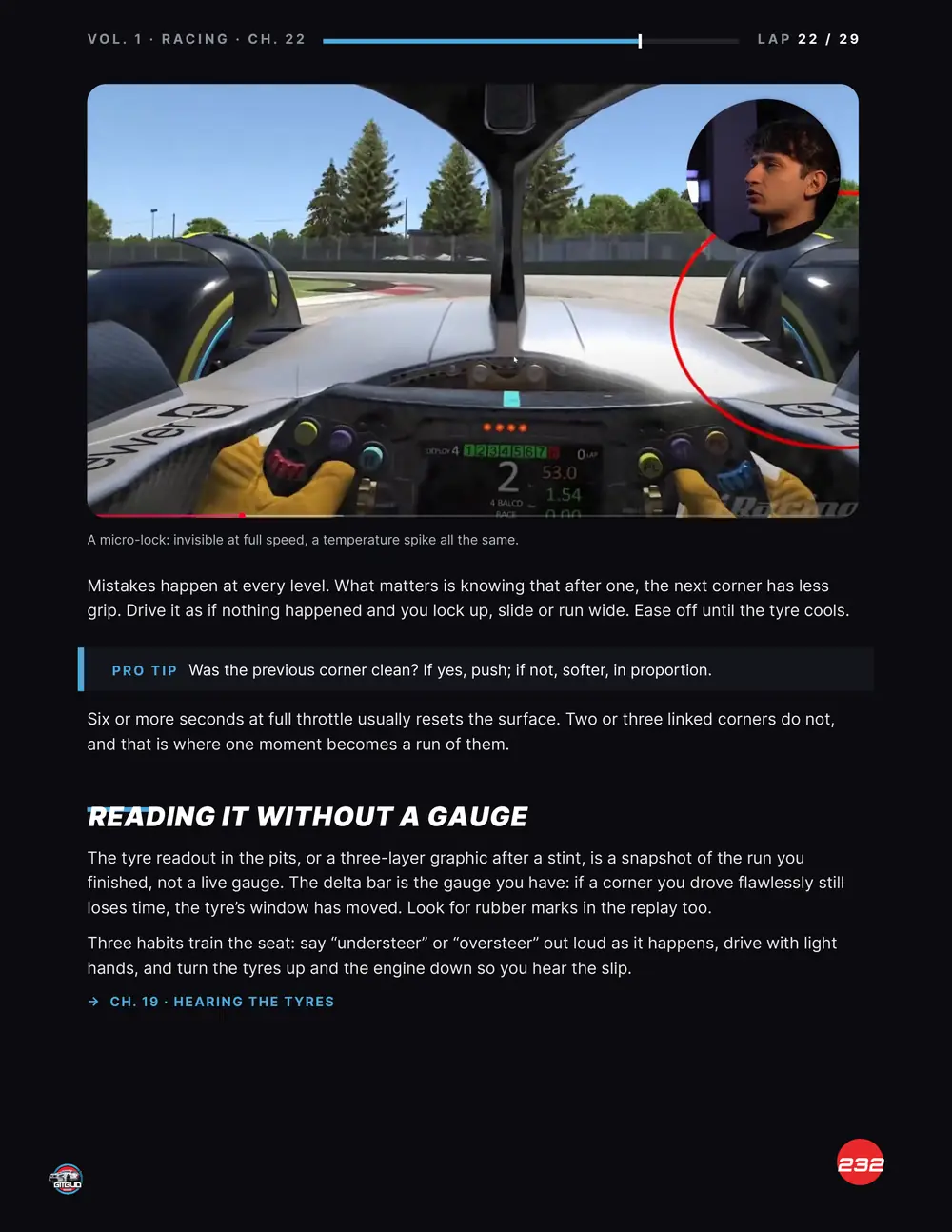
  5. Simplify the inputs: The Science of Sim Racing, page 232

    Chapter 22 · Page 232 · Simplify the inputs

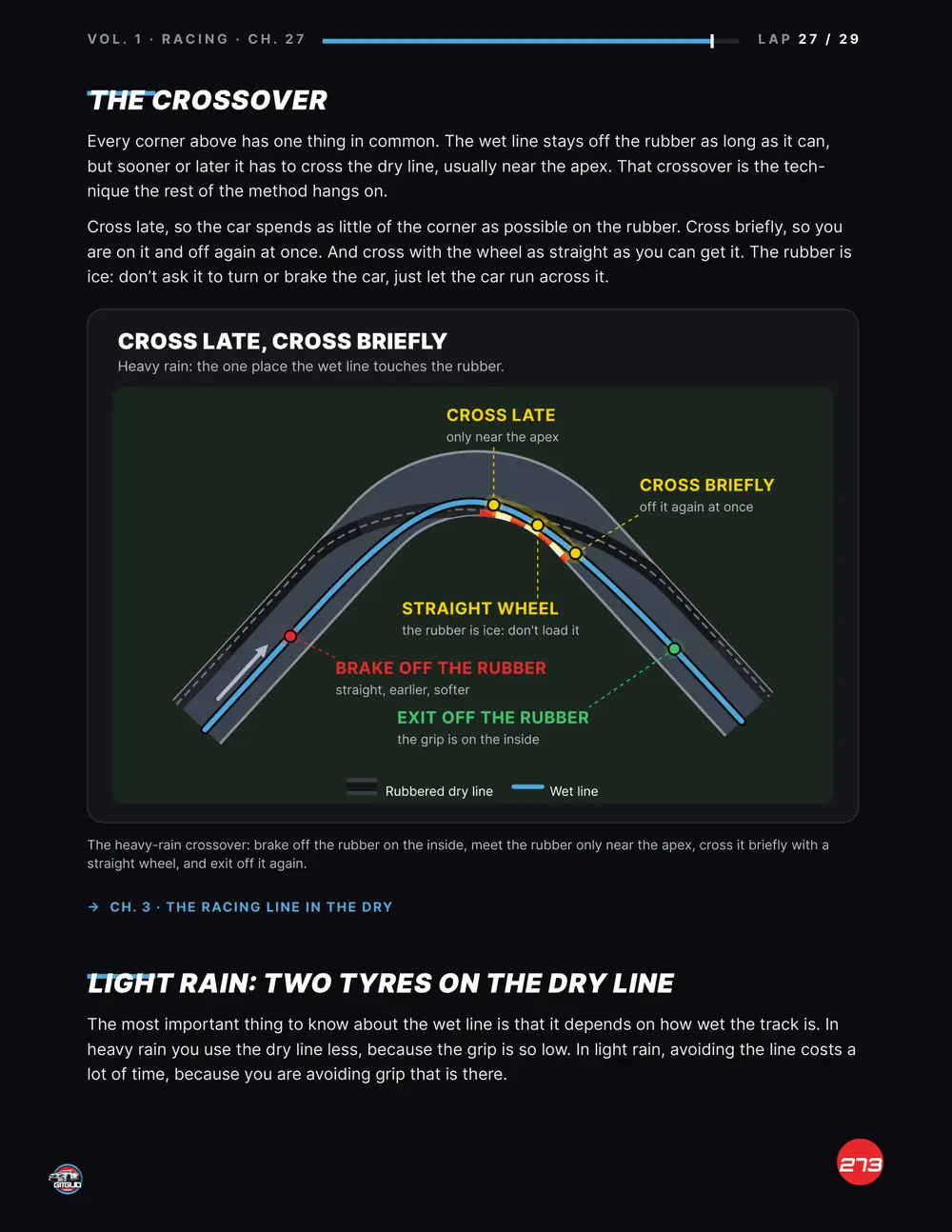
  6. The crossover: The Science of Sim Racing, page 273

    Chapter 27 · Page 273 · The crossover

Read a sample

The traction circle is the idea behind driving at the limit: how much grip is left for turning while you brake or accelerate. The passage below is quoted from the book as printed.

Chapter 8 · Braking in a straight line, and the traction circle

The circle: a budget of grip

To understand what driving at the limit is, you need the traction circle. A car experiences two kinds of force: longitudinal, when you brake or accelerate, and lateral, when you turn. Most of the time it is a mix of the two, and the result of the mix is one point on a circle.

Standing still, the point sits in the middle. Accelerate at 50 % and it moves towards the accelerate edge but stays inside, under the limit. Brake harder and harder and it reaches the brake edge, the limit; past it, the tyres lock. One detail looks odd on paper but is obvious from the seat: in a right-hander the load shifts left, so the lateral axis is drawn as the car feels it.

Now combine. Brake hard and turn a lot, and the point lands outside the circle: past the limit, time lost. Accelerate while barely turning, and it sits well inside: grip left unused. Blend the two so the point rides the edge, and you are at the limit. You cannot brake and turn very hard at once, and you cannot turn and accelerate very hard at once. You have a budget of grip; spend it wisely.
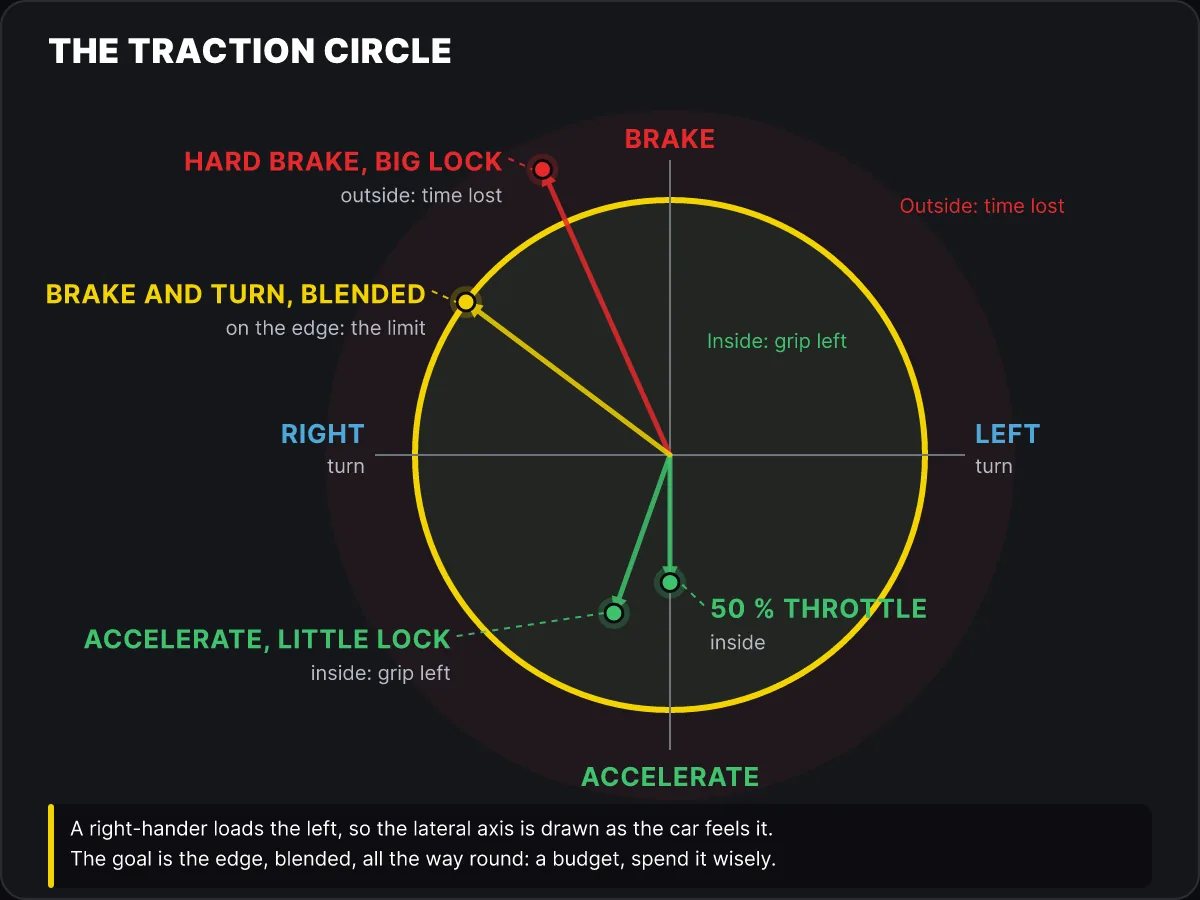
Inside the circle is grip left; outside is time lost. Blended brake and turn sits on the edge, where you want to be all the way round.

The trade is curved, not straight. Release the first quarter of your brake pressure and you free most of the lateral grip; release the last quarter and you free very little. The top of the brake pedal is cheap to give away and buys a lot of steering. Think of a balloon: squeeze too hard in one direction and the grip escapes somewhere else.

Three limits announce themselves loudly: a locked wheel, a car pushing wide, wheelspin. The fourth, asking for two things at once, is silent. Nothing squeals; the car just does not go where you pointed it. Most of a lap lives there.
Contents

I Before you drive

  1. 1 Where you are, and how to use this book
  2. 2 Set the rig so it tells the truth

II Rookies path: the inputs

  1. 3 The racing line
  2. 4 Reference points
  3. 5 Understeer, oversteer and the grip limit
  4. 6 Steering
  5. 7 Throttle
  6. 8 Braking in a straight line, and the traction circle
  7. 9 Trail braking
  8. 10 Reading telemetry

III Corner types

  1. 11 Corner types at a glance
  2. 12 The eight classic corners
  3. 13 The seven special corners

IV Technique mastery

  1. 14 The worst technique pitfalls
  2. 15 Learning a new track in five steps
  3. 16 Car balance: inducing understeer and oversteer on purpose
  4. 17 Brake bias in depth
  5. 18 Vision
  6. 19 Hearing and feeling
  7. 20 Throttle control and corner exits
  8. 21 Low, medium and high-speed corners

V Racing

  1. 22 Tyre management
  2. 23 Race pace management
  3. 24 Qualifying
  4. 25 Racecraft mistakes and fixes
  5. 26 Why you spin, and how to catch it
  6. 27 Driving in the wet

VI Practice and progress

  1. 28 How to practise
  2. 29 The rating and the mind

Try an exercise

A simulator practice exercise. A reset point (Active Reset in iRacing, or your simulator's equivalent) puts you back before the corner, and the input overlay shows your pedal and steering traces. Percentages are pedal travel as the overlay shows it. “Then 0 to 100” means the throttle, from closed to fully open. Watch the exit: one throttle application with no steering corrections.

Simulator practice exercise · Chapter 9 · Trail braking

Steering-freeze, then brake–hold–go

Car and track
Any car; one long medium-speed corner, not a chicane (the lesson's example: MX-5 at Oulton Park, Turn 1)
Setup
Parked first, with the overlay up: press hard, hold two seconds, taper, then hold 1–3 % as an active press until the shape is automatic. Then set an Active Reset before the corner.
  1. Drive one run with zero trail: release fully before turn-in and note the lock the corner needs.
  2. Brake and steer once to point the car, freeze the angle, and drag the brake; if you drop it you run wide, which is the proof.
  3. Brake to the apex, hold to the apex, then go to the throttle once.
  4. If it feels wrong, brake earlier and softer and hold longer, then 0 to 100.
  5. Add the layers back one at a time (downshifts, then steering, then throttle), keeping your attention on the release.
Goal
Full throttle with zero corrections and all the track on exit, three runs in a row.
Tip
Every per cent you release, fight for it: there is rotation in each one.

On a real circuit

What carries over

  • The racing line, reference points and every type of corner.
  • Braking, trail braking, the traction circle and weight transfer.
  • Car balance, throttle control, tyre management and racecraft.

Simulator-specific tools and exercises

  • Setting up your rig, wheel and force feedback (chapter 2).
  • The online rating and the pressure it brings (chapter 29).
  • Drills built on Active Reset, replays and the input overlay.

What a real car changes

  • In a real car you feel the forces and carry the risk: build up to the limit gradually.
  • There is no reset: a drill becomes laps in a track session, checked with a data logger.
  • Real brakes and tyres heat up and wear in ways a simulator may not reproduce.

Written by sim racing coaches. On a real circuit, learn with a qualified instructor.

The author

Marian Barbieru
Author · all three books

Marian Barbieru

GITGUD Racing coach. Top 1% in iRacing in formula and sports cars, with more than 1,500 drivers coached 1-on-1.

Questions about this book

Is The Science of Sim Racing for beginners?

Yes. It starts with setting up your rig and the racing line, then builds through braking, steering and throttle to racecraft. Experienced drivers use the later parts on technique, tyres and race pace.

Which simulators and cars does it apply to?

The principles hold in every car and every simulator, including iRacing, Assetto Corsa Competizione, Le Mans Ultimate and Automobilista 2. The examples use road cars, GT cars and Formula cars.

How long is it?

308 pages in the English edition, 29 chapters and 152 drawings. Every chapter ends with a drill you can run in practice.

Should I read it before the GT3 or Formula book?

It is the place to start. The GT3 and Formula books apply the same principles to their cars and point back to its chapters.

The series

  1. Volume 1 · Start here

    The Science of Sim Racing

    The principles that hold in every car.

    308 pages · $4.99

    You are here

  2. Volume 2 · GT3

    The Science of GT3 Racing

    Heavy cars with ABS and traction control.

    156 pages · $4.99

    Read more about this book →
  3. Volume 3 · Formula

    The Science of Formula Racing

    Light cars and downforce, where precision decides the lap.

    193 pages · $4.99

    Read more about this book →

The complete series

All three books, one price

$9.99 Full price $14.97 Save 33%

Get All 3 Books for $9.99 PDF · all 8 languages included

See all the books →