Chapter 6 · Steering: zero steering at the peak, and the kick
The kick
The second phase happens at the apex. All the way in, the angle builds linearly. Then, as you reach the apex, you stop building linearly and ask for an abrupt extra step of steering, 5–10°. It is almost as if you throw the car at the apex.
Two things can happen. The car rotates, which is what you wanted. Or it understeers, which tells you that you have found the limit of the fronts. Either answer is useful.
The timing is the whole technique. At the apex you are trailing the brake in very low percentages, and you are not yet on the throttle. That is the one moment in the corner when the grip budget has room for more steering. Add the same step early, during the turn-in and far from the apex, and it simply does nothing.
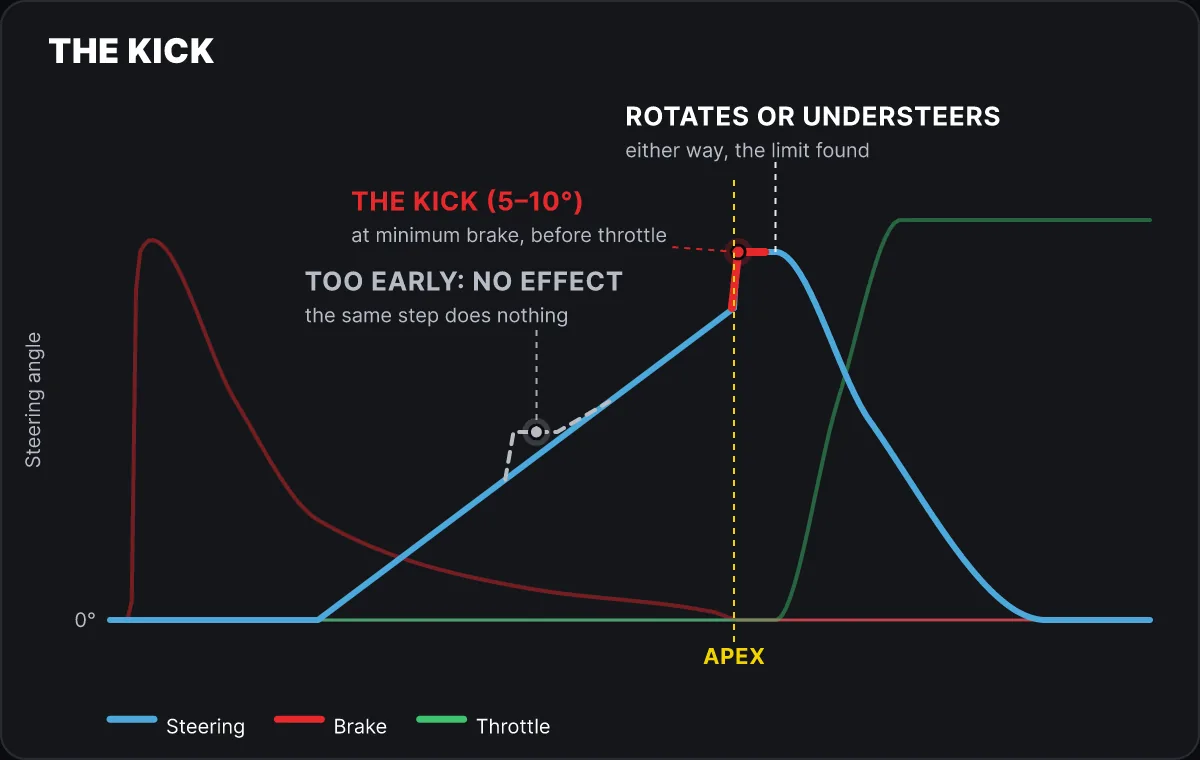
On the wheel, the kick is small. Picture your hands at the angle they reached on the way in, then moving one notch further. Do not snap it, or the tyres will slide instantly; make it progressive, but make sure it happens. If you never test whether the car will steer more, you may be under the limit with the fronts and never know.
Then read the answer. If the kick turns the car more than you needed, so that it dives towards the inside, you were under the limit: next time push more speed into the corner and brake a little later. On my own attempts the car turned far more than needed, so I braked later; it still turned too much, so I pushed more speed; and then one attempt was a bit too much. That is how you find the limit of the fronts in the middle of the corner. If the kick washes the car wide, back off a little.
You fish for grip at the apex.
Treat the kick as a probe, not a number. How many degrees make a step depends on the car's steering ratio and on the corner. It belongs in the slow and medium corners you brake for: a fast corner taken on a lift has no brake-to-throttle gap at the apex to use it in.