GITGUD ACADEMY
EN
Volume 2 · GT3

The Science of GT3 Racing

Understanding GT3 Car Dynamics, Driving Techniques & Racecraft

An illustrated GT3 racing technique ebook.

Understand why your GT3 pushes wide, struggles to rotate or loses pace over a stint. The Science of GT3 Racing connects braking, ABS, traction control, racing lines and tyre management in one illustrated book, with practical exercises to take into your next practice session.

  • 156 pages*
  • 15 chapters
  • 83 drawings
  • 8 languages

$4.99One-time purchase

Get Volume 2 · $4.99
Or get all 3 books for $9.99, save 33% →
  • English
  • Deutsch
  • Español
  • Italiano
  • Português (Brasil)
  • Русский
  • 繁體中文
  • 简体中文

* Page count of the English edition's print layout.

Who this book is for

Written for GT3 sim racers, with explanations of vehicle dynamics and driving technique that also help you understand real-world GT3 racing.

  • You race GT3 in iRacing, Assetto Corsa Competizione, Le Mans Ultimate or another simulator.
  • You are not sure when to rely on ABS and traction control, and when not to.
  • You lose time in slow corners or struggle to rotate a heavy car.
  • Your tyres fade before the end of a stint.
Inside the book

What you will learn

  1. Choose a GT3 whose handling suits your driving and the track.

  2. Understand when ABS and traction control help, and when your inputs ask too much of them.

  3. Understand why slow, medium and fast corners each need a different way of braking.

  1. Rotate a heavy car with trail braking, downshifts and brake bias.

  2. See where the limit is, and drive the line a GT3 wants.

  3. Recognise the habits that use up your tyres and compromise later laps.

How the book works

A structured way to learn

Work through the book in order to build your understanding, or go back to a chapter when a problem shows up in your driving. The explanations, illustrations and exercises stay together, instead of a practice plan pieced together from separate articles and videos.

  • Progression

    A connected progression through the subject, chapter by chapter.

  • Illustrations83

    illustrations beside the explanations.

  • Exercises

    A practice exercise at the end of every chapter, to come back to.

  • Languages

    Every language edition in one purchase, to read in the one you prefer.

Inside the book

Pages from this edition of the book. Every purchase includes every language edition.

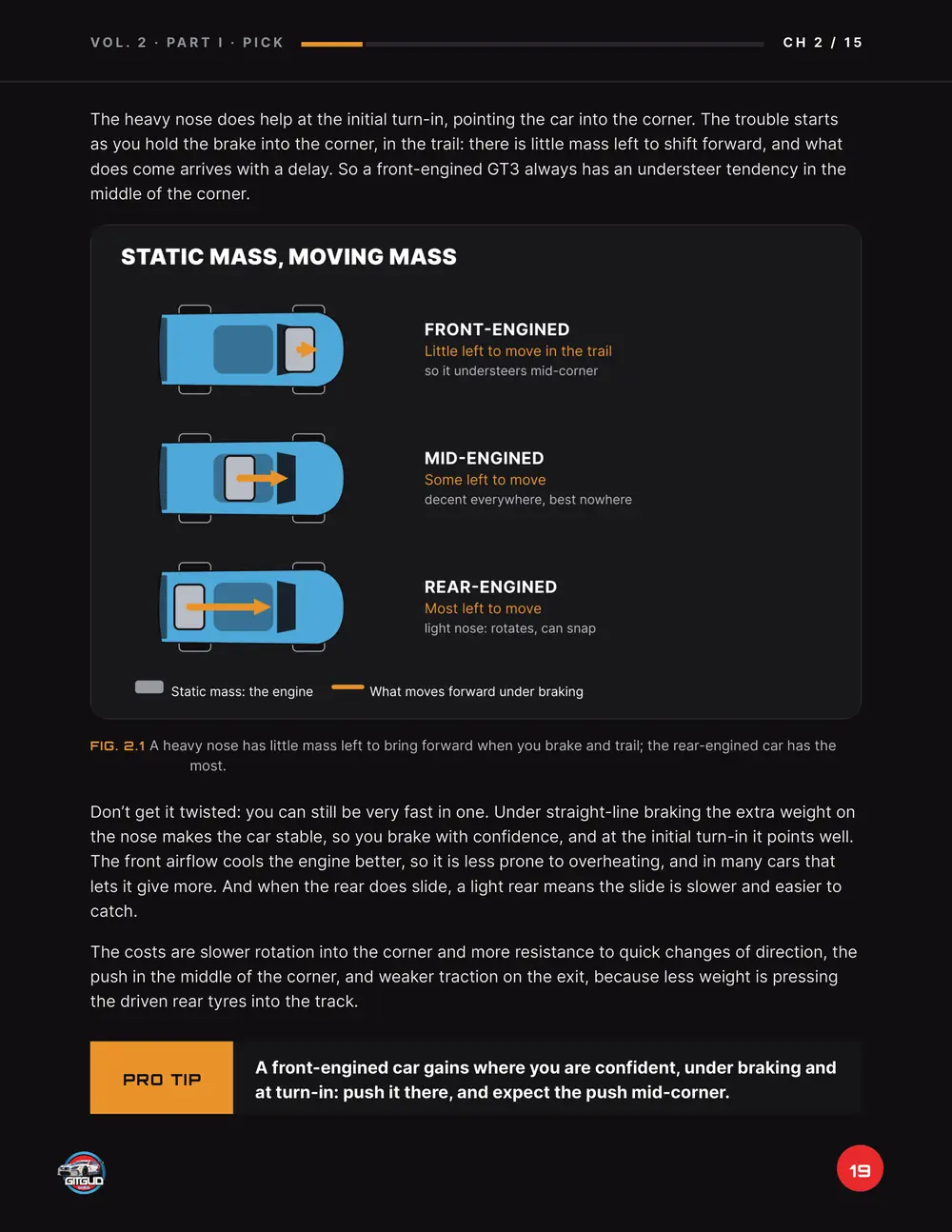
  1. Front-engined: stable, and the reason it understeers: The Science of GT3 Racing, page 19

    Chapter 2 · Page 19 · Front-engined: stable, and the reason it understeers

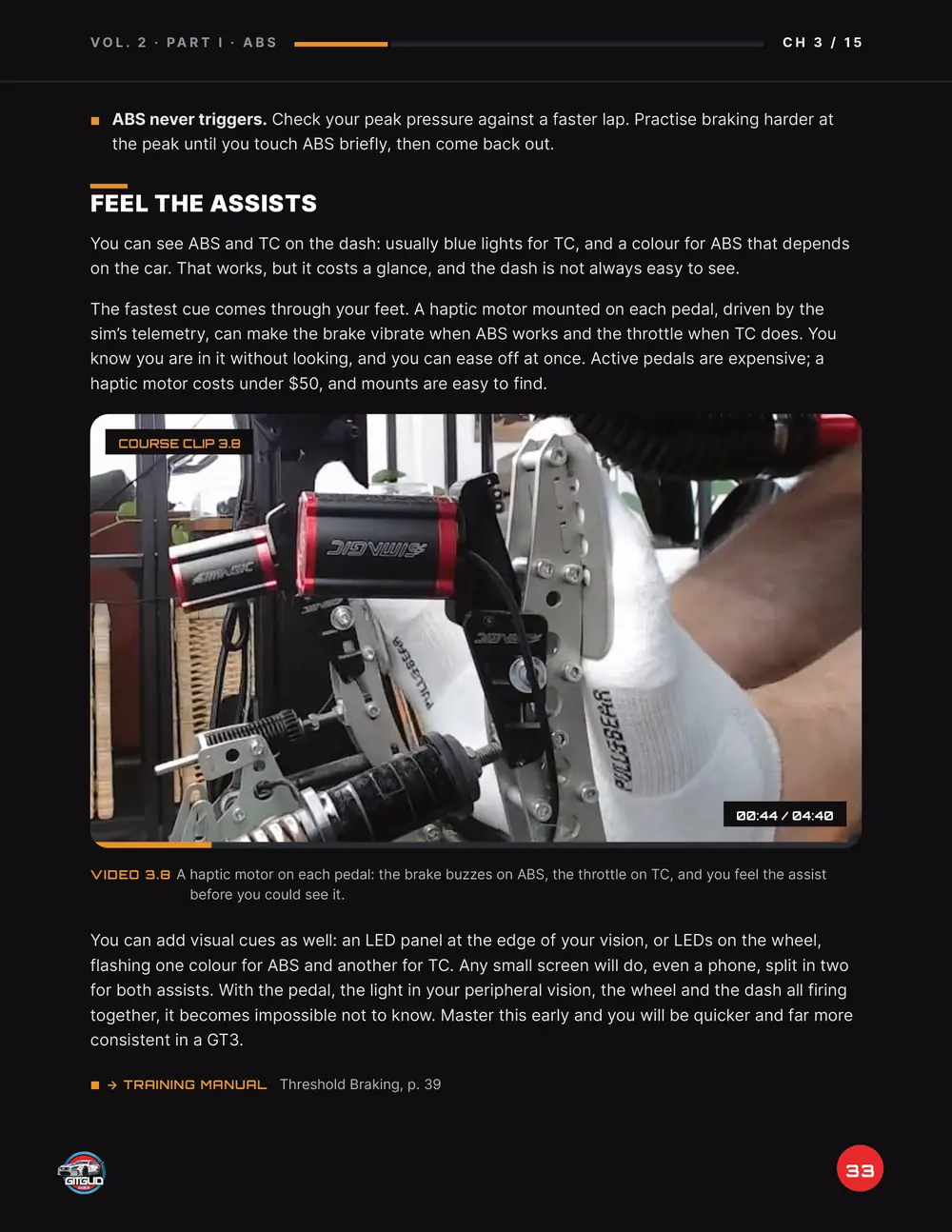
  2. What you see, and what to check: The Science of GT3 Racing, page 33

    Chapter 3 · Page 33 · What you see, and what to check

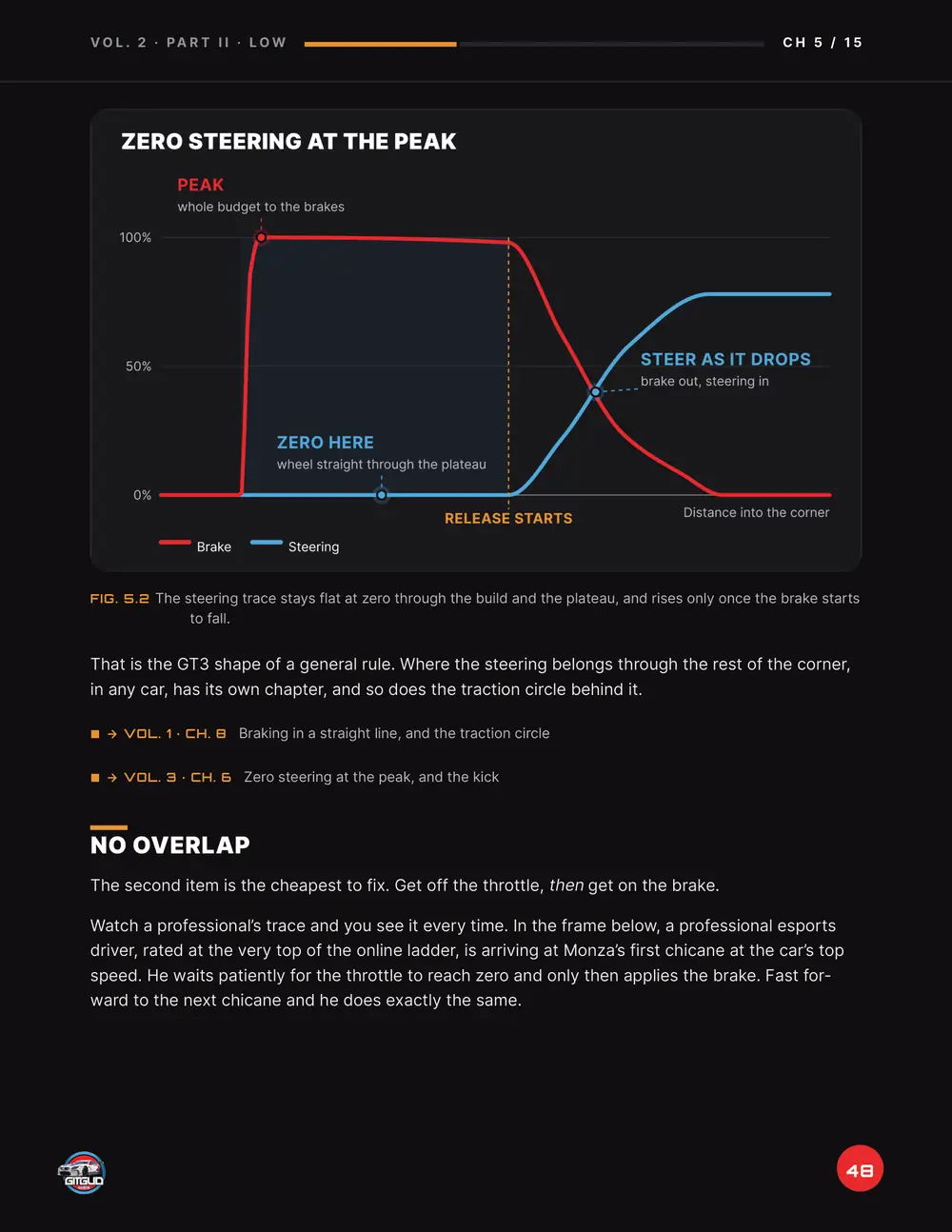
  3. The whole budget to the brakes: The Science of GT3 Racing, page 48

    Chapter 5 · Page 48 · The whole budget to the brakes

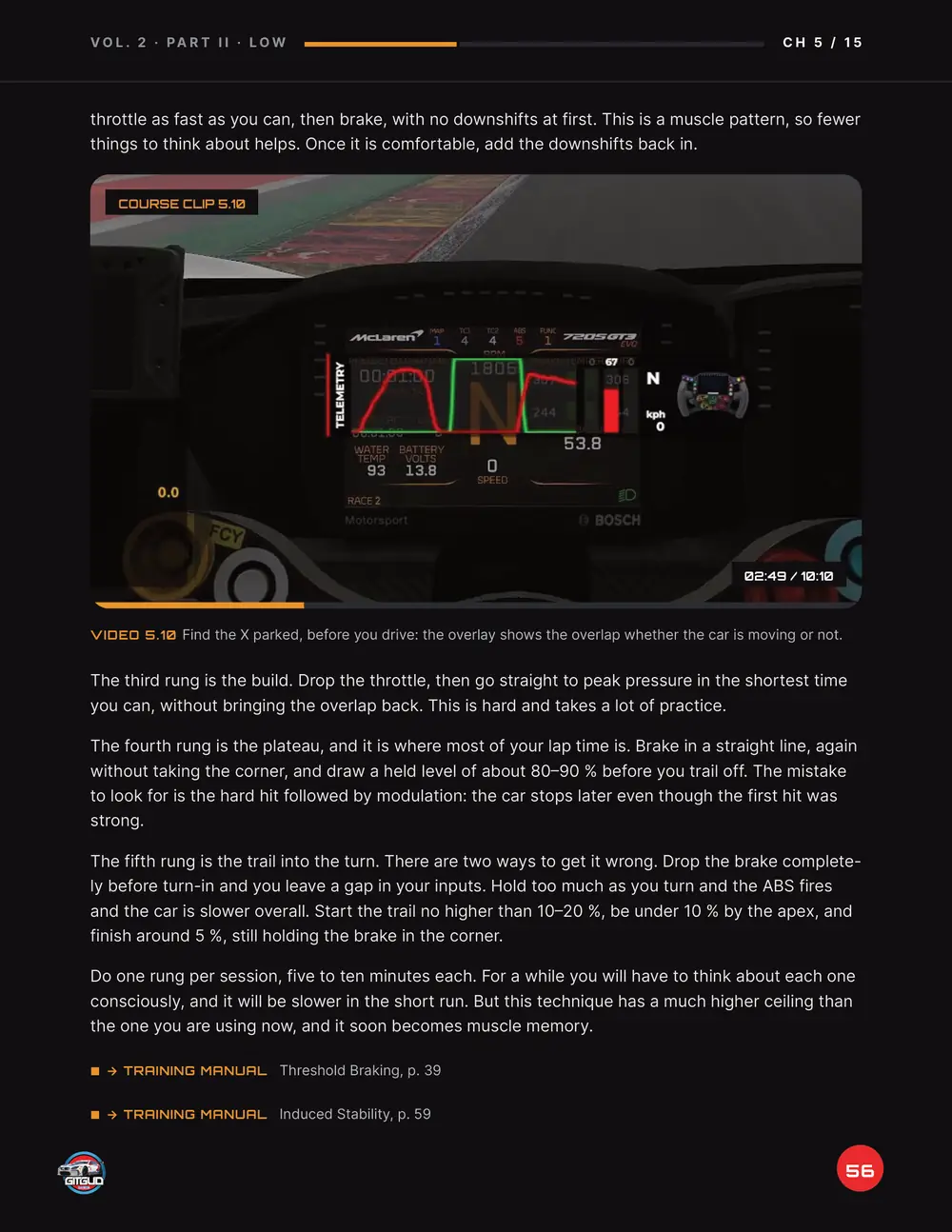
  4. The Spa ladder: The Science of GT3 Racing, page 56

    Chapter 5 · Page 56 · The Spa ladder

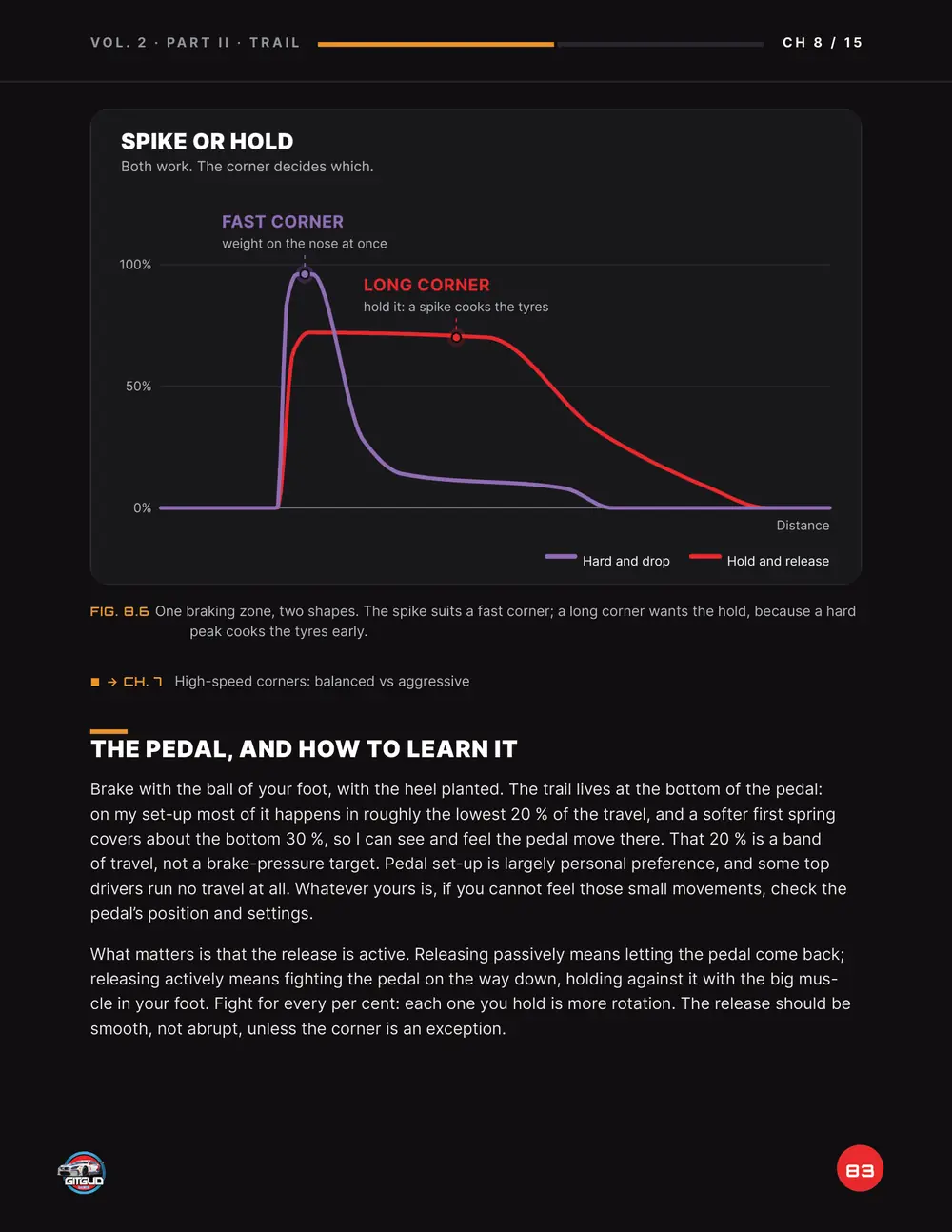
  5. Hard and drop, or hold and release: The Science of GT3 Racing, page 83

    Chapter 8 · Page 83 · Hard and drop, or hold and release

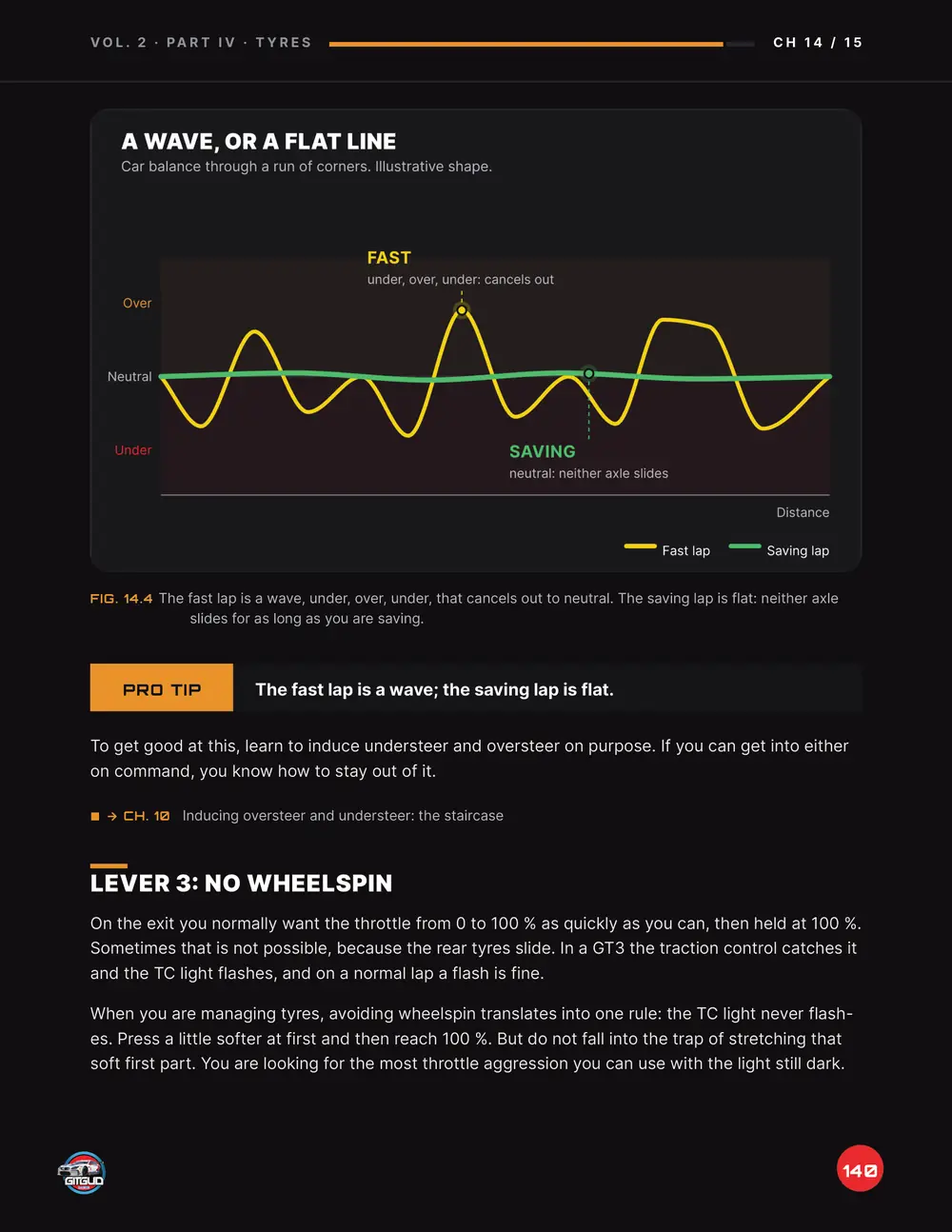
  6. Lever 2: the wave and the flat line: The Science of GT3 Racing, page 140

    Chapter 14 · Page 140 · Lever 2: the wave and the flat line

Read a sample

Chapter 5 sets out five things to get right when braking hard into a slow corner: zero steering at the peak, no overlap between throttle and brake, a quick application, a held plateau of pressure and a small trail at the end. This passage covers the third. The passage below is quoted from the book as printed.

Chapter 5 · Low-speed corners

A squeeze, not a stab

The third item is application speed. Picture two drivers braking at exactly the same point. One reaches peak pressure quickly; the other gets there a little later. The second driver cannot stop the car in the same distance, so he does one of two things. He sits deeper in ABS, pushing the tyres harder to make up the distance, or he brakes earlier to compensate and loses time.
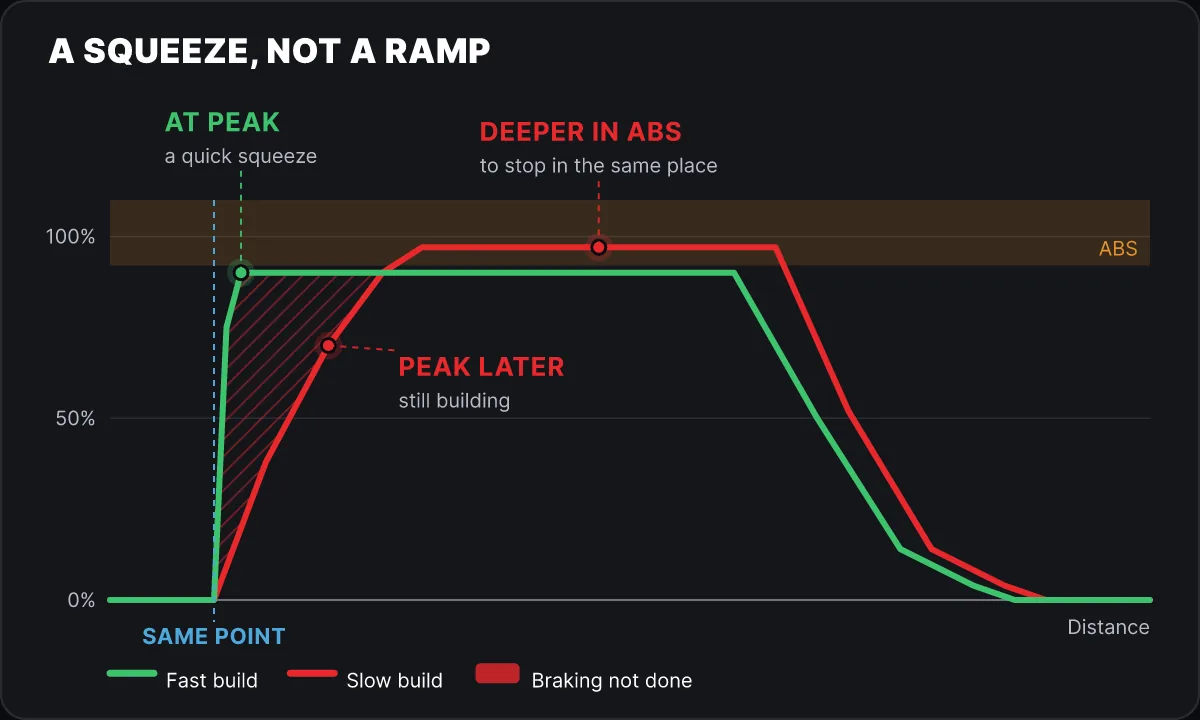
Same brake point, two builds. The slow one is still rising when the fast one is at its peak, so it has to sit deeper in ABS, or brake earlier, to stop in the same place.

So you want a quick, steady application. Quick does not mean stabbing the pedal: it should feel like a squeeze. By default most of us are not that fast on the brakes, and it is not about age or reflexes. If it is not on your radar, you will not improve it. Practise it and the build gets faster, the braking distance shrinks, and the mistakes that come from a lazy first hit of the pedal go away.
Contents

I Understanding GT3 cars

  1. 1 What makes a GT3 different
  2. 2 Which GT3 should you drive
  3. 3 ABS: when to lean on it and when not to
  4. 4 Traction control

II Braking a GT3, by corner speed

  1. 5 Low-speed corners
  2. 6 Medium-speed corners: fast-rotation braking
  3. 7 High-speed corners: balanced vs aggressive
  4. 8 Trail braking in a GT3

III Rotation and the line

  1. 9 Tools for rotation: downshifts and brake bias
  2. 10 Inducing oversteer and understeer: the staircase
  3. 11 Steering: the last big push
  4. 12 The GT3 racing line

IV The limit and the tyres

  1. 13 Seeing and driving the limit
  2. 14 Keeping the tyres alive
  3. 15 Bad habits to break
  4. Box GT3 in the wet

Try an exercise

A simulator practice exercise. A reset point (Active Reset in iRacing, or your simulator's equivalent) puts you back before the corner, and the input overlay shows your pedal and steering traces. Percentages are pedal travel as the overlay shows it. The “X” is where the throttle and brake lines cross on the input overlay because both pedals are pressed at once; the ladder removes it. Watch the brake trace take the shape of a rectangle with a tail.

Simulator practice exercise · Chapter 5 · Low-speed corners

The Spa ladder

Car and track
Any GT3 at a slow corner you can reset to (the lesson's example: Spa's Bus Stop; Monza Turn 1 or the Hockenheim hairpin also work)
Setup
Active Reset before the braking zone; input overlay on. One rung per session, 5–10 minutes each.
  1. Stop in a straight line only, without taking the corner: wheel at zero degrees at the peak.
  2. Throttle to zero, then brake, with no downshifts; once it is clean, add the downshifts.
  3. Reach the peak faster, with no X coming back.
  4. Hold a plateau of 80–90 % until the turn-in.
  5. Trail into the corner from no more than 10–20 %, under 10 % by the apex, about 5 % at the end.
Goal
A trace that is a rectangle with a tail: steering at zero at the peak, no X, ABS only at the top, and the car turning in without a gap.
Tip
It will be slower in the short run; this technique has a much higher ceiling.

On a real circuit

What carries over

  • How ABS and traction control change the way you brake and accelerate.
  • Braking by corner speed, trail braking, and rotation with downshifts and brake bias.
  • The GT racing line, the limit, and keeping the tyres alive over a stint.

Simulator-specific tools and exercises

  • Choosing which GT3 to drive in the simulator (chapter 2).
  • Drills built on Active Reset, replays and the input overlay.

What a real car changes

  • How much ABS and traction control intervene, and how they are set, differs from car to car.
  • Real brakes and tyres heat up and wear in ways a simulator may not reproduce.

Written by sim racing coaches. On a real circuit, learn with a qualified instructor.

The author

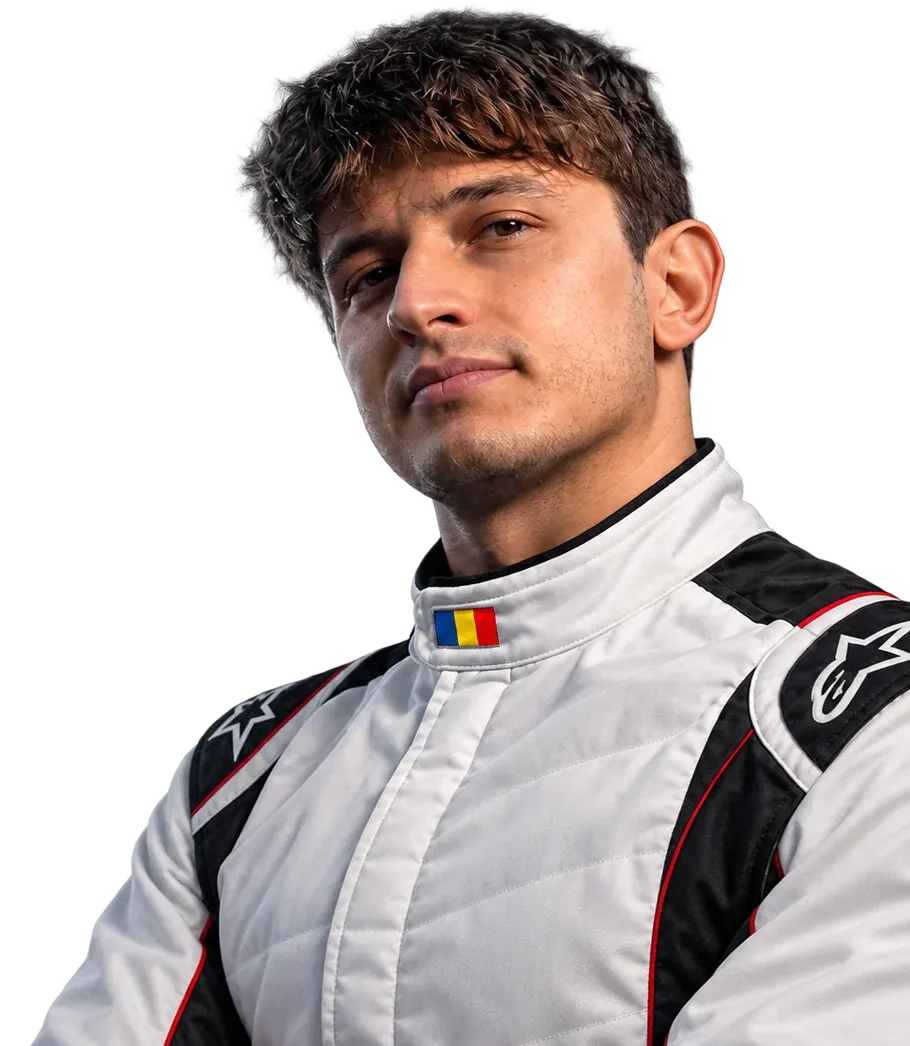
Marian Barbieru
Author · all three books

Marian Barbieru

GITGUD Racing coach. Top 1% in iRacing in formula and sports cars, with more than 1,500 drivers coached 1-on-1.

Questions about this book

Do I need Volume 1 first?

No. The GT3 book stands on its own. It points to the chapters of The Science of Sim Racing where a principle is explained in full, so the two work well together.

Does it cover ABS and traction control?

Yes. Part I has a chapter on each: when to lean on ABS and when not to, and how to use traction control.

Which simulators does it apply to?

Any simulator with GT3 cars, including iRacing, Assetto Corsa Competizione, Le Mans Ultimate and Automobilista 2.

Is there a section on the wet?

Yes, a box on driving a GT3 in the rain at the end of Part IV.

The series

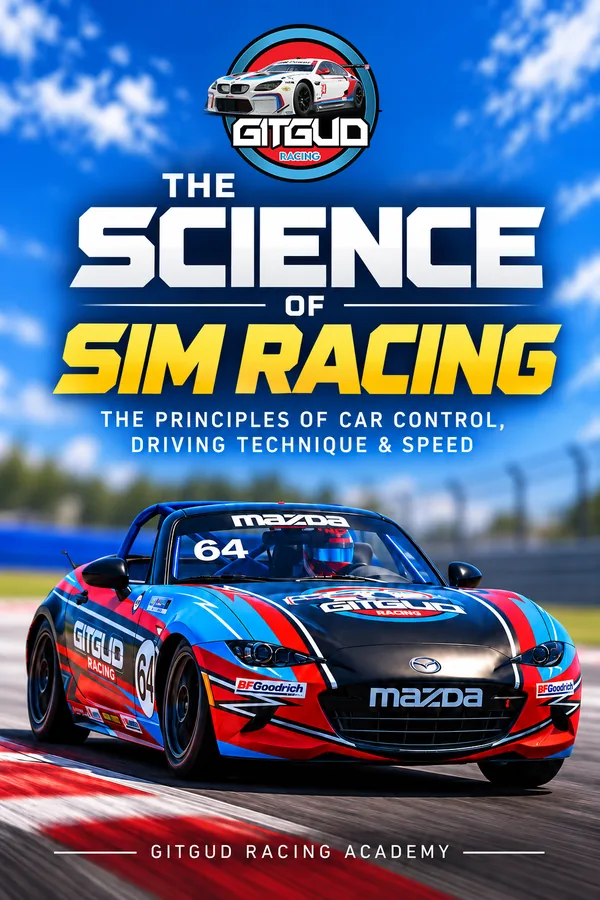
  1. Volume 1 · Start here

    The Science of Sim Racing

    The principles that hold in every car.

    308 pages · $4.99

    Read more about this book →
  2. Volume 2 · GT3

    The Science of GT3 Racing

    Heavy cars with ABS and traction control.

    156 pages · $4.99

    You are here

  3. Volume 3 · Formula

    The Science of Formula Racing

    Light cars and downforce, where precision decides the lap.

    193 pages · $4.99

    Read more about this book →

The complete series

All three books, one price

$9.99 Full price $14.97 Save 33%

Get All 3 Books for $9.99 PDF · all 8 languages included

See all the books →