How to Drive Formula Cars in Sim Racing
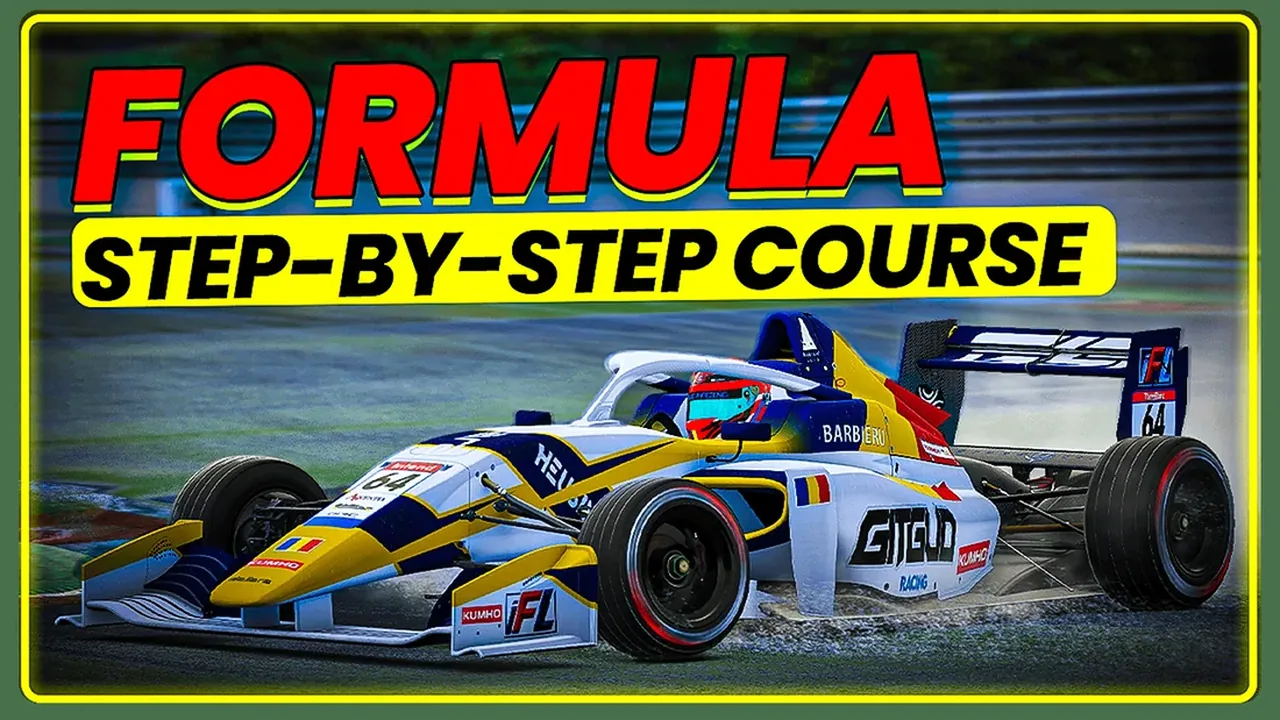
How you drive a Formula car depends first on which Formula car it is. The entry cars, Formula Vee and the FF1600, make almost no downforce: their grip comes from the tyres and weight transfer, and they teach momentum. Formula 4 is the first rung where the wings start to matter. From F3 upward (Super Formula Lights, Indy NXT, Super Formula, F1) downforce dominates, and the faster the car goes, the more grip it has.
That difference decides how you brake and corner. In a low-aero car grip barely changes with speed, so you brake for the corner and protect your momentum. In a downforce car grip drains away as you slow, so the brake pressure has to peak early and fall progressively, and over-slowing the entry throws away the aero that would have carried you through the middle. Drive a downforce car with GT or Vee habits and you will brake too hard every lap, kill your own downforce, and wonder why the car feels so much slower than the stopwatch says it should be. What every open-wheeler shares is the rest: light weight, usually no ABS or traction control, and no tolerance for contact.
This is the public version of our Formula Masterclass, with three full lessons embedded, including the instructor's own drawings and telemetry.
Low-aero cars, F4 and downforce cars compared
The open-wheel field is a genuine ladder, and each rung introduces one new idea rather than just more speed. The column that matters most is the first one: how much of the car's grip comes from aero, because that decides which advice on this page applies to you.
| Car | Aero | Braking | Main challenge | Exercise |
|---|---|---|---|---|
| Formula Vee, FF1600 | Almost none | No aero to lose; release for the turn-in | Momentum: high minimum speed | Zero-steering drill |
| Formula 4 | The first that matters | Sharp triangle, rarely a flat top | Learning what the wing does | The reapply check |
| Formula 3 | More | Triangle: peak while the aero is there | Blending mechanical and aero grip; tyres | Softer-trail drill |
| Super Formula Lights | A great deal | Much more speed carried into corners | Using all of that entry speed | Minimum-pressure drill |
| Indy NXT | Between F3 and SFL | Triangle, plus adjustable engine braking | Exit wheelspin, reluctant turn-in | Turn in harder; apply throttle once |
| Super Formula, F1 | Extreme | Most aggressive; flatter-topped triangle | Almost no time to think | Minimum-pressure and zero-steering drills |
F4 is worth a full season rather than a week; skip it and you will never quite learn what a wing does. F3 is the recommended next step, the car that best teaches you to blend mechanical grip with aero. Super Formula Lights is in many ways its opposite: easier to drive, considerably harder to master. Indy NXT is a turbocharged blend of the two, with push-to-pass to think about. The drills are explained in how to practise.
If you are completely new, spend a little time in the Vee or FF1600, then move to F4, then pick one of F3, Super Formula Lights or Indy NXT. Read the rest of this page in proportion to the aero: in a Vee, the no-ABS braking, steering, throttle and racecraft sections apply, and the downforce sections mostly do not; from F4 up, all of it applies, more strongly the faster the car. One thing to sort before any of it: an open-wheel cockpit is a different seating problem from a GT car, and the seating position guide has a Formula section.
What makes Formula cars different to drive?
Six characteristics define the class, though not every car has all six in the same measure: the two aero ones are small in an F4 and close to absent in a Vee. Two are intuitive and will make you a better driver almost immediately. Four are not intuitive at all, and they are where the lap time hides.
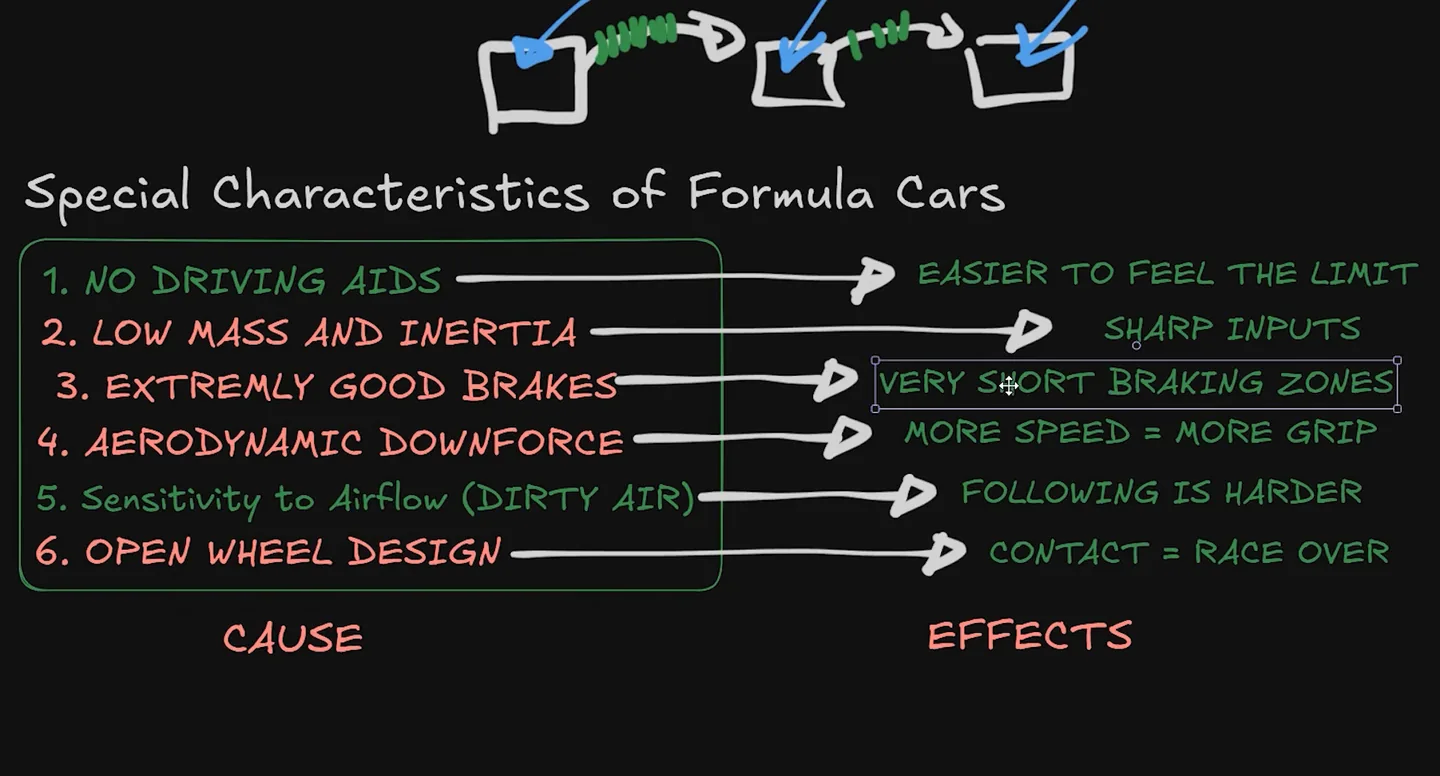
No driving aids (this is a gift). Most Formula cars in sims have no ABS and no traction control, so nothing is masking the limit. In a car with assists you genuinely do not know whether you are under the limit or over it, because the electronics smooth over both. In an open-wheeler the feedback is instant, and that makes you a better driver in every car you subsequently touch.
Low mass and very little inertia (this is not intuitive). In a GT car you wait for the platform to settle: you apply an input, the weight takes its time to move, and only then can you do the next thing. A Formula car is built to avoid that delay. You can be sharper and more aggressive with your inputs, and if you drive one with GT patience you will sit permanently under the limit.
Extraordinary brakes, so very short braking zones. The deceleration feels unreal at first. The consequence is that everything happens too quickly to think about: you cannot deliberate about peak pressure and trail release inside a braking zone that short. You have to build instinct instead.
Aerodynamic downforce: more speed means more grip (F4 upward). Easy to understand in theory, genuinely sneaky in practice. You can drive open-wheelers for years and still not use this properly. In the downforce cars it is the single biggest source of time on this page.
Sensitivity to airflow. In a car with real aero, following another car is harder, and you will feel it immediately.
Open-wheel design: contact ends your race. There is no rubbing. A light touch can cost you a wing, the downforce that came with it, or the whole car.
How downforce changes the way you drive
This section applies in proportion to the car's aero: a little in an F4, a lot from F3 upward, and barely at all in a Vee or FF1600. Downforce is the invisible force pushing the car into the track, generated by the wings, the floor and the diffuser. Crucially it adds grip without adding weight. More of it means later braking, faster cornering and earlier acceleration, at the cost of drag and top speed.
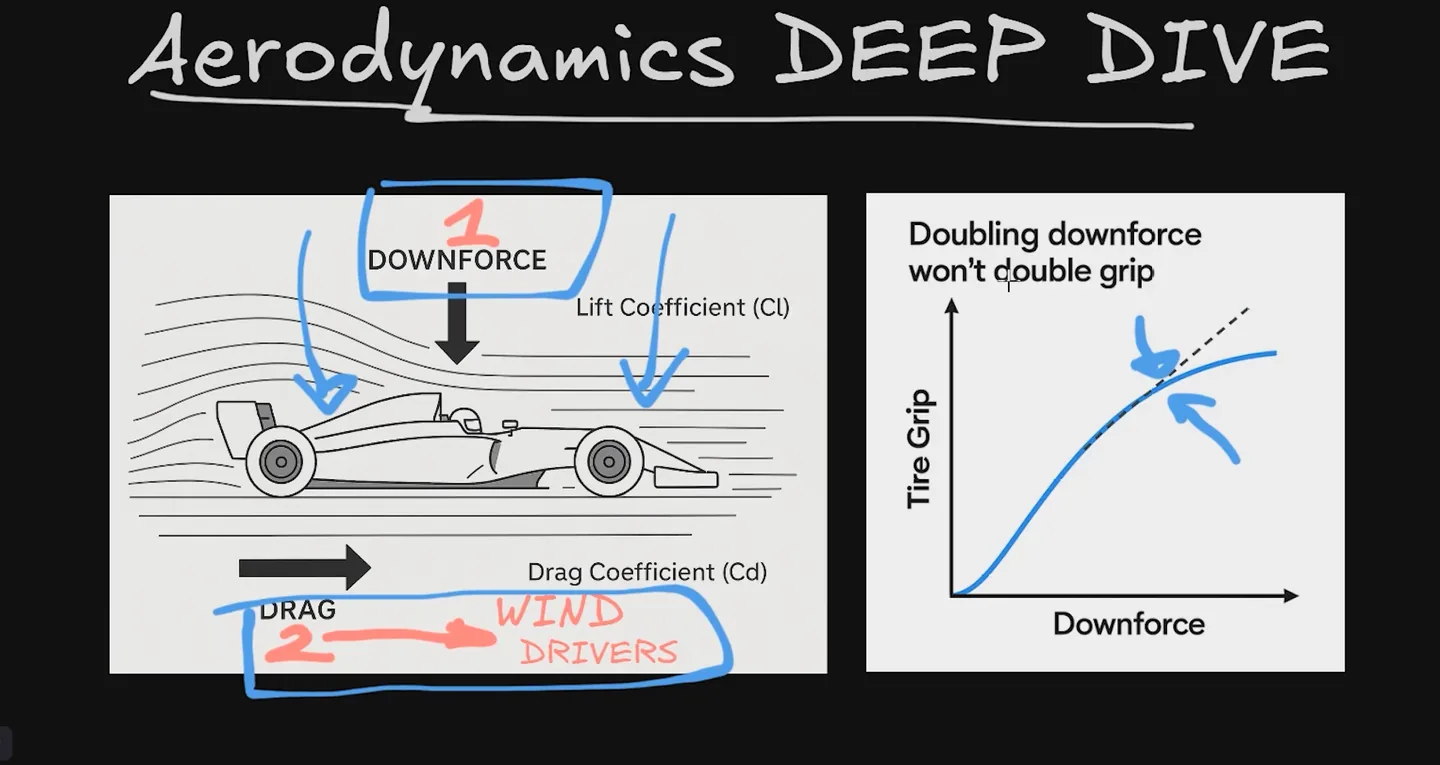
The consequence that changes your driving is this: in a downforce car, grip rises and falls with speed. You have the most grip at the moment you first hit the brakes, and you are losing it continuously as the car slows.
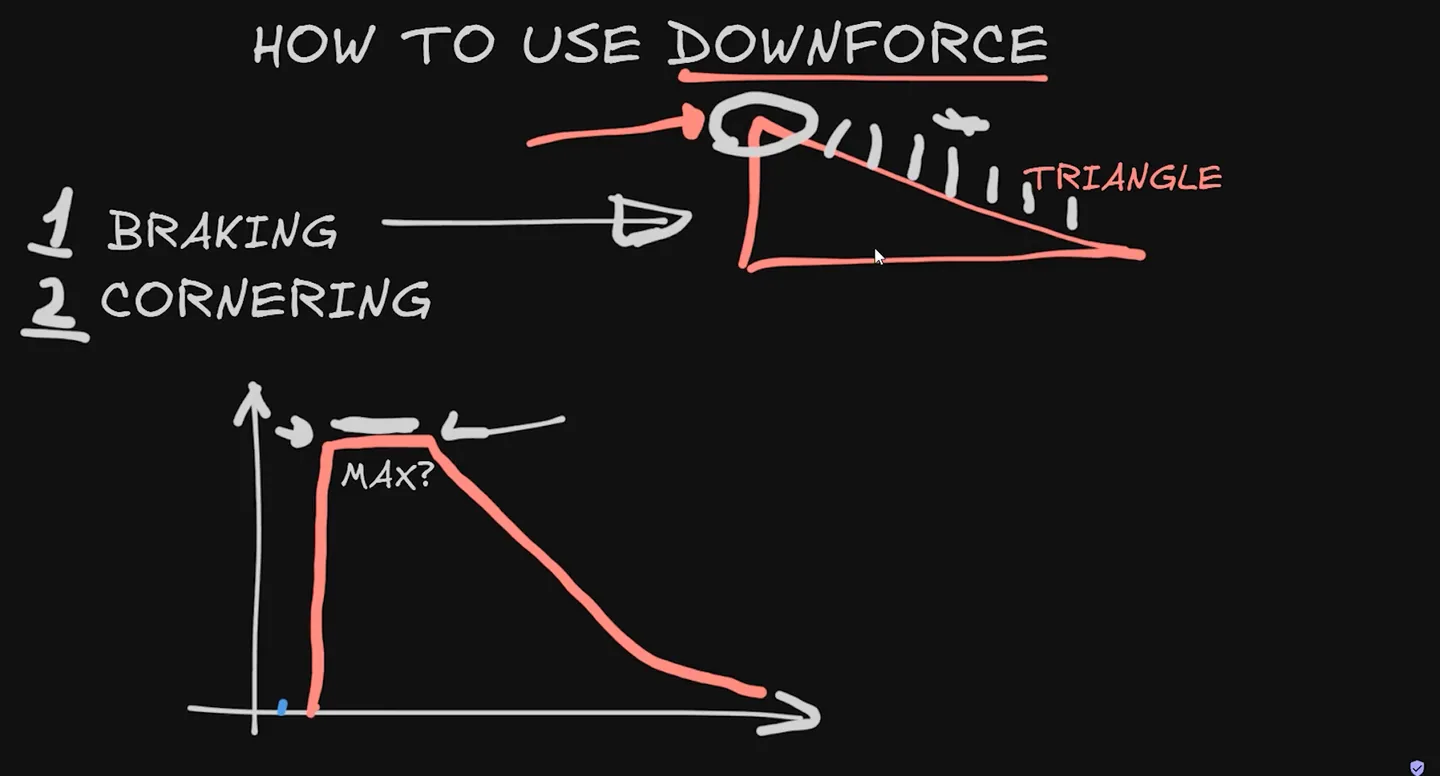
That gives you a diagnostic, the reapply check, that you can run on your own telemetry tonight. If you can add brake pressure part-way through a braking zone and the car takes it, your initial braking was not at the limit. At that point in the corner you have less speed, therefore less downforce, therefore less grip than you had at the start, so a higher pressure should be impossible. If it is possible, you left the first part of the braking on the table. The check is strongest in a car with real downforce; in a Vee or FF1600 grip hardly falls as the car slows, so it tells you less. How to run the comparison properly (delta first, then line and speed, then the brake trace) is in how to read sim racing telemetry.
One clarification, because it matters later: this is a rule about the envelope. The overall trace only ever falls; you should never climb back above a pressure you were holding earlier in the stop. Inside that falling envelope you will still move a percent or two either way, and that small movement is a deliberate tool covered further down. The envelope descends; the dance happens within it.
The shape also changes as you climb the ladder. The more downforce a car has, the longer you can hold near the peak, so the top of the triangle flattens. An F1 car braking from top speed into a slow corner shows a noticeably flat top; an F4 usually does not. The shape is still a triangle; the top is just blunter.
And the thing that makes all of this urgent: lose downforce and you never get it back. Release the brakes a fraction too early at the top, the car slows more than it needed to, downforce drops, and now you have less grip for every phase that follows. There is one small window at the start of the braking zone where the car is at its most capable, and it does not come round again.
Wind is a real input, not weather flavour
Because downforce comes from airflow over the car, wind direction changes the grip you have, and most drivers never look at it. The more aero the car makes, the more it matters.
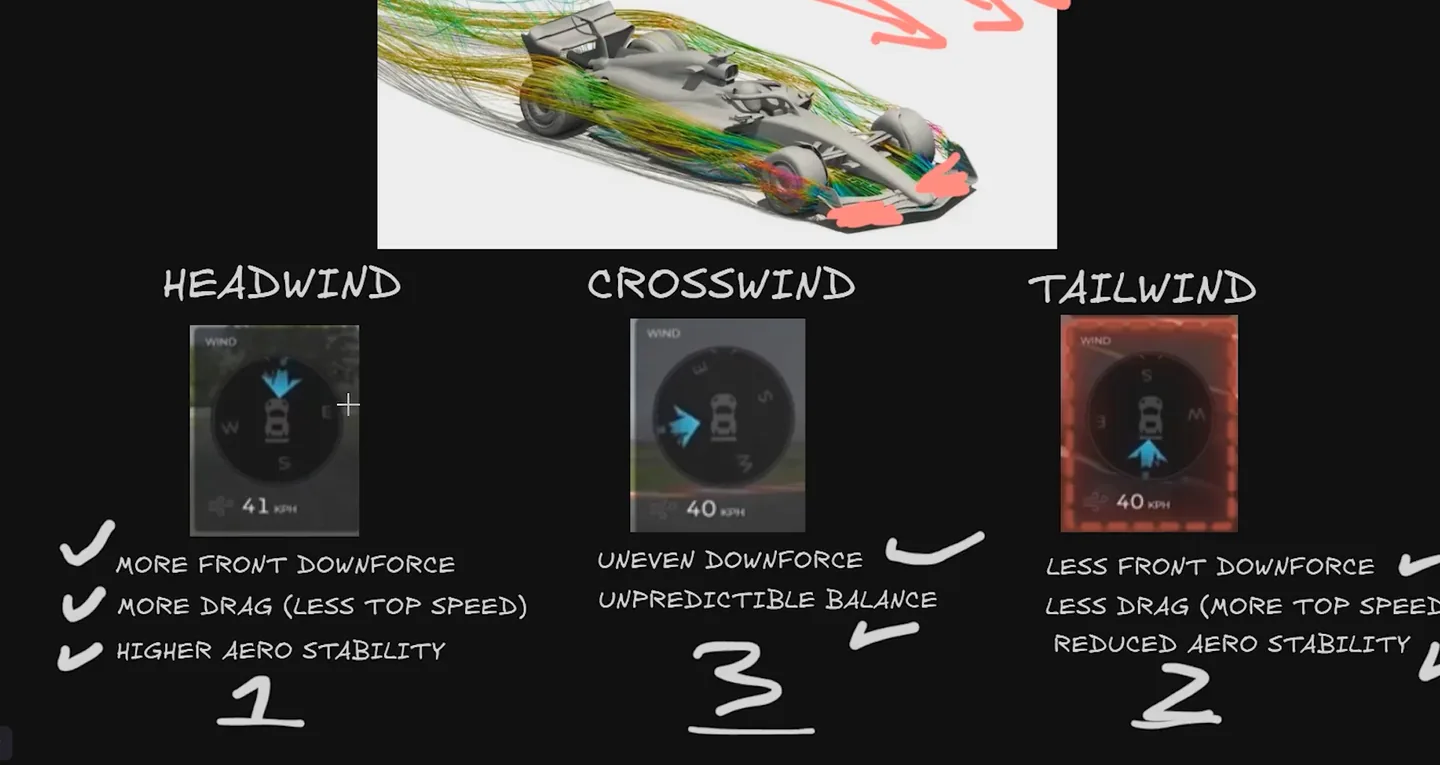
A headwind raises airspeed over the car above your ground speed: more downforce, more drag. You can brake slightly later and slightly harder, turn-in feels sharper and more planted, and acceleration out is marginally worse. A tailwind does the reverse: less front downforce, longer braking distances, a light-feeling car on entry and understeer at turn-in unless you adjust your brake point, but better traction and speed on exit. The ideal corner has a headwind on entry and a tailwind on exit.
A crosswind is the awkward one, because the load is uneven side to side. A crosswind from the inside of the turn tends to add rotation; from the outside it tends to cause understeer; mid-corner it fluctuates and you end up fishing for grip. If your sim does not show wind direction natively, an overlay will: SimHub is the usual free route, with iOverlay and Race Labs as paid options.
How to brake a Formula car
Braking without ABS is the defining skill of the class in every Formula car. In the downforce cars it is harder still, because the grip is draining as the car slows. The shape differs by corner speed, and in a downforce car the goal actually inverts between slow and fast corners, which is why so many drivers are quick in one and hopeless in the other. The release mechanics common to every car are in how to trail brake; what follows is what changes in a Formula car.
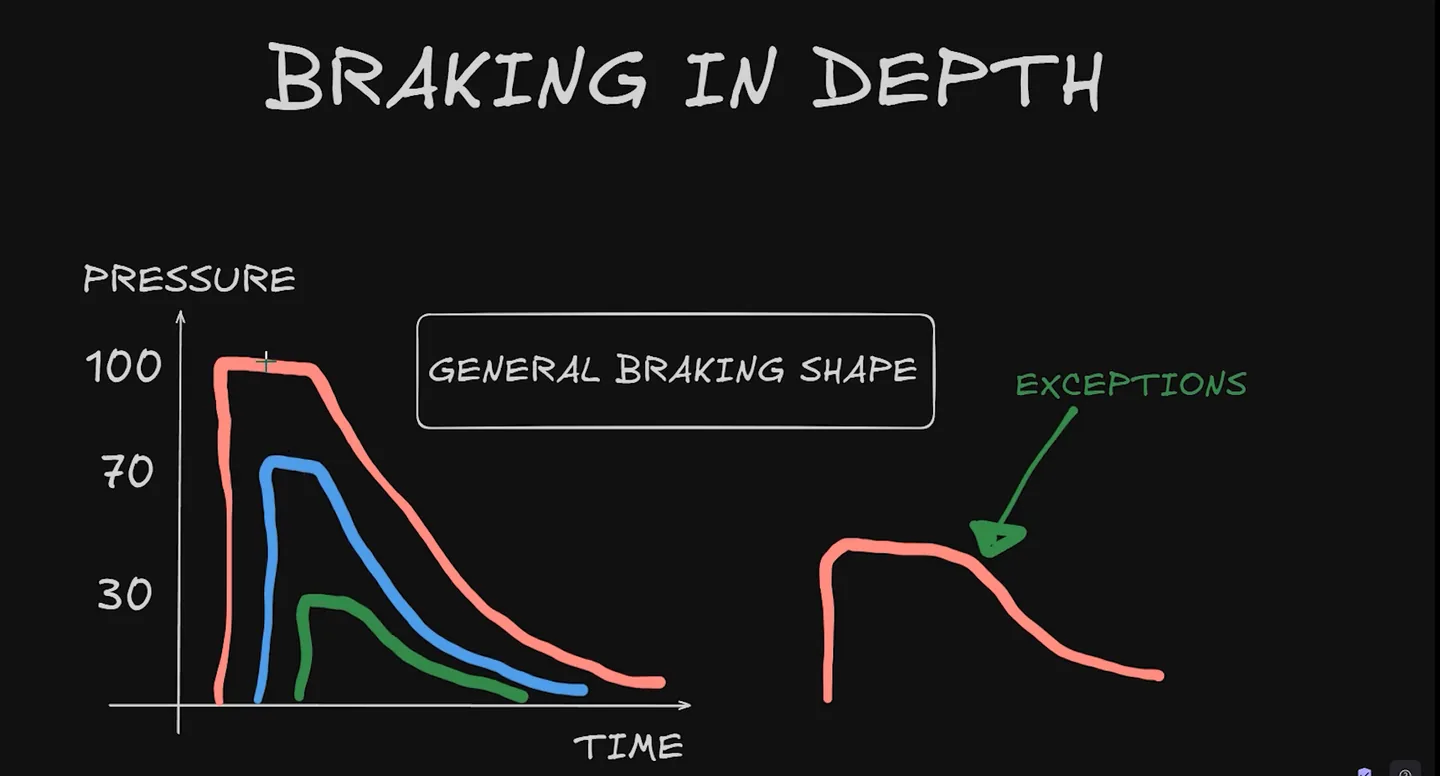
Low-speed corners: maximise the threshold
In a heavy braking zone the job is to brake hard, brake fast, and spend as long as possible at high pressure. This applies in every Formula car, Vee included. Two mistakes cost almost everyone time here.
Taking too long to reach peak pressure. The application should go almost straight up. In a downforce car you have maximum downforce at that instant and it is draining; a slow build wastes it and forces you to brake earlier.
Releasing too quickly at the top. This is the expensive one. Release early and the car has not slowed enough, so you end up holding the brakes for longer, deeper into the corner, killing your minimum speed. The fix is to find the point where the fronts are on the edge of micro-locking and hold there, then start the release.
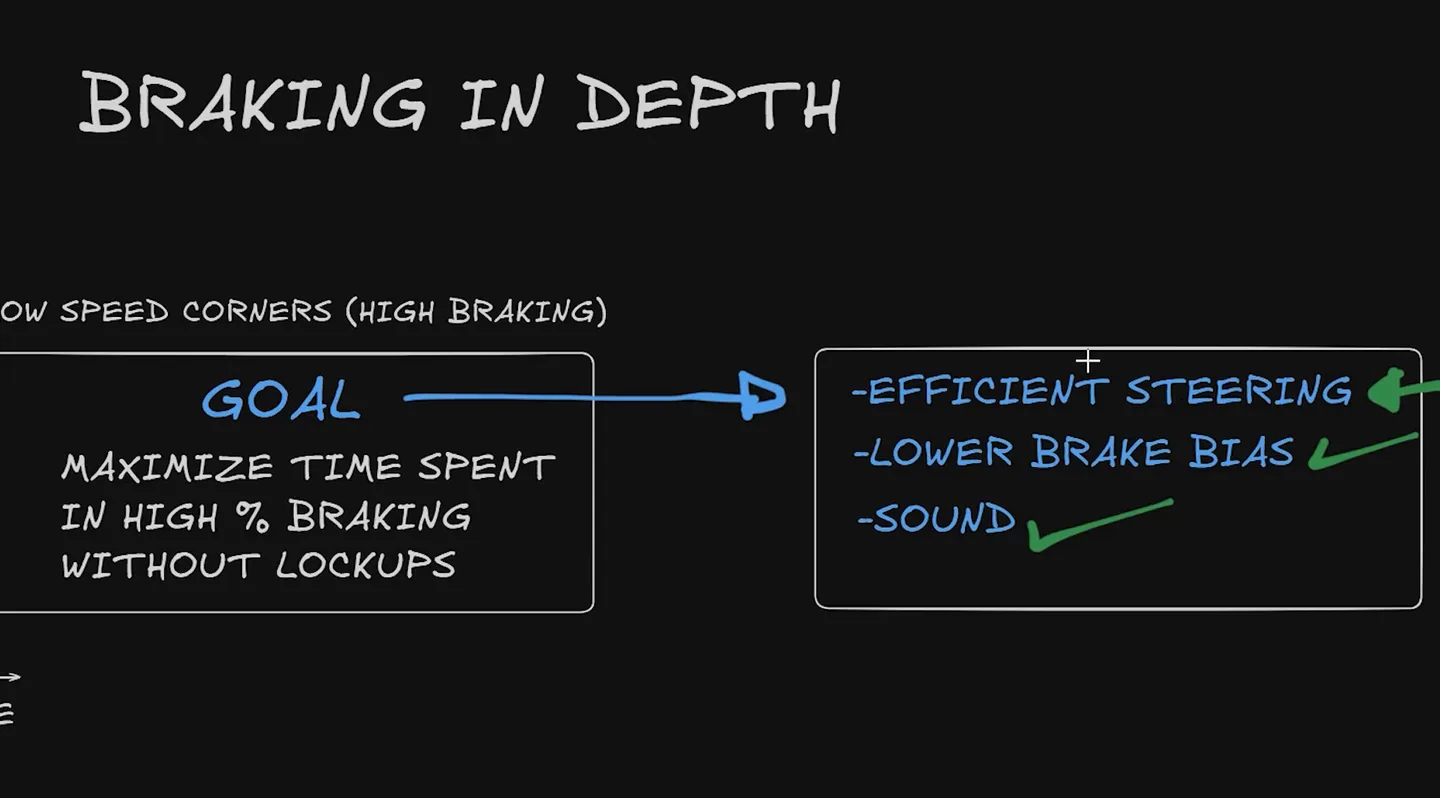
Three things let you hold that threshold longer. Sound: you should hear the tyres working; silence means you are not using them. Brake bias: moving it rearward lets you hold threshold pressure longer, covered in depth in the brake bias guide. And steering, which matters more than most people realise.
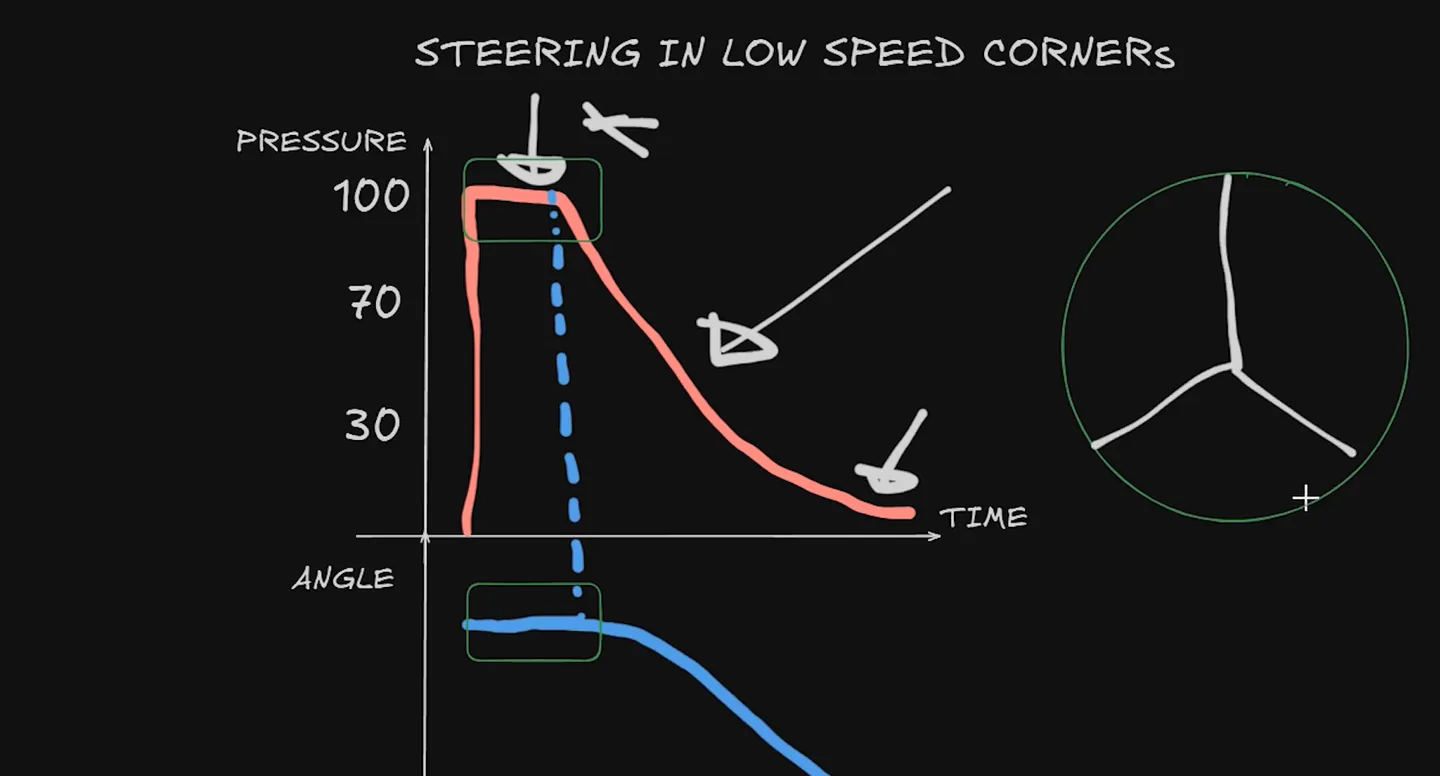
Grip is a budget split between braking, steering and acceleration. Steer while you are trying to hit peak pressure and part of that budget leaves braking. Hold the wheel dead centre through the peak and you get the whole of it. Drivers who brake and start turning simultaneously cannot brake as hard or hold it as long, and they usually blame the car. Where the braking zone itself is curved, dead centre becomes "as little steering as the track allows".
Medium and high-speed corners: find the minimum
In a downforce car the goal flips here. You are not trying to slow the car as much as possible; you are trying to slow it as little as possible while still making the corner. The numbers depend on the car and the corner, but as a picture: a medium-speed corner might peak around 60–70%, a fast one around 30%, and the question to ask is always whether you could have done it with less. If a fast corner works at 30%, try 25%.
Over-braking a fast corner does more damage than losing a bit of entry speed. The car feels slow, so you go to the throttle early, so you lose rotation at exactly the wrong moment, so the car washes wide and you have wrecked the exit, and you have overheated the fronts on the way in for nothing.
And one genuine exception. Occasionally a corner asks you to brake a Formula car like a GT car: flat across the top rather than spiking it. A downhill braking zone leading onto a long straight is the classic case: the lockup risk is high, and you need rear stability and clean front tyre temperatures more than you need the last metre of braking. Deliberately sitting slightly under the limit there is the right call. These corners are rare, and treating the exception as the rule is mistake number one below.
Why Formula cars lock their brakes, and what to do
There is no ABS catching you, and in a downforce car the grip available for braking is falling continuously as the car slows. That combination is why lockups are the signature Formula mistake.
The most common cause is not braking too hard at the start; it is failing to release in step with the speed. In a high-downforce car, peak pressure that was perfectly supported at 250 km/h will lock a front at 120 km/h, because the downforce holding that tyre down has gone. A trace that stays flat too long is a lockup waiting to happen.
The second cause, in any car, is adding steering while still at high pressure: you have spent part of the grip budget on turning, so there is less left for stopping, and the loaded front locks. And if a wheel does lock, release enough to get it rolling again and then reapply. Holding the same pressure and hoping it recovers gives you a flat spot and no steering at the same time.
The brake release: a dance between understeer and oversteer
Release is not one movement. Fight for every percent you give away, and give it away gradually rather than in a spike, because the pressure you keep on the front tyres is what keeps the rear light and the car rotating.
The mechanism is worth stating precisely, because it turns the release into a steering wheel of its own:
- Dropping brake pressure induces understeer: the car turns less.
- Adding brake pressure induces oversteer: the car rotates more.
Driving a Formula car at the limit is a continuous dance between those two. Too much rotation, ease the pressure off slightly. Not enough, add a touch back. On a zoomed-in trace from a quick lap you can see those small ups and downs all through the trail phase: that is the driver fighting for each 1% rather than dumping the pedal and hoping.
How to steer a Formula car
Formula steering is linear toward the apex, where a GT3 is exponential. You can be genuinely aggressive at turn-in, and being timid there is one of the most common ways to leave time on the table. Aggressive is not the same as past the limit, though: how to find the grip limit is the calibration for how much turn-in the fronts will actually take.
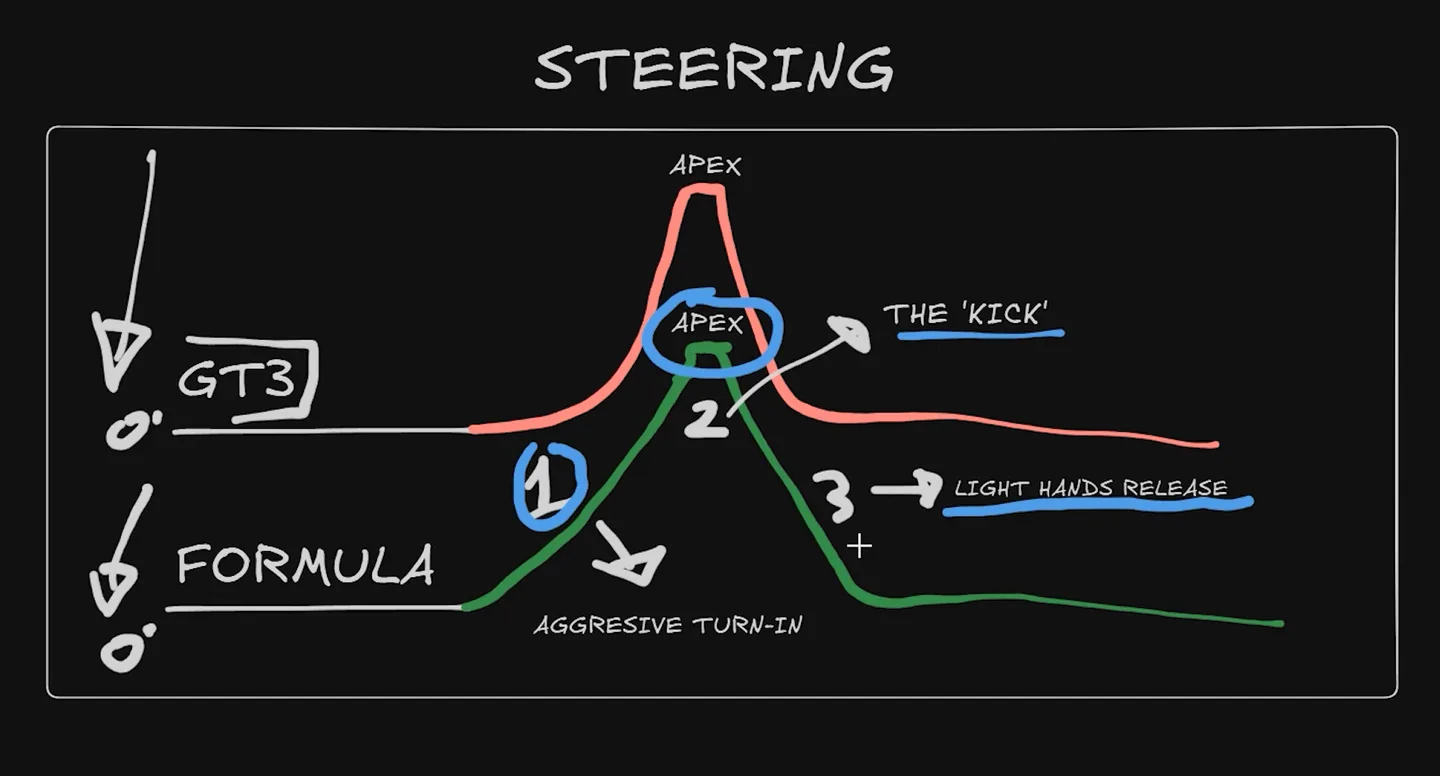
The reason is tied to the brake trace. Think of braking and steering as connected by a rope: more brake means less available steering, and releasing brake buys you steering. Because a Formula car's release is aggressive, the steering that follows it can be aggressive too. There are three distinct phases.
One: an aggressive turn-in. As you begin bleeding off peak pressure, turn in sharply, to the point where you can almost hear the inside front starting to micro-lock. If you hear nothing, you can turn in harder.
Two: the kick at the apex. Instead of continuing the linear build, ask for a distinct extra step of steering right at the apex; the course uses 5–10 degrees. Two things can happen: the car rotates, which is what you wanted, or it understeers, which tells you that you have found the limit. Either answer is useful. The timing is what makes it work: you are at minimum brake pressure and not yet on the throttle, so the grip budget has room for steering that it does not have anywhere else in the corner. Add the kick early, well before the apex, and it simply does not work.
Treat the kick as a probe, not a fixed number: how many degrees make a step depends on the car's steering ratio and the corner. It belongs in the slow and medium corners you brake for; a fast corner taken with only a lift has no brake-to-throttle gap at the apex to use it in.
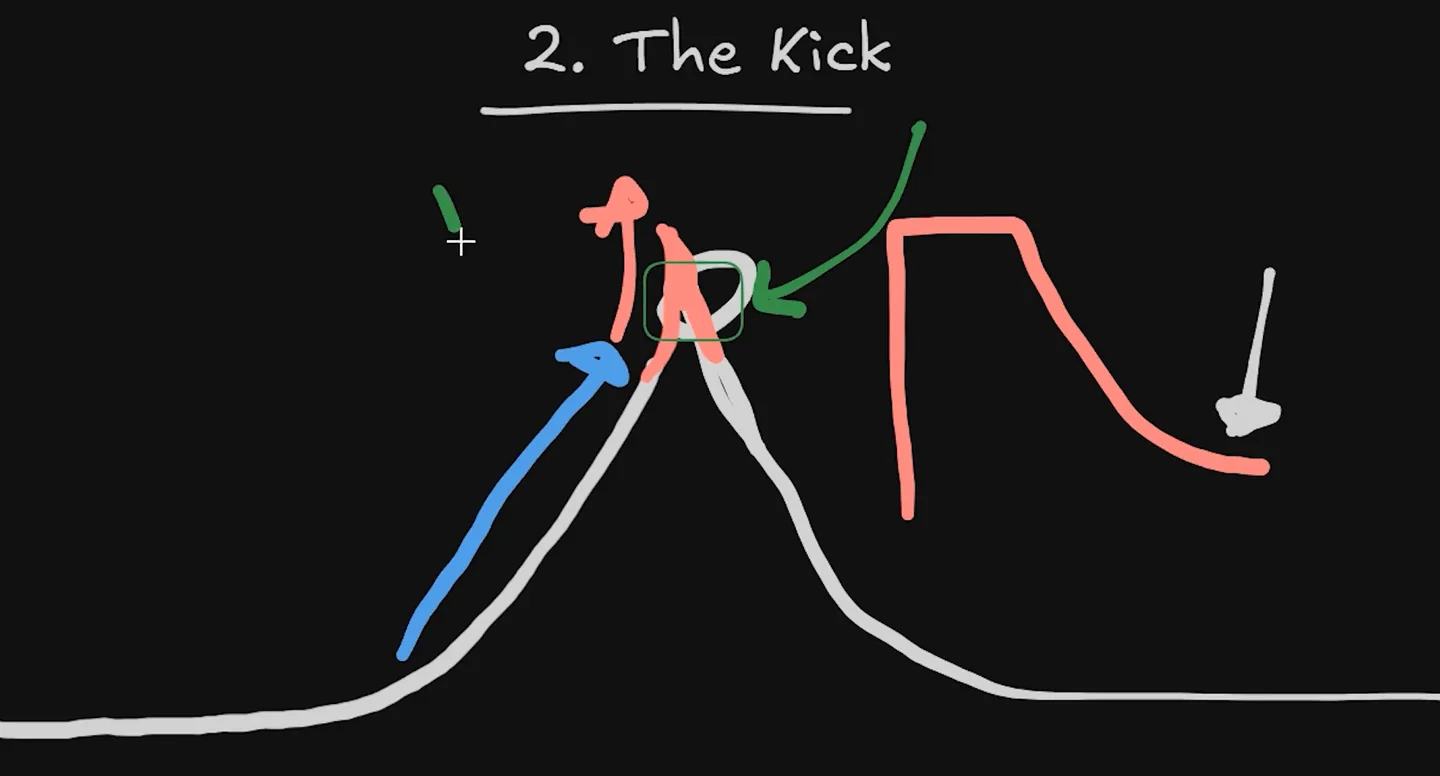
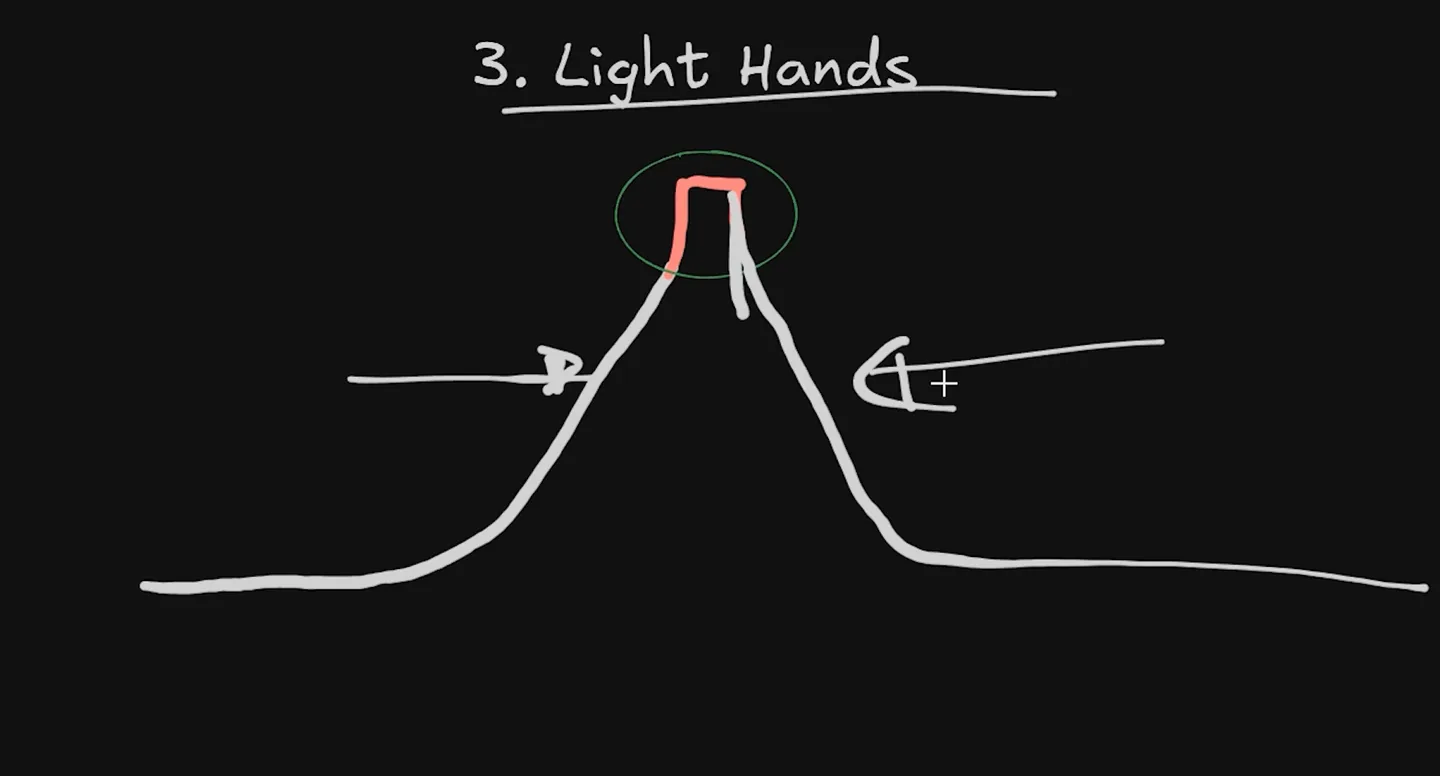
Three: light hands on the way out. Maximum steering happens at the apex and nowhere after it. (That rule is not formula-specific: sim racing steering technique is the general version, and this page is the aggressive end of it.) Past the apex you unwind, as linearly as you wound on. Adding angle after the apex, or just gripping the wheel hard enough to hold angle you should be giving back, scrubs speed all the way to the exit.
How to rotate a Formula car
In a downforce car this is where Formula driving stops resembling anything else, and it is the difference between the top 1% and the top 0.1%.
In a car that relies purely on mechanical grip, such as a Vee or FF1600, the rule is simple: more brake means more rotation. In a downforce car that rule is only half true, because trail braking too hard scrubs speed, and less speed means less downforce, which means less grip to turn with. So both of these are true at once:
- More braking equals more rotation: the mechanical effect, loading the front and freeing the rear.
- Less braking equals more rotation: the aero effect, keeping speed up so the car has more grip to turn with.
Balancing those two is the whole game, and the more downforce the car has, the more weight the second one carries. You still trail brake, because you need the front loaded and the rear light. You just trail brake softer than instinct tells you to.
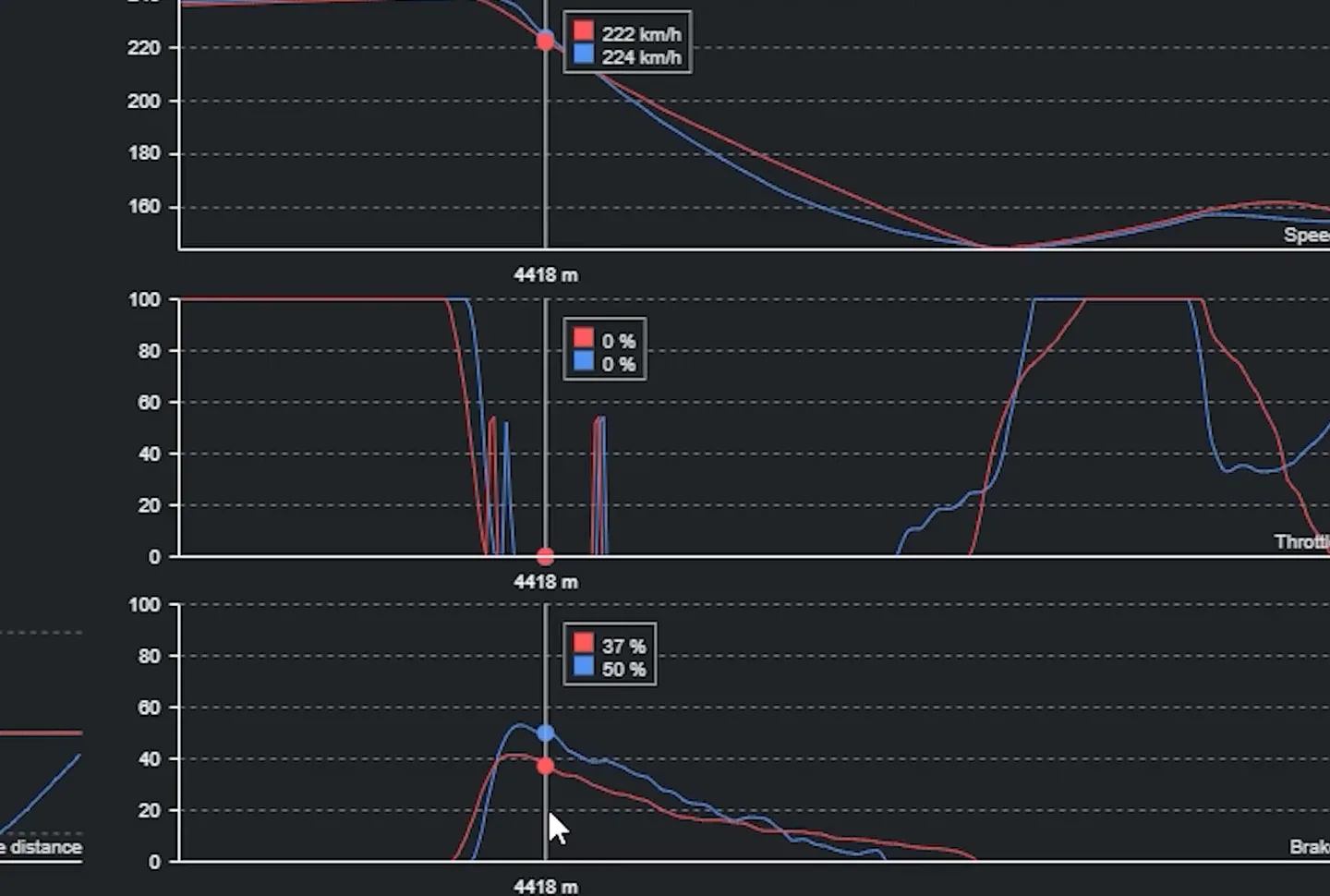
The comparisons in the course are between an esports driver and a genuinely quick, high-rated one, and the gaps are small and consistent: 12 km/h of minimum speed in one corner, 4 km/h in another, and in a third the difference is holding 4% brake instead of barely brushing 2–3%, worth 2 km/h. Two km/h sounds like nothing. Repeated at every corner of every lap, it is the gap between very fast and elite.
Note what does not happen in those comparisons: the driver carrying more mid-corner speed does not pay for it on exit. Same exit speed, sometimes slightly better. "Slow in, fast out" does not describe a downforce car: over-slowing the entry throws away the aero that would have carried you through the middle.
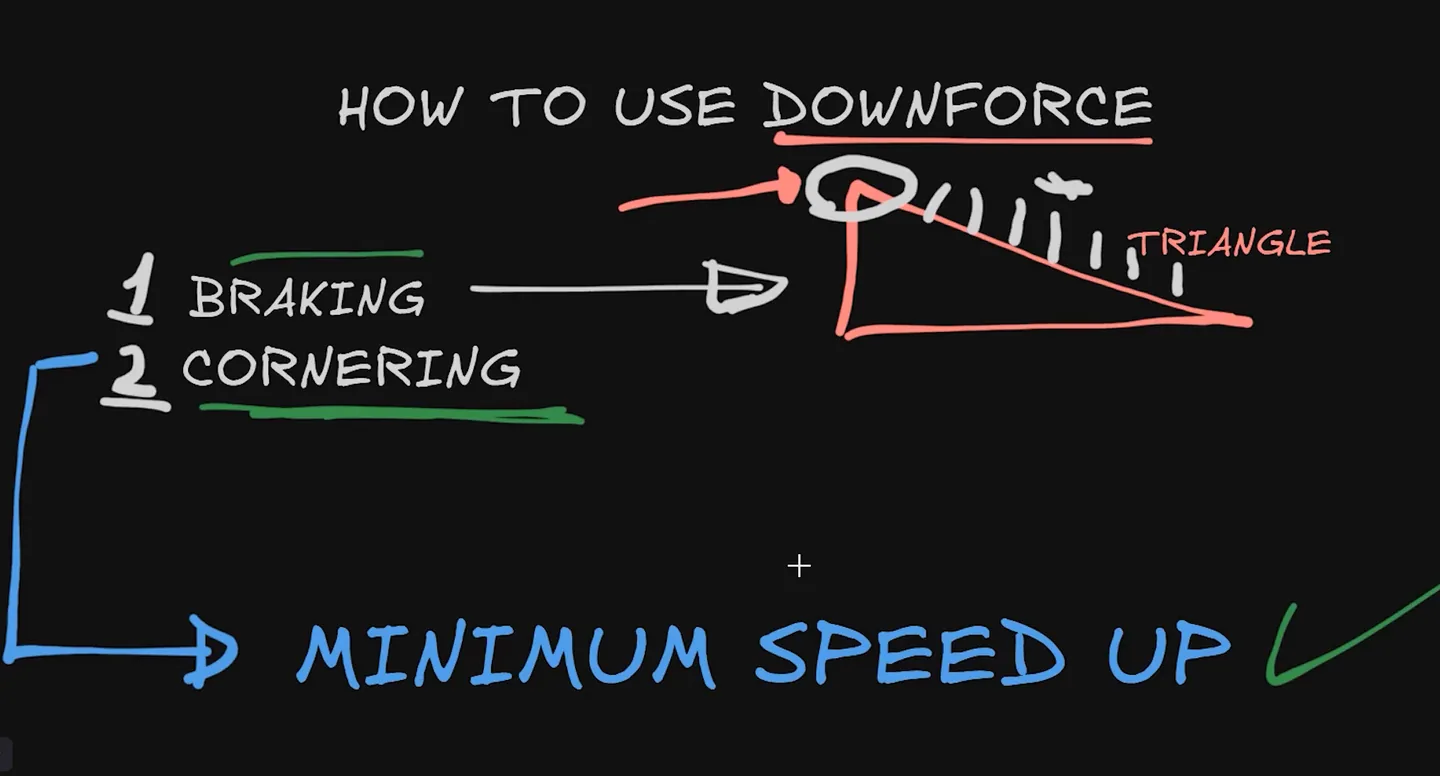
The drill for this, the softer-trail drill, is in the downforce practice route. The other rotation tools (brake bias, downshifts, differential and anti-roll bars) are covered in their own lessons, and the general physics is in weight transfer and the rotation guide.
How to apply throttle without traction control
Nothing is going to save an aggressive throttle application, which makes throttle discipline a bigger deal here than in a GT3. But the more interesting problem is the opposite one: lifting more than you need to. The first two rules below are downforce rules, so they matter most in fast corners in an aero car.
Do not lift before you turn in. Dropping the throttle and then committing to the steering costs you downforce at exactly the moment you are asking the car to turn. Turning first, at full throttle, and lifting after, is worth a surprising amount: in the course's own demonstration, a fast corner in a downforce car, 206 km/h of minimum speed became 218 km/h from that change alone.
Lift less. In fast corners you rarely need to go to zero. Dropping to 20% instead of 0% keeps load on the car; in some corners a 5% lift is all the corner actually asks for. Big binary lifts throw away grip you were being given for free.
Then apply once. This one holds in every car. Going to 80%, realising it is too early, backing out and reapplying is the worst pattern on the telemetry, and it almost always means you braked too early and over-slowed the entry. The same is true of "throttle noise", the on-off-on-off sawtooth, which usually means you turned in too early. Press once, commit, and fix the entry rather than the throttle.
The Formula racing line
Because downforce rewards speed, a downforce car generally wants the tight line and the shortest distance, the opposite of the wide, V-shaped, straighten-the-entry approach that suits a heavy GT car. Where a GT3 shoots the car in straight and rotates in a small zone, a downforce car keeps turning and keeps the speed, because the aero is helping it turn all the way through. How strongly that applies scales with the aero.
Be careful not to over-read that. "Slow in, fast out" fails as a rule about brake pressure: over-slowing the middle of the corner does not pay itself back on exit. It does not fail as a rule about geometry: for the large majority of corners a late apex is still the better place to put the car, because the straight that follows is longer than the braking zone that precedes it. Protect minimum speed with the pedal; keep favouring the exit with the line. On a double apex, stay tight to both. The general cornering method (labelling the corner, building references, comparing your best lap to your worst) applies unchanged.
Slow, medium and high-speed corners
Almost everything above changes with corner speed, so it is worth having the three cases separated in your head. In a low-aero car the distinction is smaller, because there is little aero to gain or lose at any speed.
Slow corners are the mechanical-grip case. Little aero is helping you, so this is where the full heavy-braking routine applies: fast application, maximise the threshold, hold zero steering through the peak, then a disciplined trail. Rotation and traction dominate, and patience on the throttle pays.
Medium corners are the transition, and the hardest to judge because both kinds of grip matter. Find the minimum brake pressure that still makes the corner.
Fast corners are the aero case, and mostly a test of commitment. Brake as little as possible, lift as little as possible, and avoid unnecessary corrections: every one of them upsets the platform and costs you the downforce you were relying on.
Corner speed is one axis; corner shape is the other, and a downforce car reads some shapes differently from a GT. The shapes themselves are in racing corner types, and the one where the car class changes the answer outright is the double apex, where a formula car wants a tighter line than a GT through the same corner.
GT3 vs Formula: what actually changes
If you drive a Formula car like a GT3 you will be slow in a specific, diagnosable way: under the limit at turn-in, too flat on the brakes, and never using the aero. If you drive a GT3 like a Formula car you will find it unresponsive and blame the car.
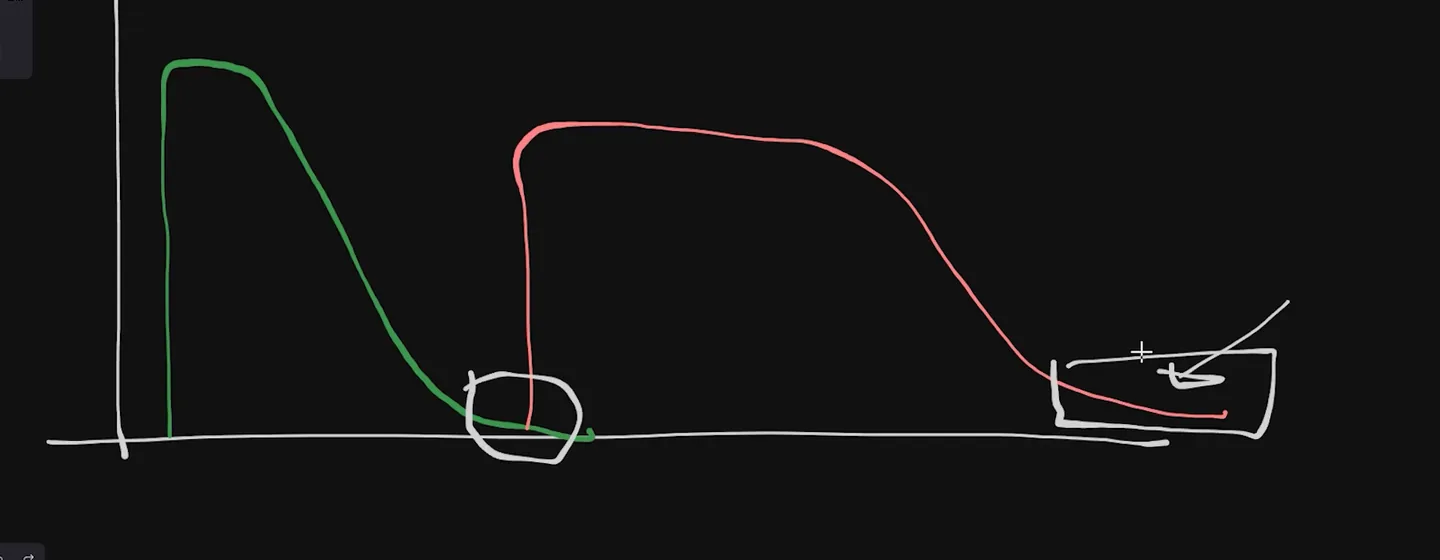
The Formula column describes the downforce cars, F4 upward. A Vee or FF1600 shares the weight, no-aids, lockup and contact rows, but not the aero ones.
| GT3 | Formula (downforce) | |
|---|---|---|
| Weight | Heavy, noticeable inertia | Light, almost no delay |
| Downforce | Modest | Moderate (F4) to extreme |
| ABS / TC | Usually both | Usually neither |
| Brake shape | Rectangle: hold the plateau | Triangle: peak then decay |
| Brake release | Gradual, trail emphasised | Aggressive, then fight for each percent |
| Steering | Exponential, gentle at first | Linear, aggressive turn-in, kick at the apex |
| Racing line | Wider, V-shaped, straighten the entry | Tighter, protect minimum speed |
| Downshifts | Timed carefully, they unsettle mass | As fast as possible |
| Lockups | Managed by ABS | Entirely on you |
| Contact | Some tolerance | Effectively none |
One rule genuinely reverses between the two, so it is worth stating plainly. In a GT3, needing more than about 90 degrees of lock is usually a symptom that you failed to rotate the car with the brakes. In a Formula car, a lazy turn-in is its own mistake: trail braking alone will not rotate the car, and going well past 90 degrees at turn-in is often exactly right. The full GT3 method is in the GT3 sim racing guide, and the car-agnostic fundamentals underneath both are the twelve driving techniques.
Racing open-wheelers: dirty air and contact
Everything above is about the lap. Racing adds two open-wheel problems that no amount of solo practice shows you: the air behind another car, and what happens if you touch it.
How dirty air changes Formula racing
A downforce car makes its grip from clean airflow, so running in another car's wake takes that grip away, and it takes it away from the front first. The car that felt planted in clean air understeers on entry, refuses to hold the line mid-corner, and stops later than you expected it to. The more aero the car has, the bigger the effect.
Practically, that means you cannot simply follow the same line and brake at the same marker while you are behind someone. You have to accept a slower entry, or move offline earlier to find cleaner air, or set the pass up a corner in advance rather than lunging at the one you are in. The cars ahead also change your drag, which is what makes the slipstream on the straight the other half of the equation.
Unlike downforce itself, this one is intuitive: you feel it immediately and consistently. The skill is planning around it rather than being surprised by it every lap. It is also the strongest argument for qualifying well: a clean qualifying lap is worth more in an open-wheeler than in anything else, because it decides how much dirty air you spend the race in.
Formula racecraft and overtaking
Two facts shape open-wheel racecraft in every Formula car: the braking zones are extremely short, and contact ends your race.
Short braking zones mean there is very little time and distance in which to complete a move, which is why passes have to be set up in the corner before the one where they happen. Exposed wheels mean the margin for a hopeful lunge is zero: a divebomb that would be merely rude in a GT car takes both of you out here. Leave room, be predictable, and be aware that the driver you are attacking has the same dirty-air problem you do. Those are the open-wheel modifiers; the fundamentals of positioning, attacking and defending, with the instructor's own race paused corner by corner, are in our full sim racing racecraft guide.
Why am I slow in Formula cars?
If you are quick elsewhere and slow in an open-wheeler, the symptom usually points straight at the cause. The aero rows apply to the downforce cars.
| What you're experiencing | Where to look first |
|---|---|
| Constant brake lockups | Release not keeping pace with falling speed and downforce |
| Good in slow corners, weak in fast ones | Not trusting the aero: braking and lifting too much |
| Fast in high-speed corners, terrible in hairpins | Mechanical-grip rotation: brake bias, downshifts, trail |
| Rear steps out on exit | Throttle application, and how early it arrives |
| Car won't rotate | Lazy turn-in, no kick at the apex, or over-slowed entry |
| Lots of steering corrections | Adding angle after the apex instead of unwinding |
| Flat top on your brake trace | You are braking it like a GT car and wasting the aero |
| You can add brake pressure mid-zone | Your initial braking was under the limit |
| Huge time loss following another car | Dirty air: you need a different line and brake point |
| One fast lap, then mistakes | References and repeatability, not pace |
If a symptom survives genuinely repeatable inputs, it may be the car rather than you: the setup troubleshooter takes it from there.
Common Formula driving mistakes
- A rectangular brake shape in a downforce car. A flat top belongs in a GT car (and in the rare exception corner above). In a downforce car it means you are ignoring the grip you had at the start and will have to brake longer.
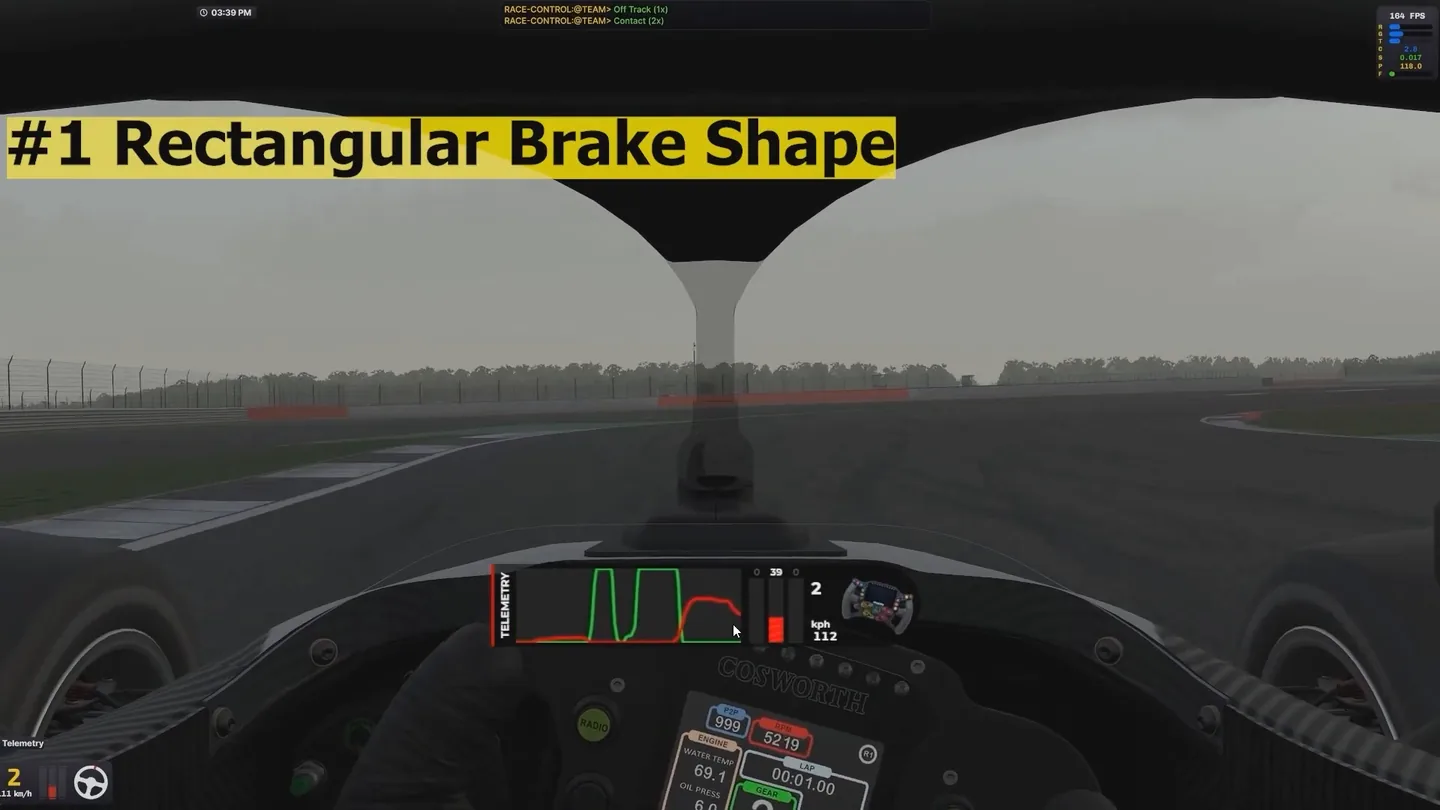
Mistake number one, on the telemetry: a flat-topped brake trace in a car that had its most grip at the moment the pedal went down. - Building slowly to peak pressure. Then reapplying more later: proof the first part was under the limit.
- A gap between brake and throttle. Off the brakes, coasting, then on the power. If you cannot stay on the brakes into the corner, brake later so that you have to. (How to move the braking point without losing the corner, and why the straight-line efficiency comes first, is its own guide.)
- Lifting before turning in. You give away the downforce right when the corner needs it.
- Lifting all the way to zero. Often 20%, sometimes 5%, is all the corner asked for.
- Throttle uncertainty and throttle noise. On, off, on again. Almost always caused by braking too early or turning in too early.
- A lazy turn-in. Trail braking alone will not rotate the car. Turn in harder and use the kick.
- Adding steering after the apex. Maximum angle belongs at the apex; after it you unwind, or you scrub all the way to the exit.
How to practise Formula driving
Pick the route for the car you drive. A few targeted drills will move you further than any amount of extra laps, and the general method underneath both routes, deliberate repetition of one corner rather than lap after lap, is in how to practise effectively.
Low-aero cars: Formula Vee, FF1600 and F4
The zero-steering drill. In a heavy braking zone, consciously hold the wheel dead centre until you begin releasing the brake. You are training the grip budget to go entirely into stopping, and it usually buys you a later brake point immediately. It works in any car without ABS, so keep it as you move up.
One corner, minimum speed. In a Vee or FF1600 the lesson is momentum, so repeat a single corner and judge each run on the minimum speed it carried rather than the lap time.
The reapply check (F4). F4 is where the aero starts, so start reading your brake trace for it: if you can add pressure part-way through a braking zone, your initial braking was under the limit. Fix that before moving on.
Higher-downforce cars: F3 upward
The softer-trail drill. On a track you know, with data you already have, brake slightly softer in the release and trail phases only. Compare traces afterwards: entry and exit speeds should match, and minimum speed should be higher. That comparison is the fastest way to convince yourself that over-slowing is costing you time.
The minimum-pressure drill. In medium and fast corners, ask the question from the braking section every lap: if this corner works at 30%, does it work at 25%? Then do the same with the lift: if it works at 20% throttle, does it work at 30%?
If you are building an iRacing career around open-wheelers, the iRacing guide covers licences and progression.
Formula sim racing FAQ
How do you drive a Formula car fast in sim racing?
First, know which kind of Formula car it is. In a low-aero car such as a Formula Vee or FF1600, brake for the corner and protect momentum. In a downforce car, F4 upward, brake hard the instant you get on the pedal, while downforce is at its highest, then release progressively as speed and grip fall away. In both, turn in aggressively, add a distinct step of steering at the apex, and unwind cleanly. Above all, in a downforce car stop over-slowing the entry: protecting mid-corner speed keeps the aero working and is where most of the time is.
Are Formula cars harder to drive than GT3 cars?
They are less forgiving and easier to read. Without ABS or traction control nothing masks the limit, so the feedback is instant and honest, which makes them an excellent teacher. What is genuinely hard is the aero: using grip that grows with speed is counter-intuitive, and drivers can spend years in open-wheelers without fully exploiting it.
How do you brake a Formula car without ABS?
Reach peak pressure almost instantly, hold it only as long as the downforce supports it, then bleed off continuously as the car slows. The trace should be a triangle that always trends down. Keep the steering dead centre through the peak so the whole grip budget goes to stopping. That triangle is the downforce-car shape; in a low-aero car grip barely falls as you slow, so the release is driven by the turn-in rather than by draining aero. Full method with the drawings.
Why do Formula cars lock their brakes so easily?
Because grip is falling continuously as the car slows. Pressure that a tyre supported comfortably at high speed will lock it moments later once the downforce has gone, so a trace that stays flat too long ends in a lockup. Adding steering while still at high pressure does the same thing, by spending part of the grip budget on turning.
Should you trail brake a Formula car?
Yes, but more softly than instinct suggests. You need some brake into the corner to keep the front loaded and the rear light. Trail too hard and you scrub speed, which costs downforce, which costs the grip you needed to turn. In a downforce car more braking gives more rotation and less braking gives more rotation — balancing those is the skill.
How does downforce change Formula driving?
It makes grip a function of speed. You have the most grip at the instant you first brake and you are losing it all the way down, so peak brake pressure has to decay rather than hold. It also means over-slowing a corner is self-punishing: less speed is less downforce is less grip. More on using aero.
Why do Formula cars have more grip at high speed?
The wings, floor and diffuser turn airflow into downward force, pressing the tyres into the track without adding weight. The faster the car travels, the more air passes over those surfaces and the more force they generate. It has diminishing returns, though: doubling downforce does not double grip.
How do you rotate a Formula car?
With the brake release and the steering together, not with brake pressure alone. Turn in aggressively as you come off the peak, then add a deliberate step of extra lock right at the apex, where minimum brake pressure leaves grip available for steering. Trail braking alone will not rotate the car. The full explanation.
How do you stop wheelspin in a Formula car?
Nothing will catch it for you, so the fix is upstream of the throttle. Get the car rotated and pointing at the exit before you commit, then apply once rather than pressing, backing out and reapplying. Repeated on-off throttle almost always means you braked too early or turned in too early, and the entry is what needs fixing.
What is the best Formula car for beginners in sim racing?
Start with a car that has no meaningful aero — a Formula Vee or an FF1600 — because they teach momentum and weight transfer without the complication of downforce. Then move to Formula 4, which is the first car where aerodynamics genuinely matter, and stay there long enough to feel what a wing does.
What is the difference between low-aero Formula cars and downforce cars?
Where the grip comes from. A Formula Vee or FF1600 makes almost no downforce, so grip comes from the tyres and weight transfer and barely changes with speed; the lesson there is momentum. From F4 upward the wings matter, so grip rises with speed: brake pressure has to peak early and decay, and over-slowing the entry costs you the aero you needed to turn. The car-by-car comparison.
Is F4 a good Formula car to learn in?
It is the natural first aero car. The grip levels change enough that you can brake harder and carry more speed than in a Vee or FF1600, but not so much that the car hides your mistakes. Worth a full season rather than a couple of weeks — skipping it makes the faster cars much harder to understand.
What is the difference between F4, Super Formula Lights and Super Formula?
Mostly how much downforce they make and therefore how much they reward commitment. F4 is low on downforce but handles like a proper open-wheeler. Super Formula Lights has a great deal of it, so the driving style is built around carrying speed. Super Formula sits near the top for both cornering speed and braking aggression.
How does dirty air affect Formula cars?
Running in another car's wake disrupts the airflow the wings need, so you lose downforce — and you lose it at the front first. The car understeers on entry and will not hold the line mid-corner, so you cannot use the same brake point or the same line while following. Passes have to be set up a corner earlier.
How is Formula driving different from GT3?
Almost everything inverts. The GT3 brake trace is a rectangle you hold; the Formula one is a triangle that decays. GT3 steering is exponential and gentle at turn-in; Formula is linear and aggressive. A GT3 wants a wider line to straighten the entry; a Formula car wants the tight line and its minimum speed protected. And you have no ABS or traction control. Side-by-side comparison.
This guide is part of the free library at GitGud Racing Academy — an online sim racing academy built around weekly lap reviews, structured courses, drills and training tools.
Train this the right way
Reading is step one. Build it into muscle memory with structured, car-specific courses and personal lap reviews from a coach — inside the Academy.
Join the Academy · $39.99/mo incl. VAT