Brake Bias in Sim Racing: How to Use It to Go Faster
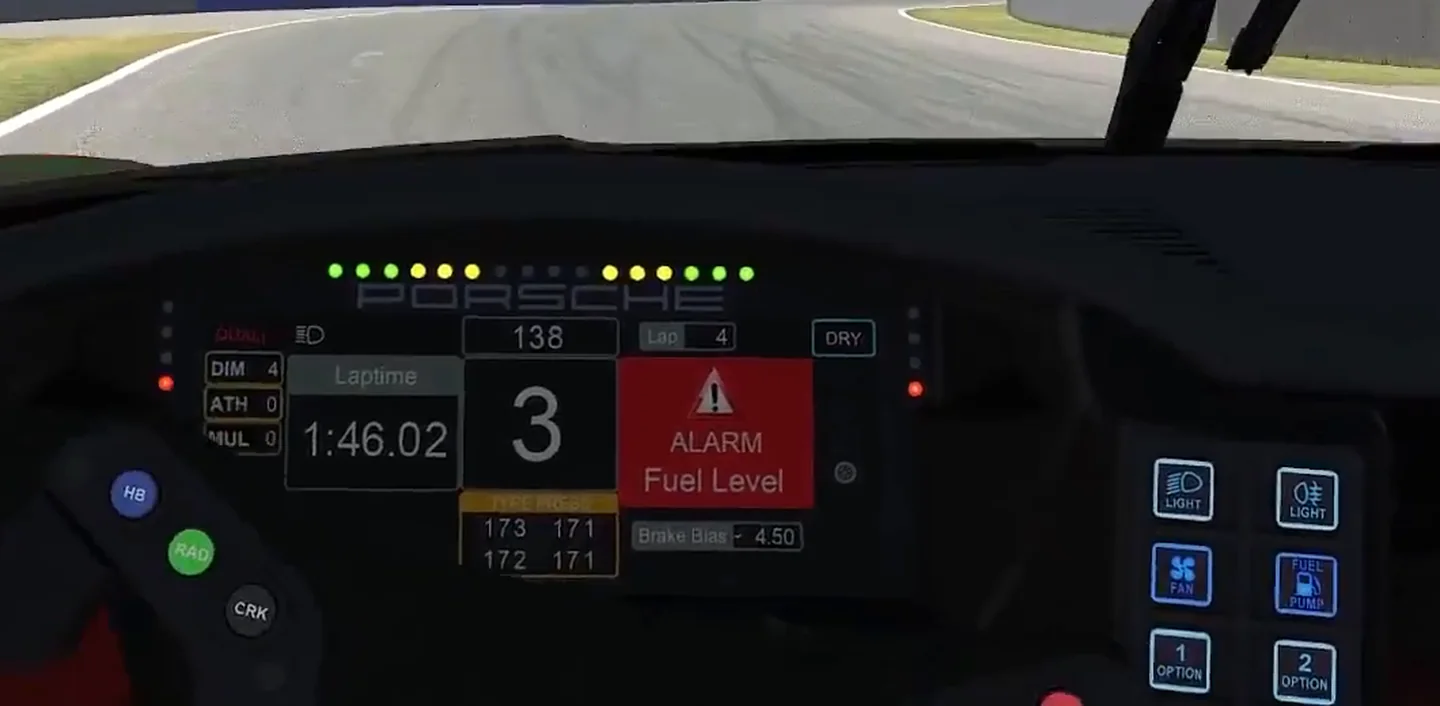
Brake bias is one of the very few things you can change while the car is moving, and most sim racers never touch it. It sits on a rotary or a pair of keybinds, set to whatever the setup shipped with, for the entire race.
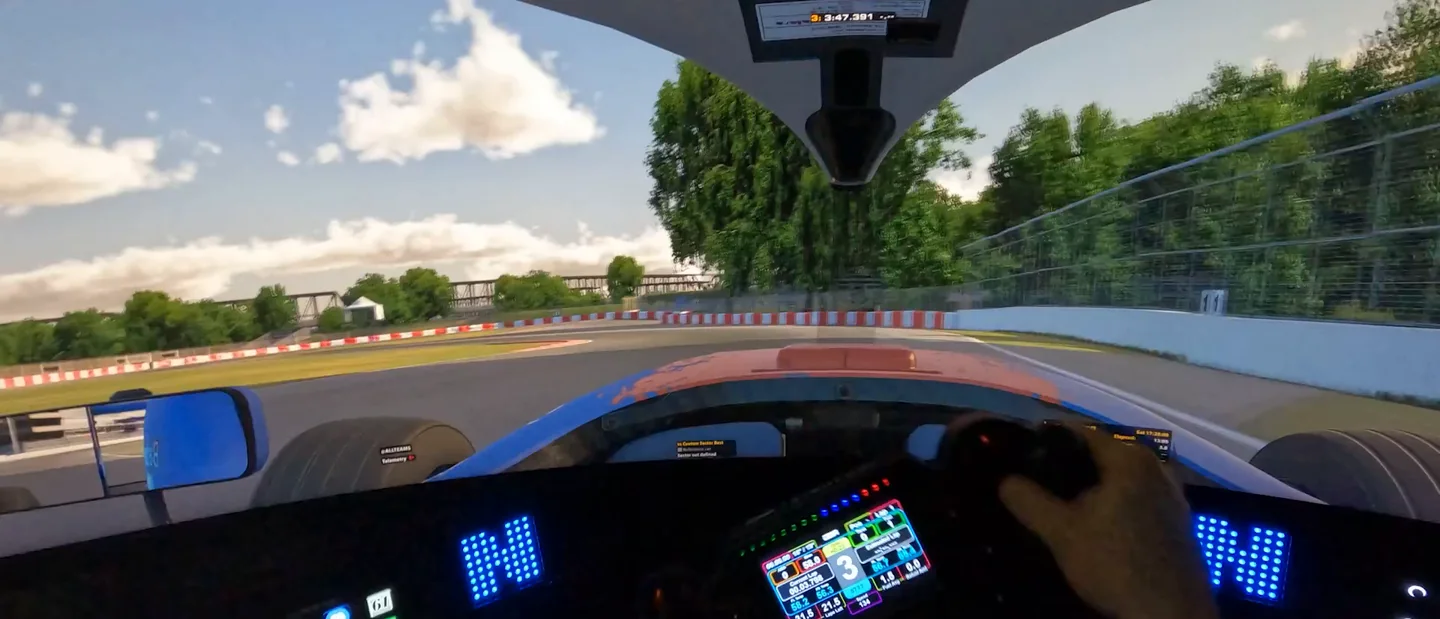
That is a waste, because bias is not only a question of which wheels do the braking. It decides how much of the car's available grip you are actually using when you hit the pedal, and whether the car resists or helps you as you turn in.
| What you do | What happens |
|---|---|
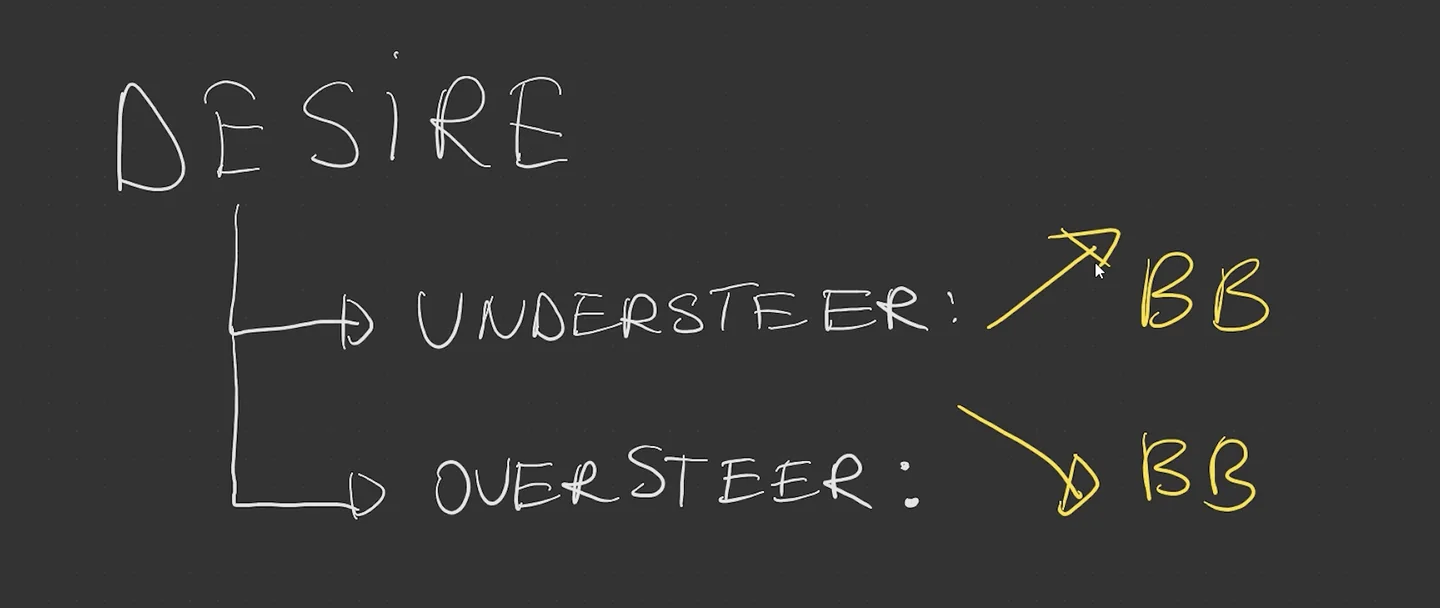
| Move bias forward | More stability, less willingness to turn, more tendency toward understeer |
| Move bias rearward | More willingness to turn, less stability, more tendency toward oversteer |
| Fronts reach the limit first | Try moving bias rearward |
| Rears feel unstable or step out | Move bias forward |
What is brake bias?
Brake bias — also called brake balance — is how braking force is split between the front and rear axles. A setting of 54% normally means roughly 54% of the braking effort at the front and 46% at the rear.
One caveat worth thirty seconds of your time before you start changing things: verify what the number means in the car you are driving. Most sims display the front percentage, so a higher number is more front bias, but display conventions and adjustment increments are not universal across every car and every sim. Change it one step, watch which end of the car reacts, and you will know which direction the number runs before you rely on it mid-race.
What moving brake bias forward or rearward actually does
More front bias
The front tyres do more of the braking work and the rear does less. The rear axle becomes calmer and more predictable, and the car becomes less willing to change direction while you are on the pedal.
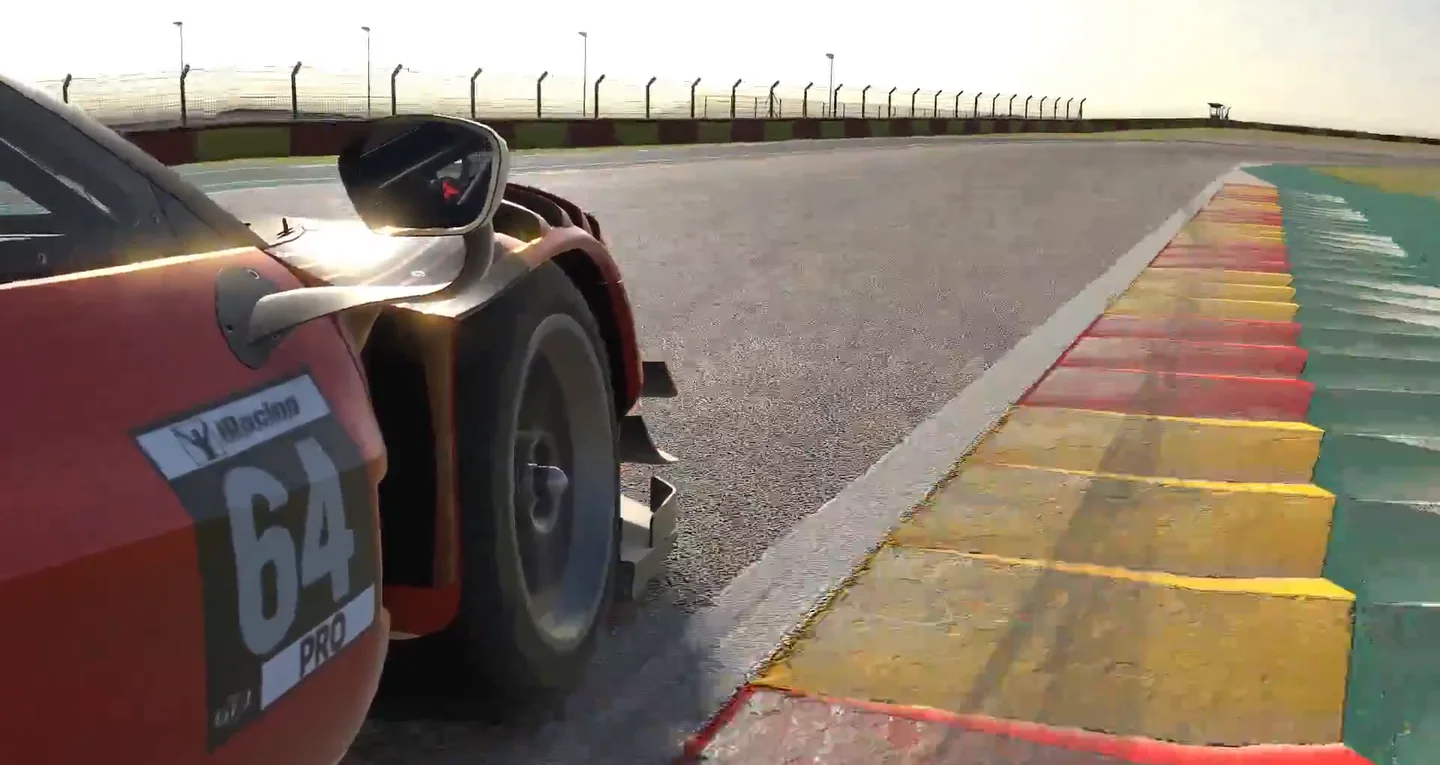
Pushed far enough, the fronts reach their grip limit while the rears are still comfortably within theirs. At that point the front tyres are sliding, and a sliding front tyre does not turn the car — so you get entry understeer and cannot carry the speed you wanted. You are also asking one axle to do work the other axle could have done.
More rear bias
The rear axle takes on more of the braking and the front is relieved. The car becomes more willing to rotate on entry, which is often exactly what you want while you still have brake pressure applied.
Pushed too far, the rears pass their own grip limit first, and a rear axle that lets go under braking is far less forgiving than a front one — this is the direction that spins cars. That asymmetry is the reason the method further down works the way it does. The twelve driving techniques lists bias taken too far rearward among the causes of a spin, for exactly this reason: past a point the rears lock first.
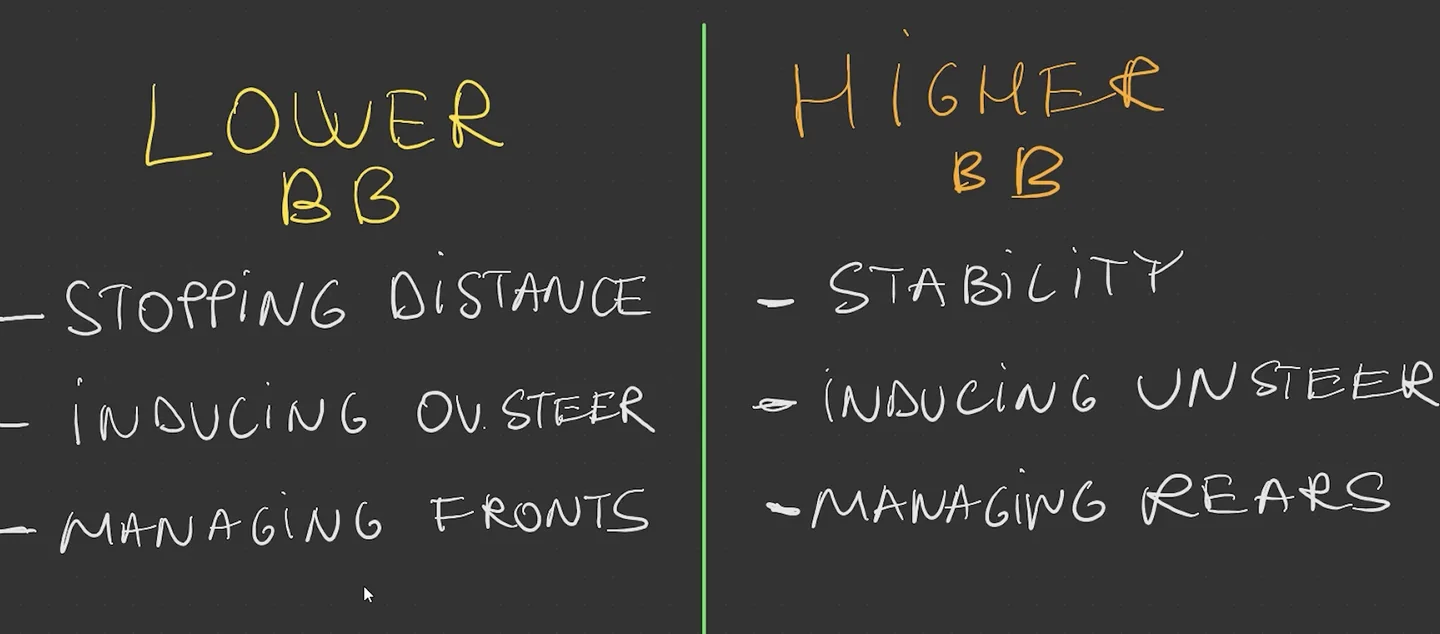
Does moving brake bias rearward make you stop faster?
Sometimes, and it is worth being precise about when, because this gets stated too strongly.
If your setup is excessively front-biased, moving the bias rearward can shorten your braking distance — you are recruiting rear grip that was sitting idle while the fronts were already saturated. The car stops better because more of it is helping.
But keep going and the rear becomes the limiting axle instead. At that point braking performance stops improving and stability gets worse, so you lose in both directions at once. The gain was never in the low number. It was in the balance.
The fastest brake bias is not the most rearward one you can survive. It is the one that gets you closest to using all four tyres while the car stays stable enough to drive consistently.
How brake bias changes understeer and oversteer
This is the table to keep, because it converts something you feel into something you can change.
| What the car does under braking | Likely bias issue | What to test |
|---|---|---|
| Refuses to rotate on entry | Too much front | Move rearward |
| Fronts lock or slide first | Too much front | Move rearward |
| Rear steps out under braking | Too much rear | Move forward |
| Rears lock first | Too much rear | Move forward |
| Stable but lazy to turn | Possibly too much front | Test rearward |
| Rotates more sharply than you want | Possibly too much rear | Test forward |
Bias is one lever among several that affect how readily a car changes direction. Using it deliberately to add a little entry oversteer, together with a sharper brake peak and the downshifts, is covered in how to induce oversteer. If the car will not turn and the bias is already where you want it, the wider subject is covered in how to get more car rotation, and the setup troubleshooter ranks bias against the other levers, phase by phase, for two real cars — this page stays on the one adjustable number. For how bias sits alongside ABS and trail braking in a GT3 specifically, see the GT3 sim racing guide. In an open-wheeler with no ABS, bias does a second job — a lower setting lets you hold threshold pressure longer — which the Formula sim racing guide covers.
How to find your baseline brake bias
The method matters more than any number anybody can give you, because it finds your number in your car.
- Establish a baseline. Run several clean laps at the setup's default so you know what the car currently does. You are looking for a reference feeling, not a lap time.
- Pick one heavy braking zone. One corner, repeated. Changing bias and track position at the same time tells you nothing.
- Move the bias rearward, one or two clicks at a time. Adjustment increments differ between cars, so work in steps rather than in percentage points.
- Watch three things: whether the car stays stable as you brake, whether it turns in more readily, and which axle now reaches its limit first.
- Keep going until the rear becomes uncomfortable — then move one step back forward. That is your baseline.
The logic is simply that the two failure modes are not equally expensive. Overshooting toward the front costs you entry speed; overshooting toward the rear costs you the car. So you approach the rear limit deliberately, find it, and back off one step to buy yourself margin for cold tyres, traffic, and the laps where your release is less tidy than it was in testing.
Should you change brake bias during a lap?
Yes — but two or three times, not ten.
Some corners genuinely want a different balance from the rest of the lap. A corner where the car feels sketchy and rotates more than you want is worth a click forward; a slow corner where the car refuses to turn is worth a click back.
But if you find yourself needing dramatic changes in almost every braking zone, that is not a sign of sophisticated driving. It means the baseline is wrong. Find a setting that works for most of the lap first, then make specific adjustments for the two or three corners that genuinely need them.
Bias is also useful outside the lap itself — on an out lap, for instance, where the tyres and brakes are not yet at temperature. That is covered in our qualifying guide, which deals with the warm-up case specifically.
When to move brake bias forward
- The rear locks or steps out under braking
- You are getting entry oversteer you did not ask for
- A specific corner where stability matters more to you than rotation
- Later in a stint, if the rear tyres are giving you less than they were at the start
- A braking zone you are not confident in — where a predictable car is worth more than a fast one
When to move brake bias rearward
- Entry understeer, or a car that will not turn while you are still on the brake
- The fronts reaching their limit before the rears
- A conservative setup you suspect is leaving rear grip unused
- You can comfortably handle more entry rotation than the car currently gives you
Bias also changes which end of the car you are asking to work hardest, so over a stint it has some influence on how each axle holds up. Be careful how much weight you put on that, though: bias is a trim, not a cure. If your tyres are finished by lap six, the first suspicion is still driving — repeated lockups, or steering a front that has already stopped responding — and those cost far more than any bias setting will recover. Why your tyres overheat and what it is actually costing you diagnoses that from the seat, and it is the right place to start. Come back to bias once the inputs are clean.
Brake bias in iRacing fixed setups
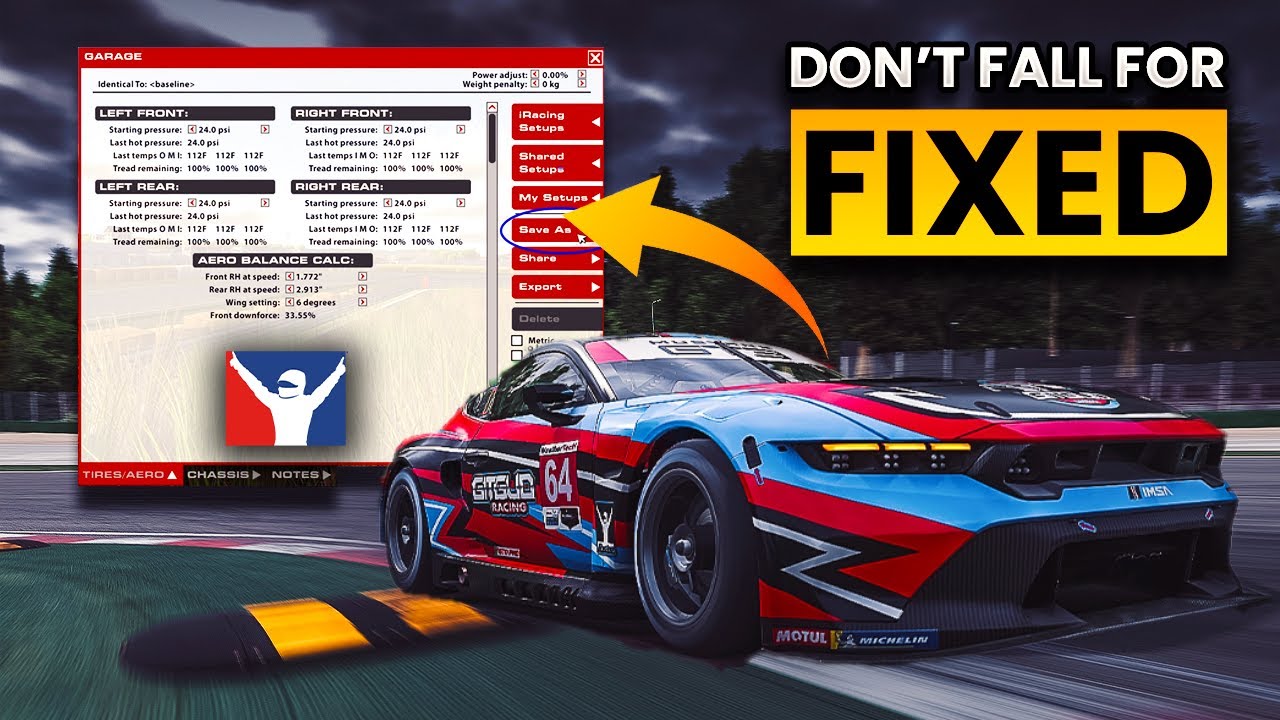
Fixed setups tend to run a relatively conservative brake bias, and there is a good reason for it: the setup has to remain driveable for an enormous range of drivers, including ones who would spin a more rearward balance immediately. Conservative is the right default for a field, not necessarily the right default for you.
Brake bias is normally adjustable from the cockpit even in fixed series, which makes it one of the few genuine performance levers available to you there. If you are comfortable under braking and not fighting the rear, testing a slightly more rearward setting is worth doing — it can unlock entry rotation the default is deliberately leaving on the table.
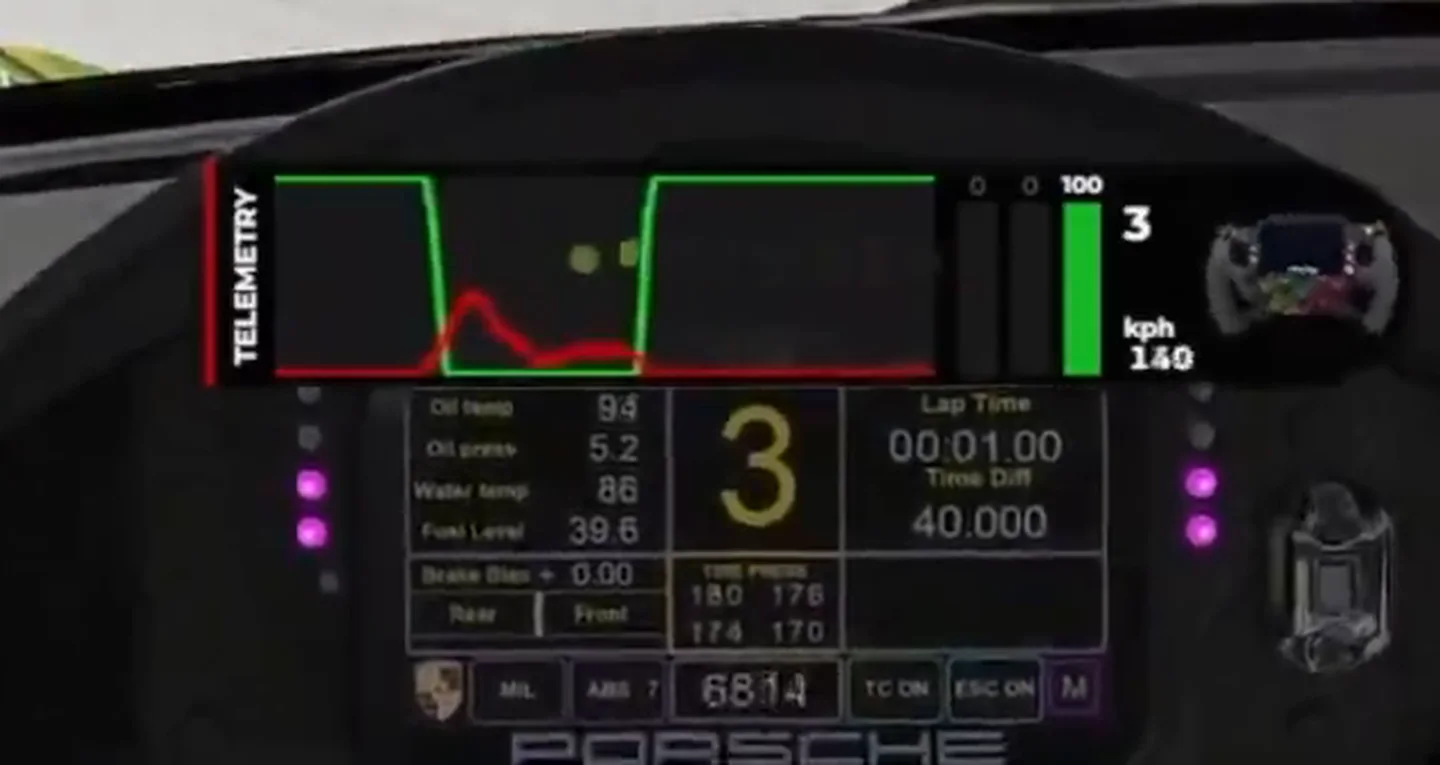
What is not worth doing is copying a number off someone else. Cars, tracks, tyre states and driving styles all want different values, and a percentage that works for a driver with a different brake release will not transfer to you.
What is the best brake bias?
There is no universal answer, and any page giving you one number is selling simplicity rather than lap time.
The best setting is the most rearward bias you can run while keeping the stability and consistency that the braking zone demands. That number differs between cars, between tracks, between a fresh set and a worn one, and between two drivers in identical machinery who release the brake differently.
Which is why the method above is the actual answer to the question. You are not looking for a number. You are looking for the point where the rear starts objecting, and then living one step in front of it.
Brake bias and trail braking
These two get confused, and the distinction is clean: brake bias determines how the car behaves while braking force is applied; trail braking is about how that force is released as steering builds.
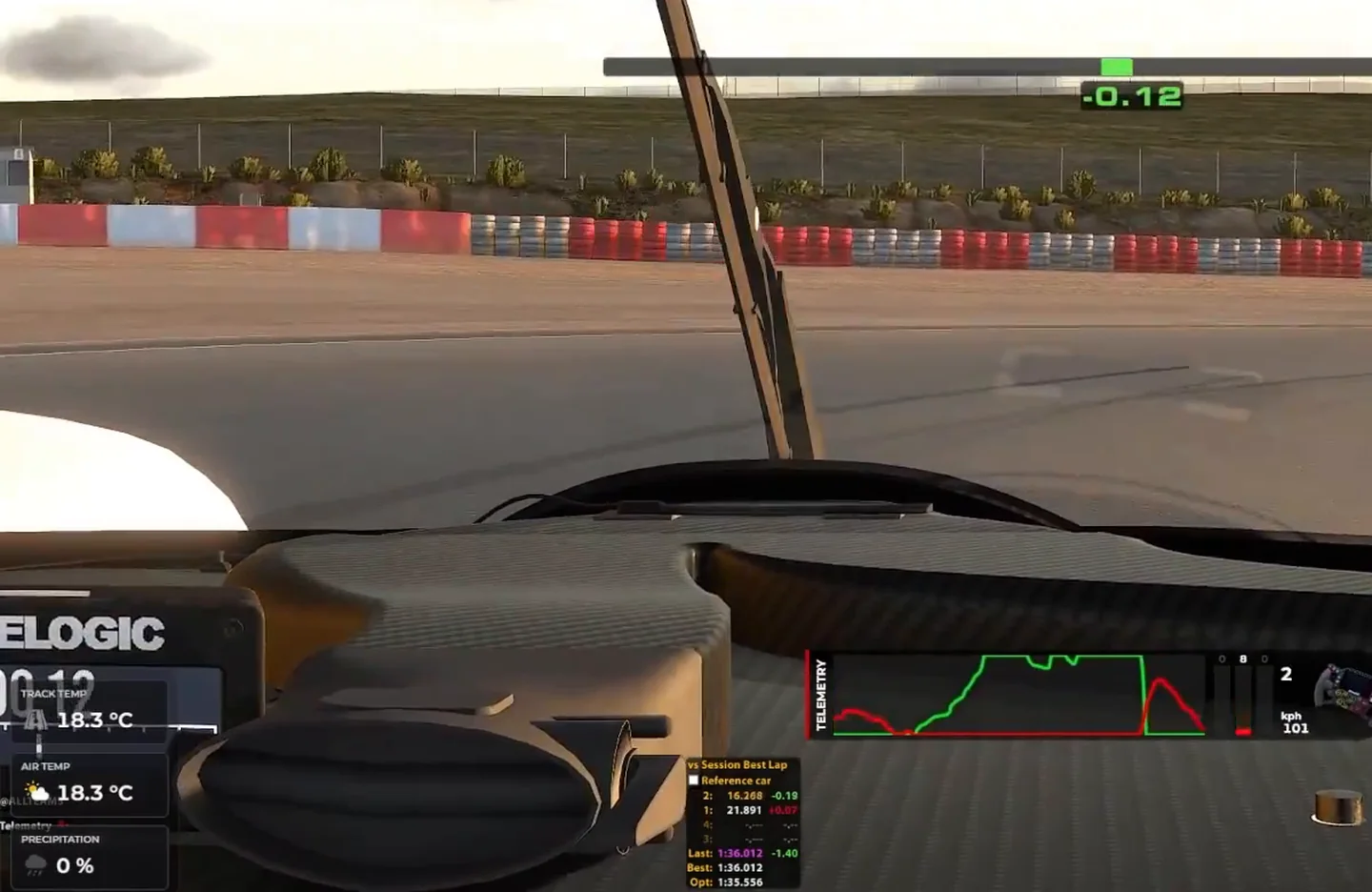
They interact, which is why bias changes feel different depending on how you release. A driver who comes off the brake abruptly will feel a rearward bias mostly as instability; a driver with a long, progressive release will feel the same change as extra rotation. If your release is the variable you are unsure about, start with how to control speed while keeping the front loaded and come back to bias once it is repeatable.
The same ordering applies more generally. Bias is a real lever, but it is a lever applied to whatever inputs you are already making — it will not rescue an entry that changes shape every lap. If that sounds like your driving, the faults in six mistakes a coach found in one lap are worth ruling out first, because a repeatable entry is what makes a bias change readable at all.
Brake bias FAQ
What is brake bias in sim racing?
Brake bias, also called brake balance, is how braking force is divided between the front and rear axles. A setting of 54 percent normally means roughly 54 percent of the effort at the front and 46 percent at the rear. It is one of very few adjustments you can make while driving, usually on a rotary or a pair of keybinds. Verify which direction the number runs in your car before relying on it mid-race — most sims display front percentage, but increments and conventions are not universal.
Is higher brake bias front or rear?
In most sims a higher number means more front bias, because the figure displayed is the front percentage. More front bias sends braking effort to the front tyres, which makes the rear axle calmer and the car less willing to change direction while you are on the pedal. Lower numbers move effort rearward, which increases entry rotation and reduces stability. Because the display convention is not guaranteed across every car, change it one step and watch which end of the car responds.
Does moving brake bias rearward cause oversteer?
It moves the car in that direction, yes. Shifting effort rearward asks the rear tyres to do more braking work, so they approach their grip limit sooner — which gives you more willingness to rotate on entry, and eventually instability or a rear that steps out. That is why the sensible method approaches the rear limit deliberately and then backs off one step: overshooting toward the front costs you entry speed, while overshooting toward the rear can cost you the car.
Does brake bias affect stopping distance?
It can, but not in one direction indefinitely. If a setup is excessively front-biased, moving bias rearward can shorten braking distance because rear grip that was sitting idle starts contributing while the fronts are already saturated. Push further and the rear becomes the limiting axle, at which point stopping performance stops improving and stability gets worse. The gain is in the balance rather than in the low number — the quickest setting is the one using all four tyres while staying stable enough to drive consistently.
What is the best brake bias?
There is no universal figure, and any single number is a simplification. The best setting is the most rearward bias you can run while keeping the stability the braking zone demands, and it differs between cars, tracks, tyre states and drivers — two drivers in identical machinery who release the brake differently want different values. Find yours by moving rearward a click or two at a time in one heavy braking zone until the rear becomes uncomfortable, then going one step back.
Can you change brake bias in an iRacing fixed setup?
Brake bias is normally adjustable from the cockpit even in fixed series, which makes it one of the few genuine performance levers available there. Fixed setups tend to ship a relatively conservative balance because they have to stay driveable across a very wide range of drivers, so if you are comfortable under braking and not fighting the rear, a slightly more rearward setting is worth testing. Do not copy a percentage from another driver — a value that suits a different brake release will not transfer.
This guide is part of the free library at GitGud Racing Academy — an online sim racing academy built around weekly lap reviews, structured courses, drills and training tools.
Train this the right way
Reading is step one. Build it into muscle memory with structured, car-specific courses and personal lap reviews from a coach — inside the Academy.
Join the Academy · $39.99/mo incl. VATWatch the full video on YouTube