Can an AI Sim Racing Coach Actually Make You Faster?
Short answer: yes, but not equally, and not for the group you would expect.
The intuitive assumption is that AI coaching helps the middle hardest — the large majority of drivers who are past the beginner stage and not yet quick. That is the group the marketing speaks to. Having coached drivers every week for years, I think the usefulness curve is closer to a U: strong for beginners, strong again for very fast drivers, and weakest exactly in the middle.
This page is about why, and about what these tools genuinely do well, because there is a real product here and dismissing it would be as lazy as overselling it.
Looking for a human coach rather than software? That is what we do: sim racing coaching with a real coach reviewing your laps every week.
What an AI sim racing coach actually is
Strip away the branding and the mechanism is consistent across the category. The software records your telemetry — speed, brake, throttle, steering, gear, line, sector times — and compares it against a reference lap. Then it surfaces the differences, either as a post-session report or as feedback while you drive.
What comes out sounds like coaching: brake a little later into turn three, get to the throttle more aggressively on exit, carry more speed at the apex. Useful sentences. But look at what produced them, and they are the telemetry read aloud.
That is not an insult to the technology, and it is worth saying plainly: translation is a real service. Plenty of drivers will never open a telemetry tool, and for them an overlay that says "you are two tenths down here, and it is the brake" is genuinely more useful than data they were never going to look at. For those who will, how to read sim racing telemetry is the manual method the software is approximating.
A delta is a difference, not a diagnosis
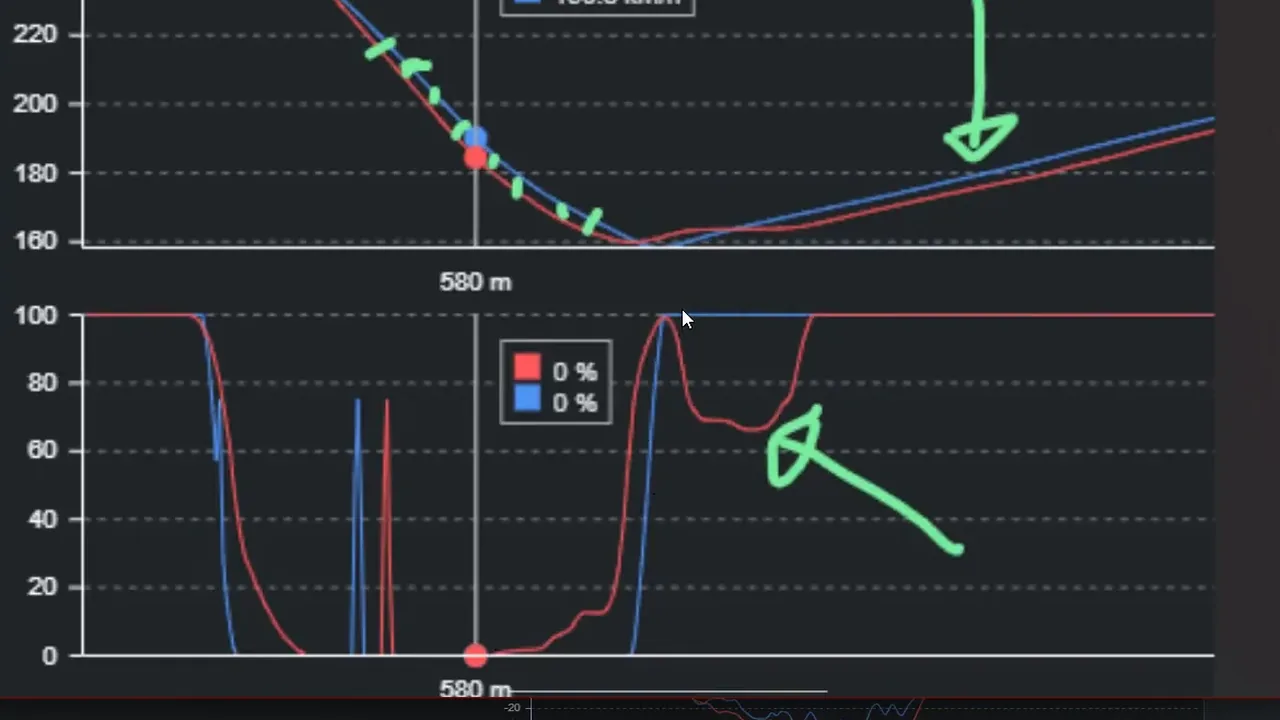
The limitation underneath all of this is not new, and it is not specific to AI. We made the same point about overlays generally when writing about why perfect-looking telemetry can still be slow — a comparison can tell you that your throttle arrived later than the reference, but not that the cause was a rotation shortfall two phases earlier. Describing telemetry and diagnosing driving are different activities.
What is worth adding here is that AI coaching does not close that gap. It makes the description far more accessible, which is genuinely valuable, and it presents that description in the grammar of instruction — which is where the trouble starts, because "brake later into turn three" sounds like a diagnosis even when it is a measurement. If you want to compare the two directly, see what an actual coach review contains.
Sit with the list of things that could produce one single difference of eighteen metres on the brakes. You do not trust the front end. Your vision is short, so the corner arrives sooner than it should. Your line is wrong, so you genuinely do need to be slower. You turn in early and have to scrub speed to make the apex. Your brake release is inconsistent, so you build in margin. Your reference point is vague. Or the reference lap you are being measured against was set on a setup, a fuel load or a tyre state that has nothing to do with yours.
Every one of those produces the same telemetry difference. None of them is fixed by "brake later" — and several of them get worse if you follow that instruction literally. When braking later genuinely is the answer, it is a sequence of its own rather than an instruction: how to brake later.
Patchwork driving
This is the failure mode I see most often in drivers who have been using these tools for a while, and it is worth a name.
Patchwork driving is fixing the corner instead of fixing the driver.
The AI flags turn three. You brake later at turn three. You find a tenth and a half. Genuine improvement, and it felt like learning. Then turn seven arrives with the same underlying cause expressed differently, and you lose more than you gained — because what you learned was not brake confidence, or vision, or how to release the pedal. What you learned was turn three: brake later.
Do that for a season and you accumulate a patchwork of corner-specific corrections rather than a technique. It looks like progress on any given evening, and it stalls, because the number of corners in the world is larger than the number of things actually wrong with your driving.
The tell is simple: if your improvements do not transfer to a track you have never driven, you have been patching.
Why beginners get the most out of it
Because beginners make mistakes that are large enough that naming them is the fix.
If you are four or five seconds off the pace, you are not losing that to a subtle brake-release shape. You are braking dramatically too early, missing apexes by a car's width, waiting far too long to get back to power, or never reaching full braking pressure at all. A tool that says "everyone else brakes here and you brake here" solves a real problem, and it does not need any causal reasoning to do it.
There is a second benefit that gets undersold: beginners usually do not know how to read telemetry, and a pretty overlay that updates as they drive is a much gentler introduction than a graph they have to interpret alone. Most genuine beginners will find seconds this way. That is not nothing.
Why the middle is the hard part
This is the section that matters, because it is the largest group of drivers and the one the category is sold to hardest.
An intermediate driver already knows they are slow. They usually know roughly where. What they get told is that they need seven km/h more minimum speed through a corner — and the honest response to that is: how?
Because "carry more speed" is not an action. The actions that would produce it are things like turning in later, releasing the brake more progressively, using a different line, reducing steering angle, or moving the apex — and choosing between those requires knowing which one is currently wrong. That choice is the coaching. The number was just the invoice.
Give that driver a corner-by-corner list of differences and the rational thing to do with it is to patch, because patching is the only action the data actually supports. They are not failing to understand the tool. The tool is not answering the question they have.
If you want a worked example of what that diagnosis looks like when it is done properly, the session behind six mistakes a coach found in one lap is exactly this — several telemetry symptoms that turned out to share an upstream cause, where fixing them individually would have failed.
Why it gets useful again at the top
The counterintuitive half. Very fast drivers get real value from AI coaching, for the opposite reason to beginners.
They do not need to be taught technique. What they need is to know where the opportunity is. Show a genuinely quick driver that someone is carrying five km/h more into a corner and they can work backwards themselves: if that is possible, I am probably under-using the front tyre during release, so let me try this. The single reason they were not already pushing there is that they believed they were at the limit.
For them the tool is a convenience — a faster way to locate opportunities in data they could read anyway. That is a perfectly good reason to pay for something.
What is actually on the market
The category has grown quickly, and the products differ more than the shared "AI coach" label suggests. The most useful distinction is whether you get feedback while you drive or after:
- Trophi.ai — markets itself on real-time coaching, describing an app that watches your driving as it happens and tells you what to fix, alongside post-session analysis.
- Track Titan — brands itself as an AI sim racing coach, built around post-session telemetry and reference-lap analysis rather than live feedback.
- RaceData AI — also post-session, positioned around finding where you lose time turn by turn.
- MOZA Racing Lab — real-time, but presented visually against AI-generated reference data rather than as a voice in your ear, and tied to MOZA's own hardware ecosystem.
- TrackPro, from Sim Coaches — offers both live feedback and post-session analysis.
Check the current feature list before you buy rather than trusting any summary, this one included; the products are iterating fast and what is true this month may not be next.
One thing to know before you read a comparison
Not a criticism of the technology, just something worth knowing about the information around it.
Search for a comparison of these tools and much of what ranks is published by the companies themselves. The most prominent "best AI sim racing coaches" roundup, and the head-to-head comparisons alongside it, are hosted by one of the vendors — and unsurprisingly, that vendor's product comes out on top. It is not hidden; it is simply easy to miss when a page reads like a neutral review.
Affiliate arrangements are also normal across the category, with commission programmes and discount codes circulating through creators. That does not make anyone dishonest, and most reviewers disclose. But it does mean the incentive across almost everything you will read runs in one direction, and there is very little independent coverage arguing that the category has limits.
Which is most of my reason for writing this. I have no product to sell you here.
Is an AI sim racing coach worth it?
Worth it if you are new enough that your mistakes are large, if you will not open telemetry on your own, if you are learning unfamiliar tracks and want to know quickly where the time is, or if you already understand technique well enough to interpret what you are shown.
Less useful if your actual problem is understanding why the car behaves the way it does, if you have been fixing individual corners for months without the gains transferring, or if you are already comfortable reading your own data — in which case you are largely paying for convenience, which is a fine thing to buy knowingly.
The framing I would push back on is AI coaching as a replacement for either telemetry or a coach. It sits between them: more accessible than raw data, less diagnostic than a person. Both of those are true at once, and the category is genuinely useful once you hold both.
Where I would put the money
I use AI daily — I write software for a living, and in programming, a domain where these tools are far more mature, the limits are still real and still obvious. Sim racing is not further ahead.
The part I would not oversell is that root causes are hard. I coach every week, and there are sessions where it takes me a long time to work out why a driver is doing what they are doing — watching them, asking questions, testing theories against the car. That is not a task a comparison against a reference lap is shaped to perform.
So: if the difference is what you are missing, buy the tool. It is cheaper than a coach, available at midnight, and it will find things. If you already know where you are slow and cannot work out why, more data on the same question is not the purchase that helps. That is when it is worth having somebody look at the driving itself and tell you which single habit to take into your next practice session. That is what sim racing coaching is for.
And if you would rather test that yourself first, structuring a practice session around one variable costs nothing and will tell you fairly quickly which of the two problems you have.
AI sim racing coach FAQ
Can an AI sim racing coach make you faster?
Yes, but unevenly. The usefulness curve is closer to a U than a straight line: strong for beginners, whose mistakes are large enough that simply naming them is the fix; weakest for intermediate drivers, who already know where they are slow and need to know why; and useful again for very quick drivers, who can interpret a difference themselves and mainly need help locating the opportunity. If you are in the middle, expect a list of differences rather than an explanation.
What does an AI sim racing coach actually do?
It records your telemetry — speed, brake, throttle, steering, gear, line and sector times — compares it against a reference lap, and surfaces the differences as either a post-session report or feedback while you drive. The output sounds like coaching, but what produced it is a comparison. That is genuinely useful as translation for drivers who would never open a telemetry tool themselves, which is a real service even though it is not diagnosis.
Are AI sim racing coaches good for beginners?
Probably better than most people expect. A driver four or five seconds off the pace is not losing that to a subtle brake-release shape — they are braking dramatically too early, missing apexes, or never reaching full braking pressure. Naming those mistakes is close to fixing them, and no causal reasoning is required to spot them. Beginners also tend not to read telemetry, so a live overlay is a gentler introduction than a graph they would have to interpret alone.
Can an AI coach replace a human sim racing coach?
They answer different questions. An AI coach reliably tells you that you braked eighteen metres earlier than a reference lap; working out why is a separate problem, and the same difference can come from distrusting the front end, short vision, an early turn-in, a vague reference point, or a reference lap set on a setup unlike yours. None of those is fixed by braking later, and several get worse. AI coaching sits between raw telemetry and a person: more accessible than data, less diagnostic than a coach.
What is the difference between AI coaching and telemetry analysis?
Mostly the interface. Both compare your inputs against a reference; AI coaching converts the result into plain sentences and, in some products, speaks them while you drive. That lowers the skill floor considerably, which is its real value. What it does not add is interpretation of why a difference exists, so a driver who can already read telemetry comfortably is largely buying convenience — a perfectly reasonable purchase, as long as it is a knowing one.
This guide is part of the free library at GitGud Racing Academy — an online sim racing academy built around weekly lap reviews, structured courses, drills and training tools.
Train this the right way
Reading is step one. Build it into muscle memory with structured, car-specific courses and personal lap reviews from a coach — inside the Academy.
Join the Academy · $39.99/mo incl. VATWatch the full video on YouTube