How to Avoid Crashes in Sim Racing
There is a version of sim racing where you spend most of your week practising and most of your Sunday being taken out by someone on lap one. The usual advice, "be more careful", does nothing, because almost nobody crashes on purpose.
The short answer: most avoidable crashes come down to four things. Predictable positioning the cars around you can read. Margins that fit the moment: bigger on cold tyres and in a pack, not everywhere. More than one braking reference, so a car alongside cannot hide yours. And looking past the car immediately ahead. None of it means being slower; two of the most useful habits here involve being less polite and less slow. They came out of a stretch of ten consecutive races without an incident.
This page is about the moment: your eyes, your position and your decisions. If your problem is the pattern, how to get better at sim racing has the incident-review method, and the iRating trap covers taking risks to repair a bad result.
What keeps happening?
Each of these is usually decided a few seconds before the contact, by something you could have known.
| What keeps happening | Usually decided by | Go to |
|---|---|---|
| You run into the back of the car ahead | Where your eyes were | Rear-ending |
| You get hit from behind under braking | Braking out of step with the pack | Under braking |
| Side contact with a car alongside | How much room you gave and took | Side by side |
| You spin or slide into someone on lap one | Grip you do not have yet | Cold tyres |
| A second crash after a spin or an off | When and where you came back on | Rejoins |
The settings and mindset that help with all five are at the end.
You keep running into the car ahead
The decision before the contact: your eyes were on the car in front, or on a board it was hiding, so its brake lights were your first warning.
Look further ahead than the car in front
Tunnel vision is the most common vision fault in sim racing, and it has two flavours. The first is staring at your own braking reference instead of the horizon. The second is locking onto the bumper of the car ahead.
Both leave you reacting to things at the moment they reach you. Keep the car ahead in your awareness, but put your attention past it: at the braking zone, at the corner after this one, at the spray of dust that means someone three cars up has already gone off. That is where your reaction time comes from.
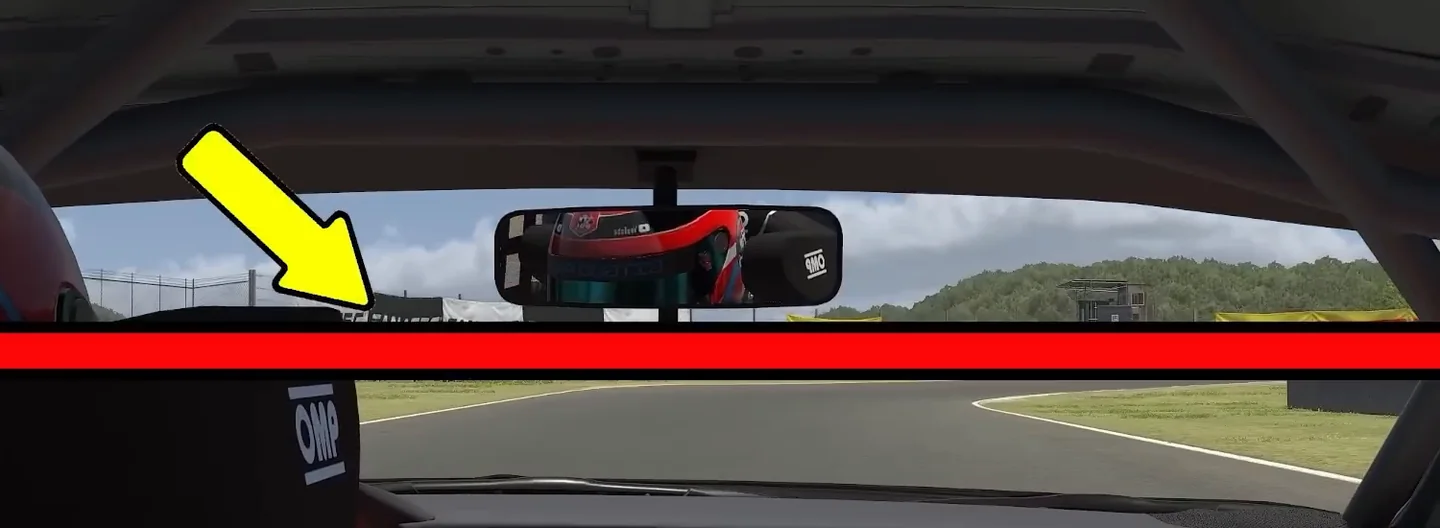
If you regularly get collected by incidents that started ahead of you, that is rarely bad luck. It is usually this.
Have more than one braking reference per corner
This is the habit that quietly does the most work, and it comes from a simple problem: your braking reference is often behind another car.
Alone, one board is fine. In a pack, the board is blocked, the car you are trying to pass is exactly where you look, and you end up guessing. Guessing in a braking zone is how contact happens.
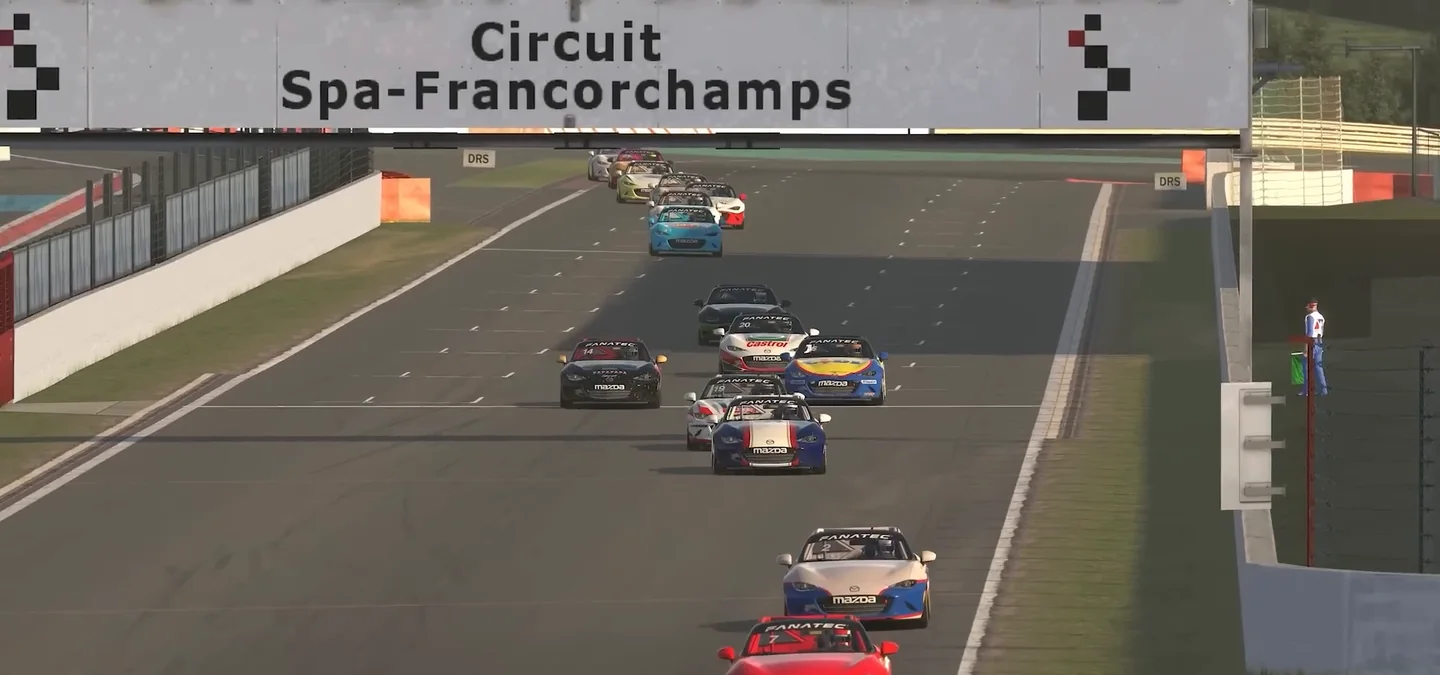
Give every corner two or three references at different heights and angles: a kerb start, a fence post, a change in the tarmac, a shadow. It buys you flexibility in traffic, and it has a useful side effect: hunting for references trains you to pick them up faster, so you learn new tracks quicker too.
You keep getting hit under braking
The decision before the contact: you braked where the car behind did not expect, or missed a car closing faster than the corner allowed.
Braking early is only safe if the cars behind expect it
The reflex when things get busy is to lift. It feels like the cautious option, and in the middle of a pack it is one of the more reliable ways to cause an incident.
Braking earlier than the cars around you expect makes you an obstacle. They have calibrated their braking to the pack, not to you. And having scrubbed too much speed, you now have to add it back mid-corner, which is exactly where you have least control.
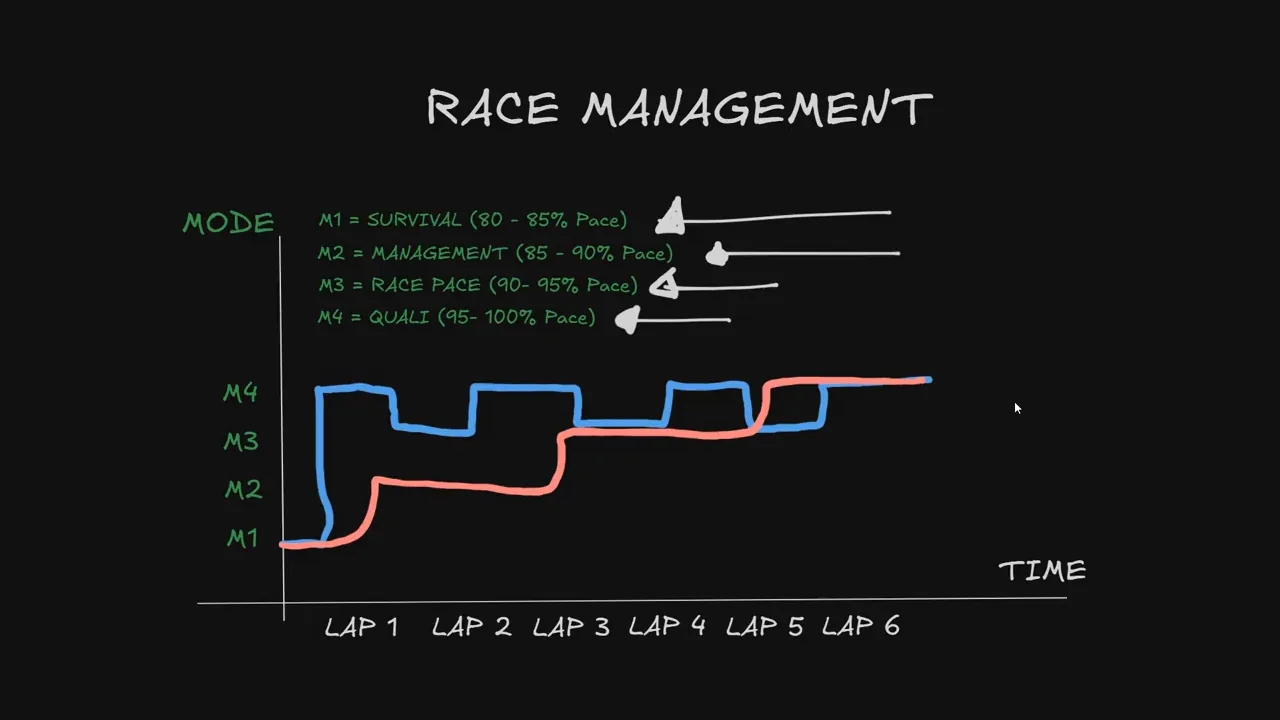
There are times to brake early, such as an incident ahead or the cold-tyre lap below; then make it early and obvious, not a sudden lift in the middle of a braking zone. Otherwise, predictability is the actual safety mechanism, and being slow is sometimes its opposite. Slow early also invites the attack, and the car behind the attacker watches. How quickly to get to your speed once the first corners are behind you is race pace.
Watch the mirrors for a dive bomb before it happens
Dive bombs look unavoidable and mostly are not. A car closing much faster than the corner allows is visible in your mirrors well before the braking zone. It means either an attempt is coming or they have already made a mistake and are a passenger.
Either way the response is the same: know they are there, take a defensive line early, and leave yourself somewhere to go. Being surprised is what turns a dive bomb into a crash. Whether the move was fair is a separate question, covered below.
Side-by-side contact
The decision before the contact: you gave away the line on entry and took it back mid-corner, or ended up with no room either side.
Give the space that is owed, not more
A lot of crashes come from a driver being generous on entry. It feels safe and reads as good sportsmanship. The problem is what it does to the next three seconds: you have handed away the line, you arrive at the apex in the wrong place, and now you are the one who has to make a correction mid-corner with a car alongside.
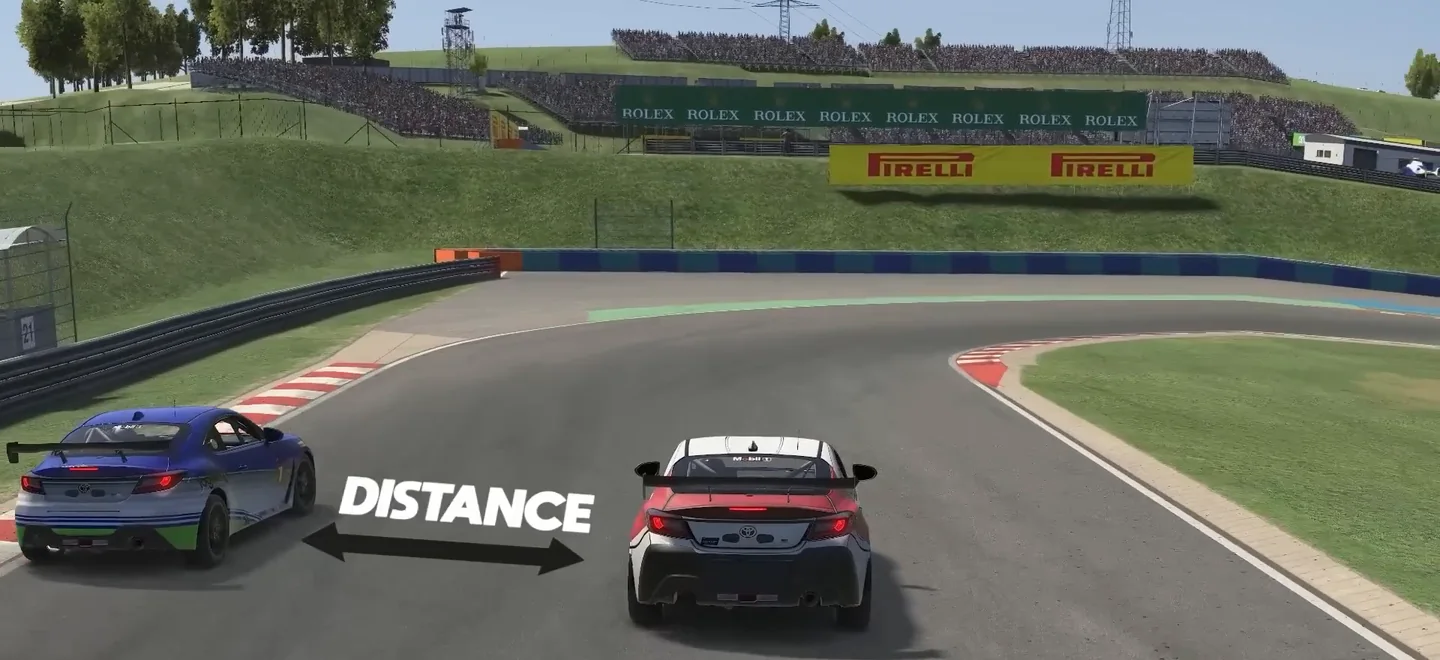
Give the space that is genuinely owed, and keep giving it to the exit. Do not give away the corner and then have to retrieve it.
Three-wide: decide whether it is worth it before you create one
Three abreast is thrilling and has almost no margin: one driver being slightly off, not even wrong, takes out all three. Whether it is worth it depends on how sure you are of your line, how well you know the drivers either side, and how much of the race is left. Early on, against drivers you do not know, it rarely is.
If you end up three-wide, the middle is the hardest place to be
The middle car has no room on either side and therefore no ability to correct anything. Outside or inside, you have somewhere to go. In the middle, you are relying entirely on two other people. Do not choose to be the meat in the sandwich.
If you are already there, hold a steady, predictable line and be ready to concede the position rather than ask either neighbour for room they do not have.
Know which corners are not worth an overtake
Not every corner is a passing place. Some are too narrow, some are too fast, and attempting a move there is a coin flip regardless of how well you drive it.
As a rule of thumb, high-speed corners are rarely worth it, and low-speed corners (hairpins, chicanes, anywhere with a long braking zone) are where passes actually complete. It varies with the car and the track, so learn which is which on the tracks you race. A failed move usually loses more time than waiting two more corners for a good one would have.
Practise the inside line, not just the racing line
Almost all practice happens on the ideal line, and then every defensive moment and every overtake in a real race happens somewhere else.
The inside line is a different corner. It is often dirtier, the grip is genuinely lower, and the first time you find that out should not be with a car alongside you. Spend part of your practice off the racing line so that defending and passing use a line you have actually driven.
Lap one and cold-tyre spins
The decision before the contact: you braked at your lap-ten point on tyres without lap-ten grip, in the tightest pack of the race.
Give more room on the cold-tyre lap
The first lap produces more incidents than any other, for two reasons stacked together: the field is at its most tightly packed, and in most sims the tyres are not yet up to temperature, so braking distances are longer than the ones you rehearsed and the car is less predictable at the limit. How cold depends on the sim and on whether there was a formation lap.
Leave a bigger gap, brake earlier than feels necessary, and let the field sort itself out. Close it up as the tyres come in. A race is almost never won on lap one, and it is often lost there.
Starting from the pit lane: know what it costs
Starting from the pits removes the lap-one risk, which is why it appeals when you are nervous. It also removes the most instructive part of the race: starts and first laps are where racecraft is built. If the reason is nerves, take the grid slot and use the bigger first-lap margin above; a messy race you learn from beats a clean one you sat out. If you have another reason, such as joining after the grid has formed, the pit lane is a reasonable choice. Make it a choice, not a habit.
Racecraft sits last in the twelve driving techniques because it is the only one you cannot practise alone. This page is its defensive half; the attacking half, how to overtake, defend and read the other driver, is the sim racing racecraft guide.
Race the AI before you race people
AI racing is underrated as preparation. It gives you starts, wheel-to-wheel situations and decisions under pressure without anyone else's race being on the line when you get one wrong.
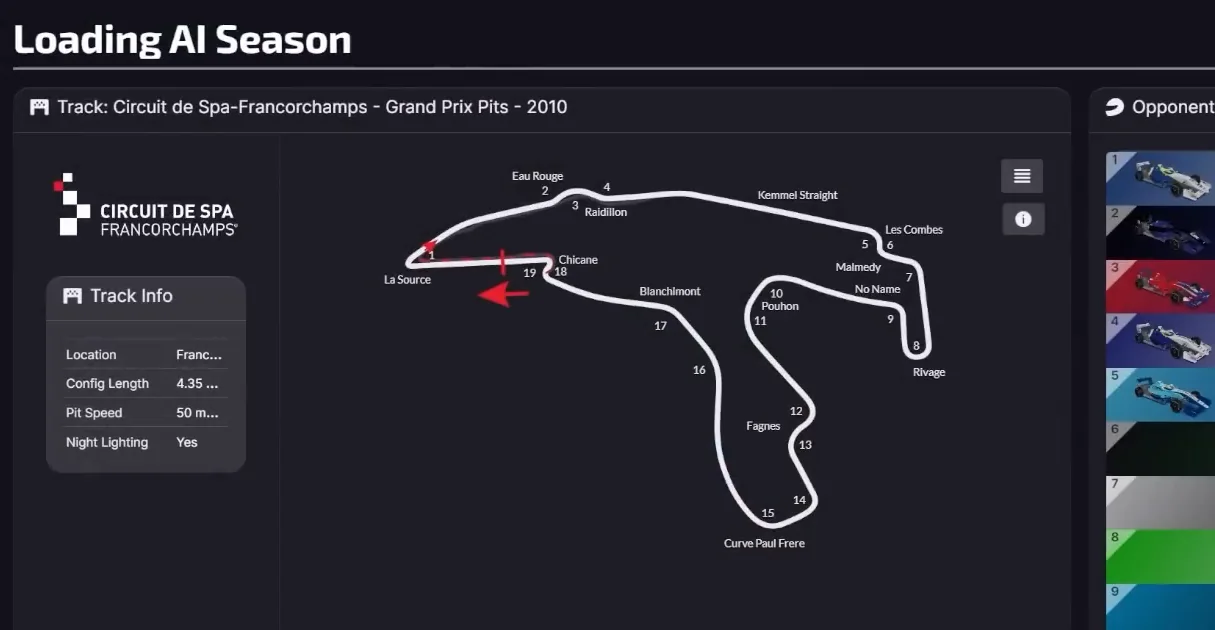
It is not a substitute for online racing. It is a good place to make your first mistakes.
Spins, offs and rejoins
The decision before the contact: you stayed on the tarmac into a spun car, or rejoined the racing line without checking what was coming.
Going off track is often the cheaper option
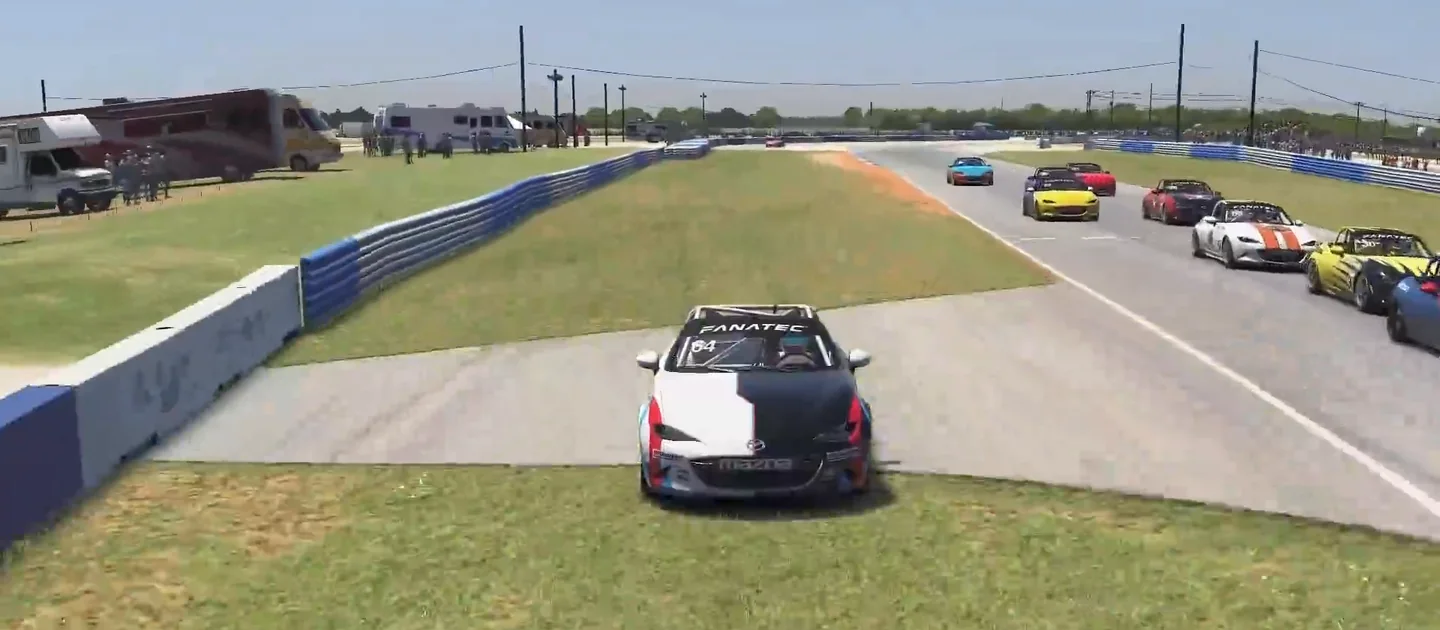
Plenty of drivers treat leaving the circuit as failure and stay on the tarmac into a car that has spun in front of them. Where there is usable run-off, that is nearly always the wrong trade: an incident point and a few seconds is cheaper than a barrier, a retirement, or ending someone else's race. Grass or gravel at speed carries its own risk, so it is a choice between two risks, not a free escape.
This is really the vision problem again: under stress, attention narrows onto keeping the car on the road, and the escape route stops being visible.
Rejoin like someone is coming, because they are
Rejoining badly causes a second crash after the one you just avoided. Two tools: your mirrors, and the delta bar.
If a car is less than about two seconds behind, assume they are arriving on the racing line at full speed and do not rejoin onto it. Wait. Losing two seconds and keeping a race is a trade worth making, and the driver you did not collect gets to keep theirs too.
Avoiding a crash is not the same as deciding fault
After contact, two questions get mixed up. Whose fault was it? is for the stewards, a protest or the league. Could I have avoided it? is for you, and it is the only one that changes your next race. A dive bomb can be entirely the other driver's fault and still avoidable if they were in your mirrors for three corners. And in iRacing the incident points land on everyone involved regardless of who caused it, so being in the right does not protect your safety rating anyway.
So review contact by asking what you knew and when, not who should have backed out. Report the move if it deserves it, then fix the part that was yours, using the review method in how to get better at sim racing.
Settings that show you more, and one to turn off
Many avoidable incidents are information problems. These settings put more of the information in front of you.
Widen your virtual mirrors
Most sims let you set the field of view of the virtual mirror separately from the cockpit view, and most drivers never touch it. Widening it is one of the largest single gains available, because the default shows you a slice of the road behind and hides exactly the car that is about to be alongside.
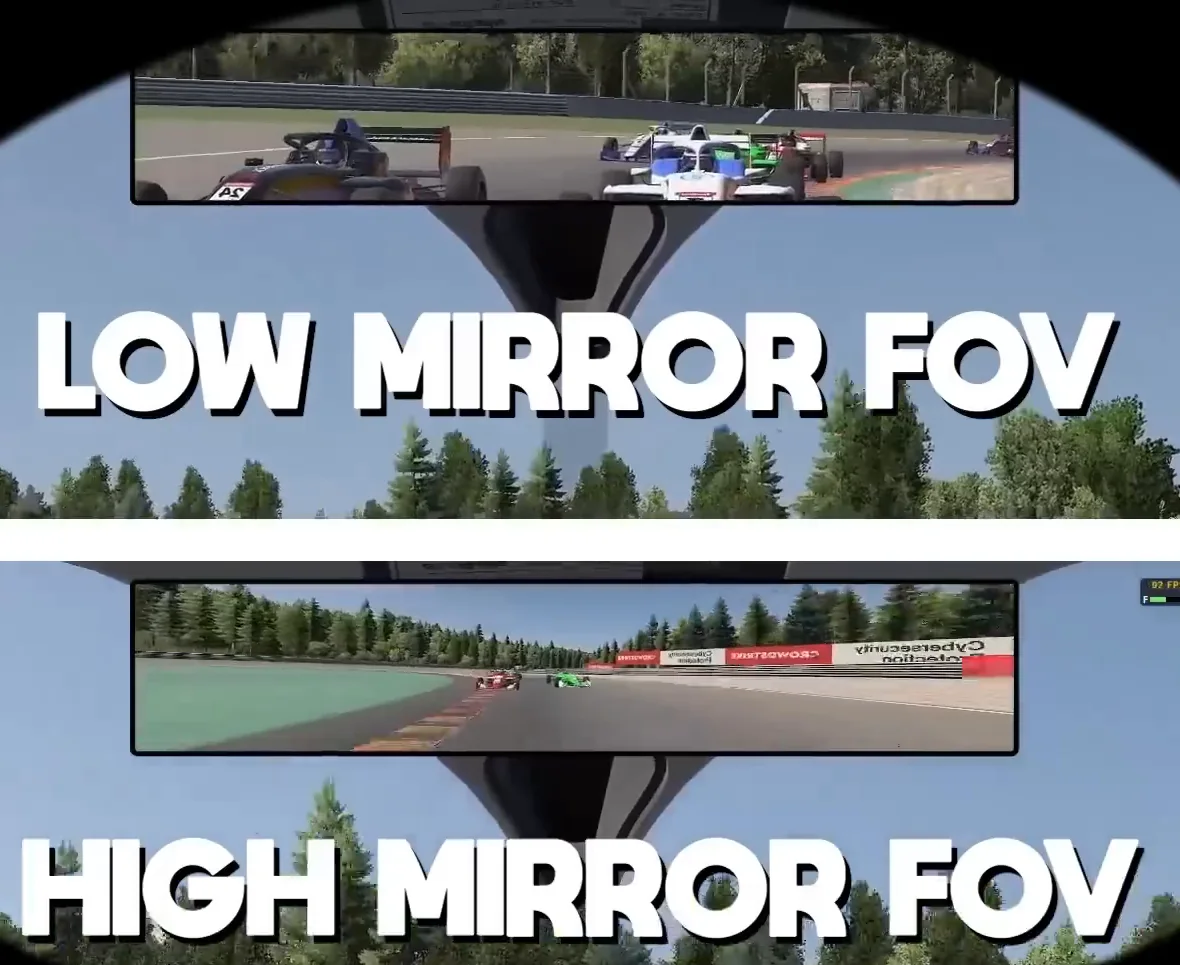
Is a very wide mirror realistic? No. It is common among the drivers at the sharp end anyway, because the competitive advantage is obvious and the realism cost is a mirror.
Get your cockpit FOV right, but do not confuse it with the mirror
Your cockpit field of view is a different setting with a different job. Too narrow and you lose the sense of speed and of where your car is on the road. Too wide and distances distort, which makes judging a gap harder precisely when it matters.
We are not going to re-derive it here, because it depends on your screen size and how far your eyes sit from it, and there is a calculator that works it out for you. Set it once, properly, and leave it alone.
One caveat that most FOV advice skips: a correct, fairly narrow FOV makes you quicker alone and more vulnerable in traffic, because your peripheral awareness genuinely shrinks. If you race on an ultrawide or a single screen, bind look-left and look-right to wheel buttons and use them. That recovers most of what the correct FOV costs you.
Run a radar overlay and a spotter
A proximity radar and a working spotter are the closest thing to a cheat code on this page. They tell you about cars you physically cannot see from a fixed screen, which is the single biggest difference between a sim cockpit and a real one.
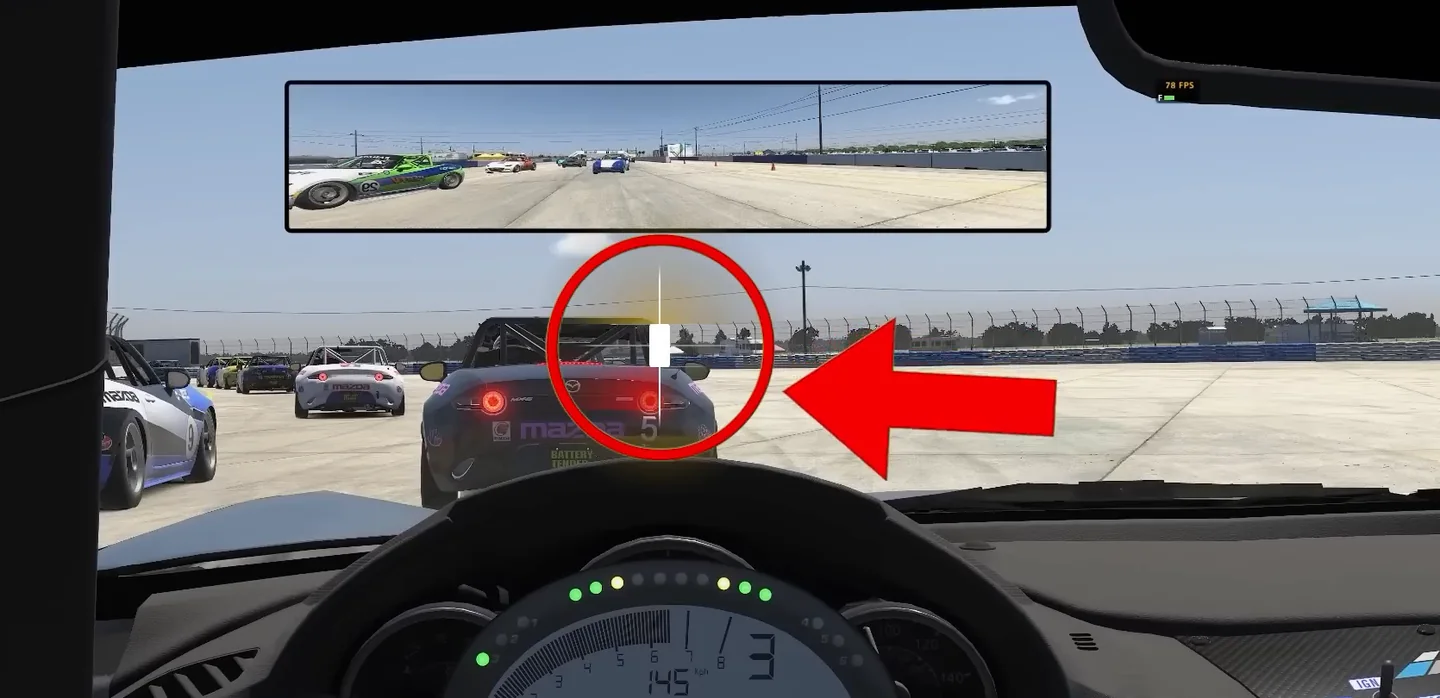
Yes, it is more to process. It stops being extra load within a couple of races and becomes the thing you glance at without deciding to.
Turn off force feedback crash effects, if your sim has them
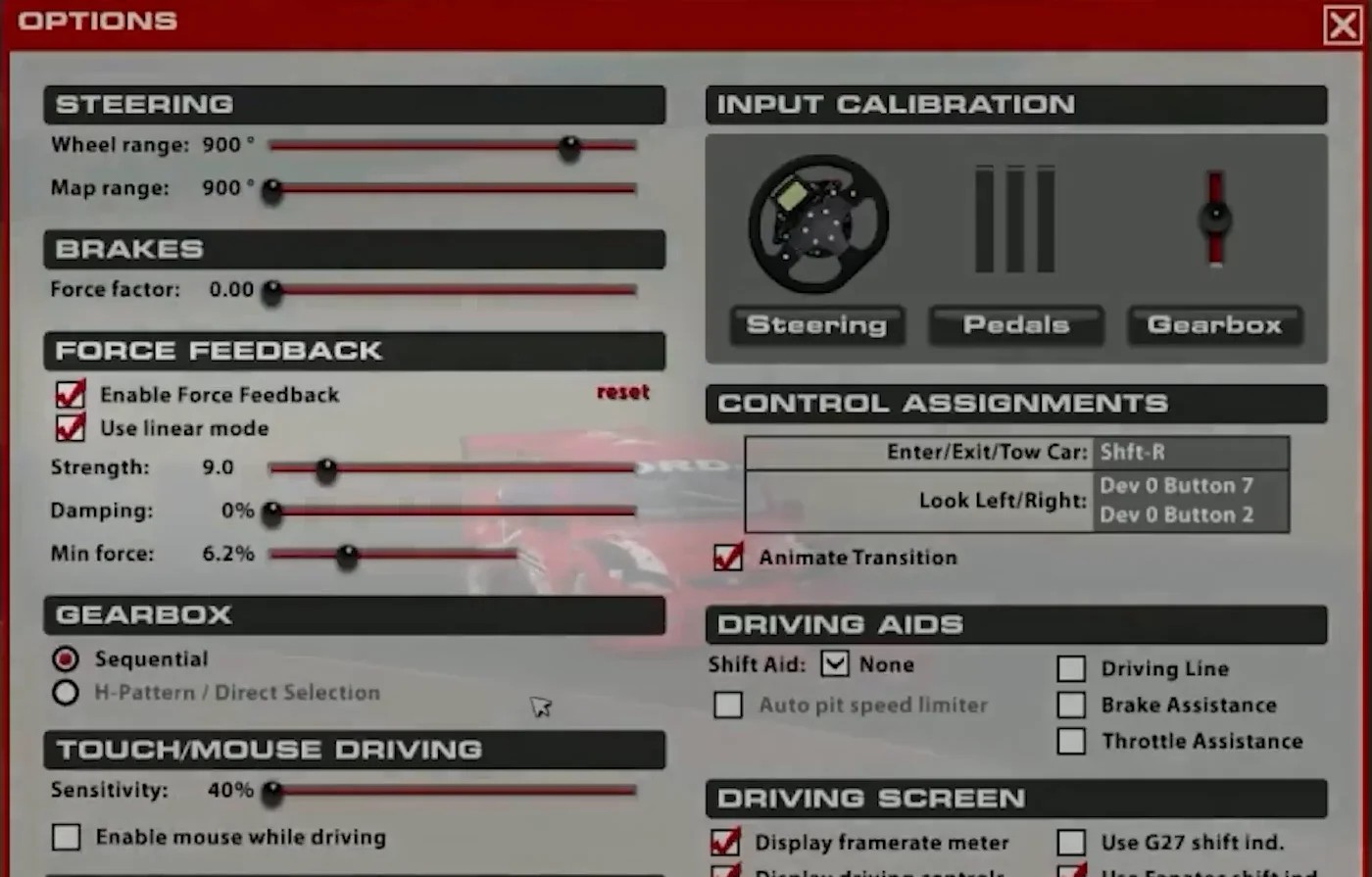
If your sim or wheelbase software has separate collision effects, they are fun until the moment they matter. When you are trying to catch a car that is already sideways, the last thing you need is the wheel fighting you with a canned effect. Plenty of saves are lost to wrestling the wheel rather than to the slide itself.
Turn the collision effects off in your force feedback settings. You keep the road feel and the grip information; you lose the part that only ever arrives when things are already going wrong.
The part that is about you
Hide other drivers' ratings
Knowing the rating of the driver next to you changes how you race them, and it changes it in both unhelpful directions. A high number makes you tentative and you concede space you should hold. A low number makes you assume a mistake is coming and you commit to moves you would not otherwise make.
Turn the rating display off in your overlays and race everyone the same. You end up more alert, because you are reading the car rather than the number attached to it.
Take a break after a bad race
Racing angry produces more crashes. That is not a moral point, it is a reliably observable one: frustration shortens your patience for exactly the situations that need patience.
After a genuinely bad race, stop. Not for the day necessarily; twenty minutes is usually enough. The instinct to immediately reclaim what you lost is the same instinct that causes the next incident.
After a rough run, make finishing the goal
When it has been a rough run, change the goal. Not a position, not a rating target: finish the race.
It sounds like a low ambition and it is a surprisingly effective one, because most of the decisions that end races are decisions you only make while chasing something. Take the chase away for a few races and the incidents tend to fall off on their own, and the results usually come back with them.
Where to start
Find your row in the table at the top and start there. If none stands out, take these three: widen the mirrors, find a second braking reference for every corner, and look further ahead than the car in front.
Everything here is about the race. If the underlying problem is that the car is not doing what you ask on entry, that is a different fix. Start with the braking mistakes a coach spots in one lap.
Avoiding crashes FAQ
How do I avoid getting dive bombed in sim racing?
Spot it before the braking zone. A car closing much faster than the corner allows is visible in your mirrors well in advance, and it means either a move is coming or the driver has already overcommitted and is a passenger. Either way the response is the same: take a defensive line early, leave yourself an escape route, and do not be surprised. Being caught unaware is what turns an attempted dive bomb into contact. Whether the move was fair is a separate question for the stewards.
Should you go off track to avoid a crash in sim racing?
Usually, where there is run-off you can use. An incident point and a few seconds is cheaper than a barrier, a retirement, or ending someone else's race. It depends what is beyond the white line, though: grass or gravel at speed can leave you a passenger too. The reason drivers do not take the escape is vision narrowing under stress onto keeping the car on the tarmac. Rejoining is the part that needs care: check the mirrors and the delta bar, and if a car is within about two seconds assume they are arriving on the racing line at full speed and wait.
Why do most sim racing incidents happen on the first lap?
Two things stacked together: the field is at its most tightly packed, and in most sims the tyres are not yet up to temperature. Nobody has the grip they practised with, so braking distances are longer than everyone's references assume and the cars are less predictable near the limit. Leave a bigger gap than feels necessary, brake earlier than your marker, and close the gap gradually as temperature comes in.
Is driving slowly safer in a sim race?
Not by itself, and in the middle of a pack it is a common way to cause an incident. Braking earlier than the cars around you expect makes you an obstacle, because they calibrated to the pack rather than to you, and having scrubbed too much speed you then have to add it back mid-corner where you have least control. When you do need to brake early, for an incident ahead or on cold tyres, make it early and obvious. Predictability is the safety mechanism, not slowness.
Where is the worst place to be in a three-wide?
The middle. A car on each side leaves you no room to adjust in either direction, so you are entirely dependent on two other drivers holding their lines exactly. On the inside or outside you always have somewhere to go. If you end up in the middle, hold a steady line and prioritise getting out of it over holding the position, and avoid creating three-wide situations unless you trust the drivers beside you.
Should I turn off force feedback crash effects?
If your sim or wheelbase software has separate collision effects, usually yes. They shake the wheel at the exact moment you are trying to catch a car that is already sliding, and plenty of recoverable moments are lost to fighting the wheel rather than to the slide itself. Disabling them costs you nothing useful: the road texture and grip information that actually help you drive come from different effects and stay on.
This guide is part of the free library at GitGud Racing Academy — an online sim racing academy built around weekly lap reviews, structured courses, drills and training tools.
Train this the right way
Reading is step one. Build it into muscle memory with structured, car-specific courses and personal lap reviews from a coach — inside the Academy.
Join the Academy · $39.99/mo incl. VATWatch the full video on YouTube